Info

Posts from the Long Form & Harold Category

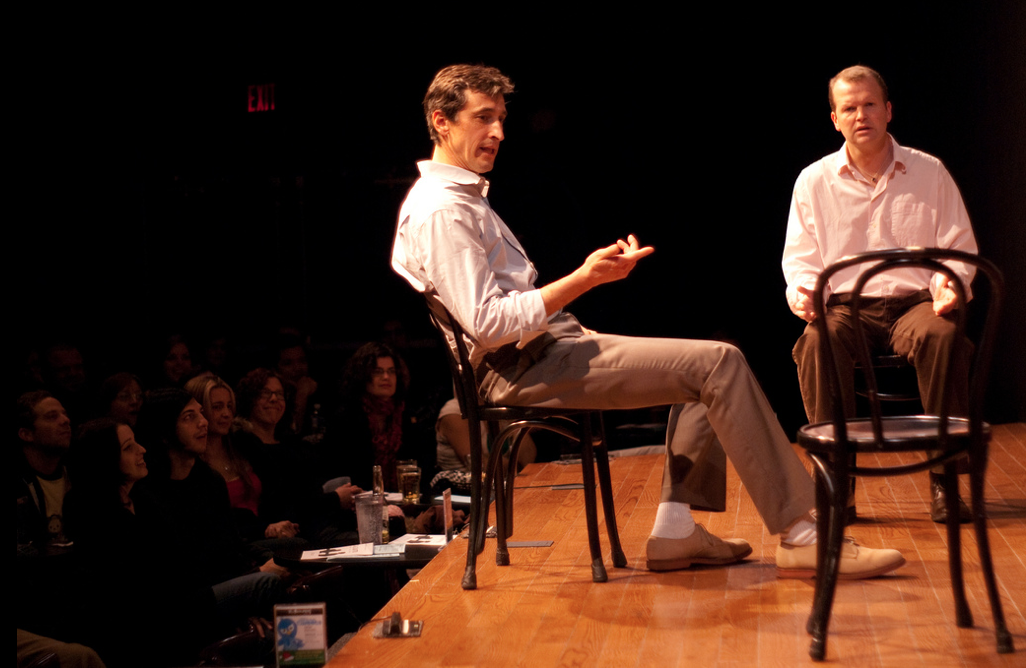
Photo © Kevin Thom

Photo © Kevin Thom

Lights up. Empty stage. 12 of you on the sidelines. You all know at least one of you has to move, RIGHT NOW, and fill that empty void.

Two people step forward. Heroes, right? They overcame the scariest thing you can do in improv and stepped out into nothingness.

Or so it seems. Because the fact is, the two that stepped out are not the bravest. They ran away from what’s truly the scariest thing in improv:

Being left on the sidelines.

“Look at those two out there, being in the moment, connecting with each other. What am I doing? I’m on the sidelines with nothing else to do but listen to the voices in my head. Think about why I didn’t step out first. Think about how to help this scene. Does this scene need help? Would I know? Should I edit? Should I have edited just there? Is it too late to edit now? It’s probably too late to edit. Why am I on this team? I’m probably the worst on this team. Maybe. Me and Chuck, bottom two for sure. Fuck, I should be listening to this scene. Okay, it’s not too late. Who are they to each other? That got a laugh. Not sure why. Delivery? Or callback? Focus! Oh good, someone edited. I should go out. What was that last scene about? I should bring a different energy. What was the word again? Oh good, someone’s out there. Why didn’t I go out?”

In the improv world, there’s nothing scarier than the voices in your head. So how do you avoid that?

One easy way is to go do a scene. Yep. I said easy. When you step out and do a scene, even a bad scene, you’re playing with someone else. You forget for a couple moments all the things you should be doing and you start doing them. If you step out and say, “Hey,” your next thought is probably What a stupid offer, but before you can dwell on that, your scene partner says “Hey” back. Now you have to say, “Sup?” and pretty quickly the scene takes focus over your thoughts.

On the sidelines, it’s just you and your thoughts.

So next time you’re too scared to go start a scene, don’t beat yourself up about it. You’re a hero to the rest of your team, ’cause that’s sure as hell not where they wanna be. Being on the sidelines is scary as fuck.
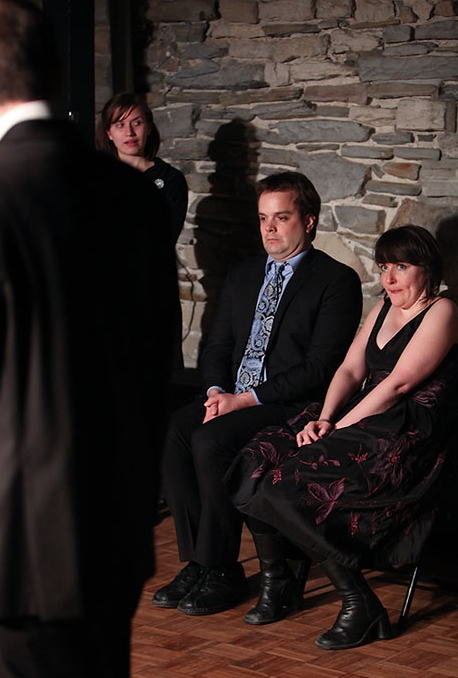
Photo © Kevin Thom

Photo © Kevin Thom

When you’re learning The Harold, it can be difficult sometimes to grapple with the structure.

Here’s one way to visualise beats and group games, and how they work together over the course of a show. In this context, “blobs” can be a word, a gesture, a character, a setting, or any other element that becomes part of the set.

LavaLampHarold

After eight years of doing improv, I’m finally comfortable on stage. Sometimes I still get butterflies before shows, but gone are the sweaty palms, the dizziness in the green room, the sudden urge to stay in the bathroom all night.

For a long time, just the act of getting on stage felt risky. Now I feel it’s time to push myself further.

This year, I want to do things I’ve never done, done only once, or never thought I could do. Things like…

Ghosting

TJ and Dave regularly incorporate ghosting in their sets. So does Toronto’s El Fantoma.

Both are masters at creating clearly defined characters whose posture, timbre, and gestures are easily identifiable. That’s important, not just for the performers, but so the audience knows what’s happening as well.

Definitely a skill I’d like to work on.

Using A Mic

Most venues have a microphone on hand, and savvy tech guys like Comedy Bar’s Mark Andrada will turn it on if they see an improviser wants to use it.

I’ve seen mics used (generally offstage) for the Voice of God, an airplane captain, a lounge lizard, and sound effects like wind, rain, a train, a gong, and beatboxing.

It looks like fun, but for some reason I’ve never dared try it. This year I will dare.

Interacting Directly With The Audience

I’ve done this once, maybe twice with my team, and never on my own. The idea of going into the crowd and mingling or talking with someone terrifies me as much as it probably does them. Which is why I have to do it.

Leaving The Stage Completely

Occasionally someone will exit the stage and never return (well, not for the rest of the set anyway). It always seems like a gutsy move, but somehow I felt if I tried it, I’d be abandoning my team.

When I think about it though, the people I’ve seen do it weren’t screwing over their scene partners. If the opportunity presents itself and it doesn’t feel forced, I’m gonna go for it.

Performing Behind The Curtain

For some reason, playing behind the curtain while staying in the scene scares the bejeezus out of me. Whenever I see people do it I think, “How do they know what’s going on? Can they really hear back there? What if the scene gets swept and they don’t know?” 

(Ahh, “What if…?” The birth – and death – of so many great things.)

Some people go one further and do their scene from the green room. This terrifies me even more, so I guess I’ve gotta try it at some point.

Making Bold Choices…And Sticking With Them

David Pasquesi sometimes plays with his back to the audience.

Anand Rajaram once stood motionless for a whole scene while saliva slowly dripped from his mouth to the floor.

Alex Tindal regularly hoists himself up to the rafters, and he’s even been known to get naked on stage.

While I’m not quite ready to get naked, I am ready to make changes. For years, I’ve struggled with “adaptive improviser” syndrome, where I come in with a strong character and then drop it when I think my scene partner’s offer is so much better.

This year I want to make brave choices and stick to them.

Taking Risks And Trusting

When S&P performed in Chicago a few years ago, Isaac Kessler played a character who died while seated. As his character stood up and slowly moved towards the light, Cameron came in behind him and slumped in the chair.

It was beautiful to watch. Not funny, but inspiring.

He told me after that he wondered for a split second if the team would know he was Isaac’s body, and not a new character, but he quickly dismissed the thought and made the move.

This year I want to make moves like that. I want to stop playing safe.

A friend on TourCo very kindly invited us to do the improv set after the show. As I feel my comfort with being on stage suddenly dissolve in a wave of nausea and sweaty palms, I’m contenting myself with the fact that I can always do it from the green room.

“The job is not to succeed, but fail more interesting than the last time – in a more subtle fashion or in a more intriguing way.” – TJ Jagodowski

We looooove beatboxing in improv. You never know when you’ll need to add some mad flava to a soundscape, Bat opening, impromptu song, or Beastie Boys warm-up.

Since not everyone grew up listening to Biz Markie or Jam Master Jay, we were thrilled to find this beatbox tutorial from Dub FX. It’s fun, easy, and fast. If you can say “bouncing cats,” you’re ready to spit like a pro. Click below to watch.

“When the rational mind is shut off, we have the possibility of intuition.” – Viola Spolin 

Group mind, in my opinion, is one of the coolest things in improv.

When group mind is present, you don’t steer scenes: you’re compelled to move, together. It’s about letting go of consciously thinking and being in a state of flow.

If that all sounds a little “woo-woo” for you, here’s a true story:

When Cameron worked in advertising, he was part of a small creative department. They worked together, ate lunch together, and generally hung out together.

One day Carla, an art director, looked up from her layout and asked,

“Who’s that painter guy?”

Without hesitating, Cameron’s partner Matias blurted “Ansel Adams!”

Carla smiled and said, “Right. Yes, thank you.” Then she went back to her layout.

Cameron spun around, speechless. He kicked his chair over to Matias and said, “I was gonna say Ansel Adams!”

Now, if you asked me, or, oh, probably a million other people to name a “painter guy,” they’d probably say “Da Vinci” or “Warhol” or pretty much anyone other than Ansel fucking Adams.

Cameron and Matias knew Adams was a photographer, but they didn’t give their brains a chance to override their response with “That guy’s not a painter!”

Is that an example of group mind? I think so. (And if not, then what the hell is it?)

I’ve seen and experienced group mind many times, on stage and in rehearsals.

Devon Hyland and Matt Folliott did a show where Devon stepped out to initiate a new character. He’d barely gestured when Matt stepped in, and – knowing the move that was in Devon’s head – fleshed out the scene in just a few words.

To those of us in the audience, it was stupefying. We could see from Devon’s reaction that Matt had articulated what Devon intended, but how?

When I asked Cameron about that scene, he said, “I don’t remember. We were all so in the moment.”

That, for me, is the essence of group mind.

It’s like a school of fish, or a flock of birds. They’re so connected, so seamlessly entwined, it’s impossible to know who moved first. They could only be moving together.

In fact, scientists have built computer models that prove birds in flight are not merely watching and responding to one another. Their moves are so flawlessly synchronized, they could only be coming from some deeper, intangible level within.

So how do you cultivate group mind?

There really is no substitute for spending time together. Not just rehearsing and performing, but hanging out socially as well.

Go bowling instead of rehearsal one night. Take a road trip together. Host a potluck. Or just get drunk and play board games. The more experiences you accrue as a team, the more you’ll bond.

On the other hand, if you don’t like, trust, and respect each other, you’ll never achieve group mind; at least not on a consistent basis.

“Good chemistry is worth 100 practices.” – Will Hines

When you’re starting out in improv, chances are you’ll be thrown on a team with a bunch of random people. Some you’ll click with. Others you won’t.

When that team is dissolved (as most teams are), don’t let those relationships die. If you need to, form your own team with the people you clicked with, and keep playing together.

Chemistry lets you shorthand things. It makes things effortless. It’s why Seth Rogen, James Franco, Jonah Hill and Judd Apatow keep doing projects together. The same goes for the cast of Anchorman, the UCB four, and countless other ensembles.

Like twins or couples who finish each other’s sentences, you can develop an almost psychic rapport with your…giraffe. (Turns out Sally was gonna say “teammates.”)

Del Close described group mind as “One mind, many bodies.” The Caligula exercise can be sweaty and exhausting, but it’s great for connecting non-verbally.

Count To 20 is a good warm-up for quieting the brain and feeling the next move. (If you really want to swing for the fence, try counting to 50 or more.)

“Fall, then figure out what to do on the way down.” – Del Close

When you tap into group mind, you step into the unknown and enjoy the act of falling, together.

What’s your view on group mind? Have you had any interesting experiences? Leave a comment below, we’d love to hear them.

Photo © Keith Huang

Photo © Keith Huang

“I think of it like dance, or like a basketball team. A good basketball team has practised so much and knows each other so well that they know where they’re gonna be at any given time, or they understand the rhythm of each player. And they’ve worked so long putting it together slowly that it’s effortless, or it seems effortless.”

Screen shot 2013-12-12 at 6.58.27 PM

Here’s a great example of a monoscene, by UCBT’s uber-talented Death By Roo Roo. Click below to watch.

This is a great form for improvisers of all disciplines to drop in on and play with ease.

Director’s Cut takes five improvisers and turns them into movie directors. Before the show, each “director” chooses a film genre (Sci-Fi, Horror, Teen Romance, etc.) and is responsible for casting and directing their fellow improvisers for their portion of the show.

Before the first scene, each director gets an ask-for to help inspire their improvised film.

Directors stand stage left or right, and set up the narrative aspects of their film. For example, they might set up the Horror movie scene with, “We see three young men pull up to an abandoned cabin in the woods. They get out of their car, excited to spend a few nights in the wild. But one has an uneasy feeling about the cabin…”

The improvisers then start playing the scene. The director can chime in or side-coach to help explore relationships, the narrative, or anything else he or she finds interesting about the unfolding story.

The director can also set up character archetypes and names; anything really, as long as they leave room for the performers to play.

After we see the five movie styles or genres, the audience votes off one movie, and we see the continuation of the four remaining improvised films until one movie and director remain.

So much fun! It’s an easy form to grasp, and a real audience pleaser.

(Thanks to actor/improviser Matt Folliott for this post.)


I learned an early lesson in showing up at a Cage Match final years ago.

Photo © People and Chairs

Photo © People and Chairs

Adam Cawley, Reid Janisse and Marty Adams were one of two teams performing, but according to the rules they couldn’t win, because one of their team members was missing.

That didn’t stop them from putting on one of the funniest shows I’d ever seen.

At one point they swept a scene so quickly, the stage was left bare for a second. Without hesitation, Adam pointed his finger and yelled “Empty stage!”

The three of them strode back on and walked in a circle, pointing and yelling “Empty stage! Empty stage!” in unison.

It was ridiculous, and hilarious, and people were crying with laughter.

I was blown away by their commitment to creating something out of literally nothing. And even though they couldn’t win, they showed up and gave it their all. No wonder they made it to the finals.

“Eighty percent of success is showing up.” – Woody Allen

It’s a simple thing, but it’s so important.

Show up.

For rehearsals.

In scenes.

For a show you said “yes” to – even if it was months ago and you forgot.

Showing up shows you care.

About your team, your scene partner, and yourself.

Photo © People and Chairs

Photo © People and Chairs

The Living Room is a deconstruction-based long-form set that uses storytelling to inspire scene work.

After grabbing a suggestion, this form opens with the cast having  a casual dinner party-type conversation. Improvisers stand in a horseshoe (or sometimes sit) and tell a story inspired by the suggestion. Here, players don’t necessarily have to play themselves, but should be telling truthful stories, or talking about events actually happening in the world.

Any player inspired by one of these stories can step forward from the horseshoe into the middle and begin a scene.  The ensemble plays a few scenes inspired by the conversation, then the cast returns to the “dinner party,” using information from those scenes to begin a new conversation. (Improvisers shouldn’t act out the stories, but rather use one idea mentioned as a jumping-off point.)

The Living Room flips back and forth between “dinner party conversation” and a series of brand new scenes. As the show gains momentum, the conversations should get shorter and the scenic element should get longer.

(Thanks to improviser extraordinaire, Rob Norman, for the 411.)