Info

Posts tagged improv comedy

Marty McFly’s trip back (and forwards) in time is one of the most loved films of the ’80s – or any era. For the past year, Toronto improviser/director/producer Quentin Matheson has been entertaining audiences with his ode to the franchise, Back To The Future: The Improv Show.

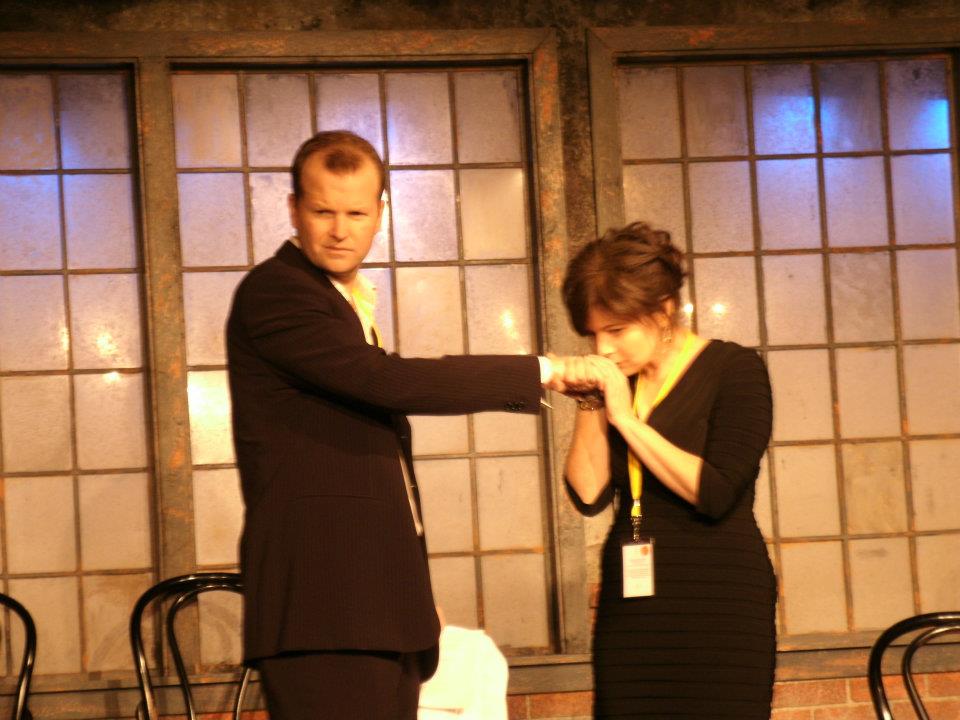
Cameron and I were the featured couple at their BCIF show last year, and it was one of the funnest times I’ve had on stage. (Hey, any chance to brag about dating the intern 10 years younger than me, I’ll take it.)

We asked Matheson about the geeky glory that is BTTF.

130216_poster

P&C: For newbies, what’s the premise of the show?

QM: Like the movie, we explore the idea of rewriting history with the intent of still hitting the happy ending.

We get a real love story from a couple I interview at the start of the show. The cast then recreates the story, but we give it the Back To The Future treatment. Namely, a time-traveller who screws things up!

P&C: What inspired you to develop it?

QM: I was fairly new to improv and wanted to get more involved in it when I went home to my folks’ for Christmas. Comedy Bar’s Festival of New Formats was in a couple of weeks, which piqued my interest.

Anyway, Christmas is the only time I watch cable and that year BTTF was running constantly. Watching it, I was reminded just how clever and satisfying that screenplay is. And it just struck me maybe that story structure could work on stage and for any love story. I forgot about it for a year until the next New Formats came around, and thought I’d try it.

P&C: How do you choose your couples; what are their qualifications, so to speak?

QM: I’m looking for stories we can build an epic action-adventure around. But really just a fun, interesting story. A loving couple that’s been together a good while and are clearly going the distance.

P&C: It’s a great mix of comedic truth (the couple’s story) and truth in comedy (the improvised portion). Are you ever surprised by what people reveal on stage?

QM: I didn’t expect the couples to be quite so earnest. I think the supportive crowd helps bring that out. You get some vulnerability which is awesome, because it raises the stakes.

P&C: Tell us about the secrecy around the show.

QM: People are always curious who the next couple is going to be, but I keep it secret. Even the cast doesn’t know. They hear the story at the same time as the audience.

P&C: You’ve assembled a fabulous team of improvisers. What are some of the challenges of the show’s format, or do they find it relatively easy to play out?

QM: I think re-enacting a story just told is straightforward enough for seasoned improvisers, but our big challenge is working out the twist: how the time-traveller changes the storyline, and how to get back to the happy ending. Fortunately the cast is up to the challenge.

P&C: How can interested couples get in touch with you?

QM: Please email me at q@welldressedrobot.com

What Past Couples Have Said About The Show

How did you feel when you were asked to do the show?

“Flattered, exhilarated and excited.”

“So exciting. No one knew, but that year marked 20 years of being together. We’re not much for ceremony, but what a beautiful anniversary gift.”

How did it feel up there telling your story?

“It’s great to share. I guess most couples come up with their own original myth that they pull out when asked. Usually in the re-telling, you gauge your audience and cut it short when you sense you’re boring them. But it was wonderful to be encouraged to go on in detail in front of a captive audience.”

“People loved it. We felt like celebrities.”

What would you say to other couples who might want to do this?

“Feel the fear and do it anyway! It’s great fun, and an awesome chance to share your love story with others.”

The next BTTF: TIS is Saturday, February 16, 8:00 pm at Comedy Bar.


So you have to write a bio for your festival submission/Facebook page/fringe show. Now what?

Most performer bios are straight, earnest write-ups with a laundry list of every show the person’s ever done.

Bo-ring.

Unless you work for Second City, where bios read like a playbill from Smallville High (“Jimmy Jones is thrilled to be in his third Mainstage revue…“), this is a chance to let your comedy skills shine.

A snappy, well-written profile will make you stand out, so spend a few minutes and make it fun. Below are three great examples. First up, a solo bio for the improvised show, Throne of Games:

Kevin Whalen “Petyr Baelish”

Kevin Whalen is delighted to reprise his role as “Lord Baelish” in Throne of Games. When not playing a self-centered, two-faced pimp, Kevin can be found eating nachos. During pre and post nacho eating, Kevin is probably teaching comedy at the The Second City Training Centre or perhaps performing sketch with The Second City Touring Company. If none of the above applies, you might find him improvising with the comedy troupe S&P or at home deciding which plaid shirt accurately reflects his mood today.

Amazing!

It starts off like a typical bio, then takes a left turn into funny. The self-deprecating tone is a refreshing change from the usual platitudes, and gives an insight into Kevin’s personality. Now let’s look at a team bio:

Standards & Practices

(Cameron Algie, Matt Folliott, Isaac Kessler and Kevin Whalen) BIG BANG. Four gods of improv explode onto the stage and create a new world. A world without rules, limitations or laughterlessness. Using their training from Annoyance, UCB, iO, ITC, Second City and Bad Dog, they organically follow the ideas using extreme characters, heart-wrenching emotional commitment, and wild physicality until there’s order to the chaos. And a new world is born: Awesomeland.

Photomontage © Tom Vest

(Standards & Practices sold separately)

In just a few sentences, Standards & Practices have painted a vivid picture of who they are. And hey, there’s Kevin Whalen again. (What can we say? Dude’s funny.) Note the use of active, playful language that accurately reflects their unique style of improv. For a team bio, you probably don’t need to go into a ton of detail. Just give the reader a taste of what you’re all about in a paragraph or so.

Achtung, baby: S&P’s chutzpah is balanced with brevity. Plus, they consistently deliver the goods. Unless you can do the same, don’t overpromise with a blurb that’s more hubris than humorous.

Now maybe you’re thinking, “That’s all great, but I need to present myself in a professional manner. What if some Big Talent Agent or other really important person reads it?”

As someone who writes copy for a living, I urge you to think of your bio as an ad for yourself. And we all know what happens to boring ads.

It doesn’t matter who you’re trying to impress. Which bio do you think they’ll remember: the one that lists every show you’ve done since you were seven, or the pithy paragraph that made them chuckle? You’re in the entertainment business. Take the opportunity to engage your audience before they set eyes on you.

Now let’s look at that rarest of things, a successful working comedian’s bio:

Anthony Atamanuik 

Anthony Atamanuik has been writing, performing, and producing comedy for over ten years. In 1997 he moved to Los Angeles after graduating with a BS in Film Theory from Emerson College. While living in LA Anthony worked for Jim Henson Interactive, Mr. Show, and sadly, Suzanne Somers. He moved to New York in 2000 and started training and performing at the Upright Citizens Brigade Theatre in 2002. Anthony has trained with Matt Walsh, Matt Besser, Owen Burke, Billy Merritt, Kevin Mullaney, Seth Morris and others. He performed with various Harold Teams including Creep, and performed with the acclaimed Instant Cinema. Anthony is currently performing with critically acclaimed and award-winning weekend team Death by Roo Roo on Saturday nights. He is also a regular performer in ASSSSCAT 3000 on Sunday night. Anthony also performs his one-man variety show, The Tony and Johnny Show, Tuesday nights at 9:30 pm, and every Wednesday he makes movie magic with Neil W. Casey in the Two Man Movie. He has played various roles in Adult Swim’s Fat Guy Stuck In Internet. He has also appeared on Late Night With Conan O’Brien, The Caroline Rhea Show, The Reggie Watts Live At Central Park Comedy Central Special, and in a very special DVD extra on Todd Barry’s Comedy Central special. For the last 7 seasons, Anthony can be seen on NBC’s 30 Rock, playing a very expressive staff writer who doesn’t speak.

Notice how all three examples have something in the opening and closing that elicits a smile. Even, in fact especially when there’s a lot of info, you want to reward the reader for wading through it.

A lot of bios are written in the third person. It’s more formal, but can come across as pretentious if you’re not careful. (Read some solopreneur websites and you’ll see what we mean.) Whether you write in the first or third person, just avoid coming across as, well, a douchebag. Even though his work is “acclaimed” and “award-winning,” Atamanuik sounds confident but humble.

Update: Since this post was written five years ago, Atamanuik has gone on to land his own series on Comedy Central, The President Show. His brilliant impersonation and improv skills aside, we like to think a kickass bio helped.

For more inspiration, check out Seth Godin’s post on why resumes are redundant in the digital age.

Better yet, buy his life-changing, career-building book, Linchpin.It’s what motivated us to start this blog, and Cameron to ditch a job in advertising for his true passion, helping people overcome anxiety through play. (You can read his story here.)

Photo © Rebecca Drysdale

Photo © Rebecca Drysdale

(Quote from The Boiling Point Improv)

Photo © Keith Huang

Photo © Keith Huang

Quick!

Think of your favourite improv scene ever. (If that’s too hard, the best one you’ve seen recently.)

Whether it featured a couple of co-workers, conjoined twins, or the Ikea monkey and his Mom, I’ll bet dollars to donuts it wasn’t about a “special day.”

Many of us were taught every scene should be “Today is the day that…” Unfortunately, that can lead to forced or clichéd scenes.

“Today’s the day we’re finally going to get married!”

“Today’s the day I quit my job to become an astronaut!”

“Today’s the day I win the Nobel Peace Prize!”

Any of these scenarios could turn out to be great. And there’s nothing wrong with making a huge offer at the top of the scene. But there’s also nothing wrong with starting small and finding the “what” along the way.

And if the what turns out to be nothing more than discovering a woman has married an exact carbon copy of her shouty father (as happened in one of my favourite scenes), that’s just fine.

“Be so believable it hurts. Don’t just play the idea of the scene. Dive deep into the scene. The relationships are what’s important. Simple scenes are all you need; it doesn’t have to be ‘about’ something.” – Greg Hess

If you can get your hands on a copy, watch TJ and Dave’s show entitled Before The Party. The entire 50-minute set revolves around two guys getting ready for some kind of shindig.

We never actually find out what happens at the party. Who cares? It’s all about these two characters, from their music choices to their fear of failure with women.

The more you focus on what’s happening right now, the more we’ll lean in to learn more.

Jason Mantzoukas’s one-man Hermit show (described here) is another great example. While it did turn out to be an unusual day, he didn’t start by declaring that right off the top.

Instead, the scene built to a climax slowly and methodically. And how much more powerful was it because the audience discovered the “what” with him?

When you’re fully present and immersed in what’s happening on stage, you’ll create something people remember – because they experienced it too.

Photo © Kevin Thom

Photo © Kevin Thom

We’ve all seen shows where someone decides to use a real prop on stage.

It’s usually small, like coins or a cell phone. And once it’s introduced, everyone tends to fixate on it: the players, as well as the audience.

I’ve seen seasoned performers kill it with props, but more often, props kill the scene.

Props work well in shortform games, like the one from Whose Line Is It Anyway? If everyone knows up front that they’re part of the show, the results can be frickin’ hilarious.

But using props in longform tends to throw players and audiences off a little. When everything else in the scene is imaginary, bringing in something real is a bit like shining a light on shadow puppets. The magic and mystery disappear.

Besides, as I’ve learned from writing for radio, it’s way cooler to let people imagine their own version of your world.

Of course, there are exceptions, and the photo above is one example.

Revel Theatre hosted a show recently where there happened to be books and a table on stage. Kevin Whalen literally stumbled on his character. When the lights went up he stumbled a little, and reached out to steady some books that were falling.

“Sorry! Soooooorry!”

His character was born in that second, when he organically reacted in the moment. Kevin’s scene partner, Reid Janisse, endowed him as an author.

As the scene progressed, Kevin alternated between haughty high status befitting a new author, and the grovelling apology he established in the first few seconds.

The scene worked, for two reasons:

1. Kevin didn’t decide to incorporate books into the scene. The prop more or less incorporated itself by falling over, and Kevin simply reacted to and embraced what happened.

2. While Kevin occasionally picked up a book, the scene wasn’t about the props. It was clearly about a weirdo author and his relationship with his agent, the bookstore owner, and his fans.

It definitely helped that Kevin and Reid are both pros.

Bottom line? When in doubt, leave it out.

It’s no secret there are a lot of sci-fi and fantasy nerds – uh, fans – in the comedy community. But you don’t have to be a diehard Thronie to enjoy the improvised parody, Throne of Games. 

We asked Director Colin Munch and fellow cast member Kris Siddiqi about their world of the Seven Kingdoms.

ToGphoto

Photo © Paul AIhoshi

P&C: What were some of the challenges in adapting a series as popular – and mammoth – as Game of Thrones for the stage?

KS: Everything.

CM: Yeah, pretty much.

Picking what was important and what wasn’t important was so difficult. What moments we were going to focus on, what characters we were going to include.

KS: Getting people up to speed on a really thick, huge universe. And just being able to sort of skim the top of that, get that basic information out that needs to be gotten out, and still be able to translate the intentions of the character, and their placement in the world.

CM: [It was] probably equally challenging for those who didn’t know the world, as it was for those who do. Because you have to choose between being a know-it-all nerd and actually making choices that are playable, rather than just dumping knowledge.

KS: Totally. I think as improvisers, we always play in genres no matter what. If it’s there, we’re playing in the genre.

But that’s what makes these challenges easier to work with, because we’re all well versed in the tropes and the idiosyncrasies of the genre. And something like this is steeped in every single trope and idiom that a fantasy genre comes in.

CM: Yeah, it’s not just a mediaeval fantasy. It’s a murder mystery, it’s a family drama, it’s a horror story at times. It covers all the bases.

P&C: The cast reads like a Who’s Who of Canadian comedy greats. How did you choose people for each role?

CM: Well, we wanted [Kris] for Ned immediately. It was definitely a bonus that you were already a fan and were available. But you were the first name that was put forward for the cast.

I really wanted [Conor] Bradbury for Khal Drogo right away. I knew I could put him in jean shorts and he wouldn’t argue with me.

KS: Did you choose more on just on physical appearance or…?

CM: Well Paloma [Nunez] and Alice [Moran] did most of the casting, because they’re more familiar with who’s who in the community.

I was really focused on temperament and attitude rather than what they looked like. Rob Norman doesn’t look like a 14-year-old boy, but he plays Joffrey really, really well.

P&C: It’s rare to see costumes used in improv, let alone ones as elaborate as yours.

Does performing in costume help or hinder players?

KS: It helps.

CM: Absolutely. The one challenge it creates is it, in a way, can lock our actors into playing a single character. Which can be detrimental to the show as a whole.

Paloma can’t just toss off her dress and jump on and play another character; she pretty much has to be Cersei for the whole show. Whereas I as Viserys could probably just toss off my wig and come in as something else if I needed to.

KS: But I think really that’s the only difference. Because again it’s being improvisers and being used to like, “Oh, where’s a joke I can drop?” or “How can I help this scene?” We’re not as able to do that in this, again, because those costumes clearly define who you are.

CM: And it lets us act a little bit more than we usually get to. You get to sit in your character more; you don’t usually get that luxury when you’re just guys in t-shirts and jeans.

KS: When you have that pomp, it totally adds to it. Me and [James] Gangl did a show years ago based on Deadwood

CM: Yeah, Dreadwood!

KS: We had a friend who worked at a costume store, and she did the fittings for everyone. And there was the day when everyone saw themselves in costume… The room was kinda silent, because everyone’s gears were turning in their head: “Oh, look at me, look at me!

And then there was a silent thing amongst the guys in the cast where they all started growing mustaches and muttonchops.

CM: It’s amazing the beards that have sprung up in the TOG rehearsal process. Etan [Muskat]’s got a beard. Ken Hall’s been growing that beard for like, six months.

Also, I love how crappy Nug [Nahrgang]’s costume is. We just throw a cape and crown over whatever Nug shows up wearing.

His character is so in contrast to the rest of the players in the show. He’s this super contemporary, 21st century party animal. I haven’t seen him yet, but he’s ordered Stark and Baratheon jerseys for everyone.

KS: That’s what I like; where I’m taking it so seriously and he…not that he’s not, but he’s not, you know what I mean? And that’s the good back-and-forth that we have, is that I have to be so loyal and Nug is just taking the attitude that, yeah dude, Baratheon’s just a party guy. He’s just an old frat boy.

CM: And that’s the advantage that we have, doing parody. Kevin Whalen can take Peter Bealish and just make him, essentially pootytang. Take him to the extreme of this pimp character. And he totally gets away with it because he plays it so well.

P&C: Each show revolves around a different part of the storyline. How much is improvised and how much is true to the original books?

CM: We have a specific series of moments from the first season that we need to hit, but the content of each episode is completely improvised.

P&C: Game of Thrones has a dark quality that’s been compared to Mad Men and The Sopranos. How does that translate to comedy?

CM: I think that you can get away with so much if you tell people they’re about to see a comedy. You can take people to a real emotional place, to a real dark place, if you hold their hand and tell them “Don’t worry, it’s all in good fun.”

That’s my big philosophy with art and theatre, and I do it with Bad Dog and Sex T-Rex.

KS: Yeah. My thing is always when you take the work seriously, then the audience sees you taking it seriously, and they go, we will now commit to their commitment.

Like when Bruce [Hunter] walked in as Tywin in the last [season].

Bruce has been doing comedy and writing and directing in this city for longer than some of us have been alive. So when he walks in with a stage that’s packed with like, Aurora Browne and Paul Bates and Nug, I just remember him taking the piss out of everyone. No one could say anything to Bruce. Just like Tywin.

When he turned to Alice and said, “Who’s this? Has anyone raped her yet?” And just that, that’s a very dark line! It’s very true to the world, but it’s still pretty dark man. But it worked.

CM: For one of your first lines on stage. When you come in as character…and that’s the first thing you say? I can count on one hand the number of people who could pull that off.

KS: I think that’s what the darkness translates to. It translates to knowing when you can take advantage of it.

CM: And we don’t shy away from it, either. Our world is just as dark as theirs is. Bran still gets pushed off that tower. People die.

KS: People fuck.

CM: People fuck. People go to jail.

I’m looking forward to taking that to the next level in the second and third seasons, because the world gets so much worse.  And I know that we’ll be able to pull it off because the comedy is so good.

You can see Throne of Games at the Next Stage Festival, January 2 – 13. 


ToGPromo

Image © Alice Moran

If you’ve seen Inglourious Basterds, you know how incredibly powerful the opening scene is. (Spoiler alert: If you haven’t seen it, stop reading and get thee to Netflix.)

A farmer and his family are doing chores when Nazis pull up to their humble dwelling in the French countryside. The Colonel, played Oscar®-ly by Christoph Waltz, asks for a glass of milk. The farmer obliges, and the two men trade pleasantries. But beneath the bland words, tension is building.

Tarantino, though, is in no hurry to cut to the chase. He’s content to simply sit in that tension. Scratch that: he revels in it. Over the course of fifteen minutes, he builds the suspense in tiny increments.

Fifteen minutes. Of two men sitting and talking.

While it’s not uncommon in improv, it’s unheard of in feature films. And we’re riveted for every deliciously agonizing second.

This is drama at its finest, and great comedy works the same way.

“You don’t have to keep explaining every little detail. You’re there to enjoy the discovery as much as the audience.” – David Pasquesi

The Nazi Colonel could have got what he came for in the first three minutes. But then we’d be deprived of the slow – and terrifying – realization of the farmer’s situation for ourselves. (Not to mention one of cinema’s greatest scenes.)

Most of us have been trained at some point to get the “who, what, where” out there, sometimes in the first three lines.

This might rid the scene of ambiguity, but it also takes away a lot of the discovery.

TJ and Dave know who they are to each other right off the top of a scene, simply by the way they are sitting, standing, or moving in relation to each other.

You’ll never hear David blurt out “Hey John, as your boss I just wanna congratulate you on fifteen years working here at Wal-Mart as a greeter!”

Take a tip from the masters: make assumptions, as opposed to declaring everything overtly.

“Slow down and taste your food.” – Susan Messing

Just as Tarantino isn’t afraid to stay on one scene, don’t be afraid to sit in your scene as it unfolds. Instead of being in a hurry to get through it, look for ways to slow down.

Remember how the Colonel took out his pen and ink, unscrewed the ink bottle, unscrewed the pen, dipped it ink, and screwed the lid back on the bottle? How the farmer unwrapped his pipe from its pouch, filled the bowl with tobacco and lit it? All of this happened in real time.

The time it takes to fill a pipe and light it is the scene. It’s not “getting in the way of” the next thing.

Object work can help ground you on stage, so reach out into your environment and find something, then let it inform your character.

Enjoy The Sounds of Silence

The conversation between Nazi and farmer is punctuated by pauses. Strong verbal initiations are great, but sometimes silence is the strongest response of all.

How many times have you walked into a scene and waited for your partner to speak, only to have them stare at you and say nothing?

There’s a difference between staring blankly because you’ve got nothing, and staring silently because staring silently is your thing.

If you can push through the initial discomfort, when one of you finally does speak, it will almost always produce explosive laughter as a result of tension being broken.

Hold Your Fire

Tarantino films are famous for blood, knives, and Mexican stand-offs. But unlike a Bond film that opens with all guns blazing, Tarantino plays it slow. So he shows us a bunch of guys dissecting a Madonna song, long before we see Mr Blonde sever a cop’s ear.

Sometimes it’s fun to go all James Bond. But when you start your scene at a 10, the only place to go is down.

Try building your scene one brick at a time, and before you know it, fifteen minutes will have flown by.

Now if you’ll excuse me, I’ve gotta go watch Django again.

Screen shot 2013-06-27 at 3.33.16 PM

No holiday is complete around here without listening to The Beatles’ Christmas records, which were made for their fan club during the ’60s.

The Fab Four had loosely-prepared scripts, but there was always plenty of improvising in the studio. Apple recently released the complete set on coloured vinyl, or you can search to hear them on YouTube.

IMG_0458

This month’s issue of Vanity Fair is a must-read for comedy fans. Guest edited by Judd Apatow, it’s filled cover-to-cover with funny, from Louis C.K. to Chris Rock to Garry Shandling and the proverbial “and many more.”

Of special interest is a spread entitled Who’s Afraid of Nichols and May?

If you’re not familiar with auteur Mike Nichols and his genius creative partner Elaine May, this article traces their history as the first celebrity improvisers. Starting out with The Compass Players directed by Paul Sills, they quickly took the world by storm.

Their process of using improv to create great sketches is the genesis for Second City today. Google “Telephone Operator,” “Mother and Son,” and “$65 Funeral” to see how they created great two-person scenes with spare environments and lots of specificity.