Info

Posts tagged improv comedy

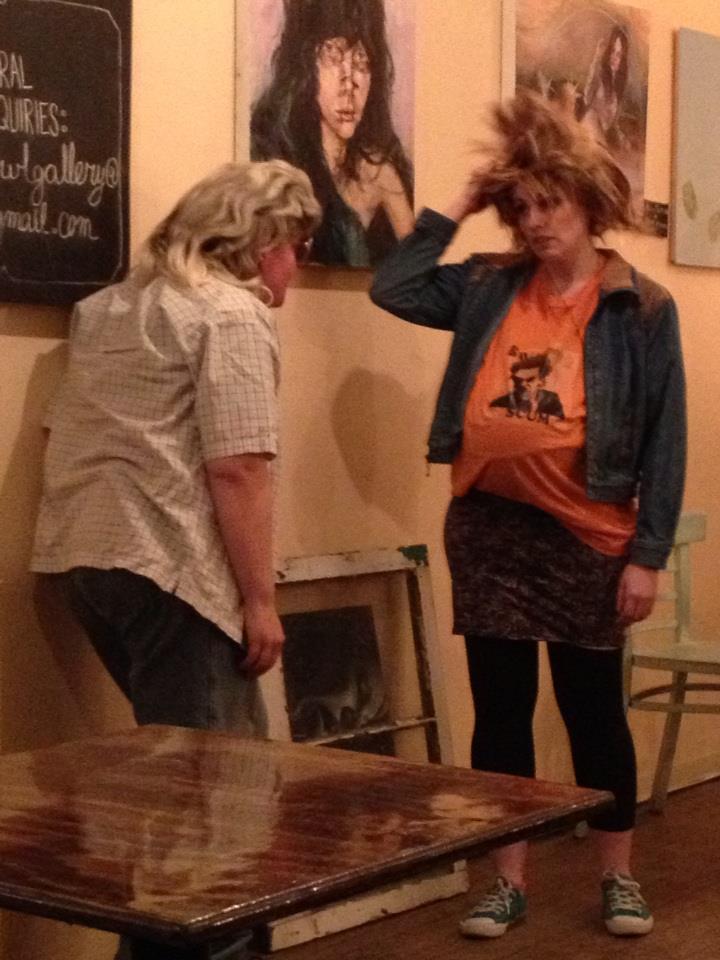
Last night some friends did an improvised version of Degrassi: Junior High. It was hilarious.

With a couple of cheesy wigs and some spandex, the performers had the audience in stitches. And it made me realise what a difference even a little specificity makes.

Sure, they were playing established characters. But it’s not like anyone remembered the original storylines.

What they had were the characters’ deals, or points of view, and a time period (the ’80s) as a backdrop.

5941_10152628393470134_1389934536_n

“Mr Raditch didn’t count on the four J’s: Joey Jeremiah in a jean jacket!” – Jason Donovan as Joey

Think of your favourite fictional characters, and you immediately picture their clothes, their favourite tchotchkes, and their environment:

• Dexter with his “kill outfit,” souvenir blood samples, and Miami bachelor pad

The Wire‘s McNulty and Bunk getting drunk, the omnipresent orange sofa, Omar with his gun, or Senator Davis’s trademark “Sheeeeeeeeit!”

• Don Draper in his razor-sharp suit, downing whisky at 10 a.m. in his hip ’60s ad agency

Any one of those details would add richness to an improv scene. Together, they create a world.

For more inspiration, check out Design*Sponge‘s feature called “Living In…” It’s a visual recreation of the objects from movies and TV shows.

Click on the links to see how they break down the things that make up Best In Show, Downton Abbey, and Bill Cunningham New York.

We could all use one of these. Click below to watch the video.

“Symmetry looks good to us; we want more of it.” – Susan Messing

Mirroring is a fast and powerful way to connect with your scene partners and, oh yeah, impress your audience.

Photo © Kevin Thom

Photo © Kevin Thom

When Mansical performed at Comedy Bar recently, I couldn’t attend, but Cameron described it for me after the show.

In one scene, a player stepped forward and did a simple dance move. He was joined by another player, who did the same thing.

A third player stepped out and did a different move. He was joined by someone who mirrored him.

The two “pairs” continued to move to the accompanist’s music, timing their actions with both their own scene partner, as well as the other pair.

As Cameron acted out both duos’ movements, I pictured the great “routine” they created.

The next day, a friend who saw the same show described the “choreographed dance number.” When I told her it was improvised, she was amazed.

Cameron and I are your typical white-bread-and-mayo kind of dancers. But when we get on a dance floor, we mirror each other, and suddenly even the weird, angular, and bizarre moves look, well, better.

Two of just about anything looks better, as Jimmy Fallon and Michelle Obama’s Evolution of Mom Dancing video clearly illustrates. (If you haven’t seen it yet, click on the link to watch.)

And more than two people is even better, if you work together and give and take focus.

You can use symmetry to establish group mind, create a dynamic stage picture, or just get out of your head. Try it in your next opening, group game, or two-person scene.

Photo © Kevin Thom

Photo © Kevin Thom

This short-form game is great for getting out of your head because the constant movement means you don’t have time to plan. It’s also a fun reminder of how body language informs character and dialogue, and the importance of play (something we sometimes forget).

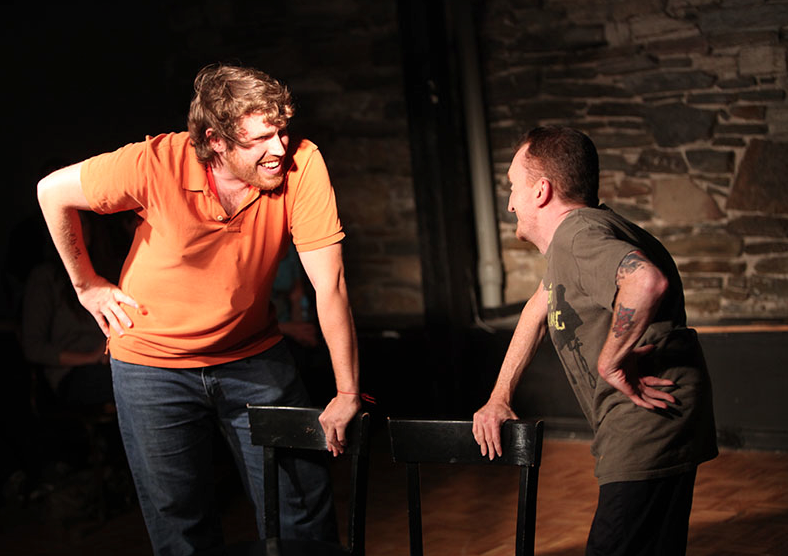
All you need are three players and a chair. As the name suggests, one player must always be sitting, one standing, and one bending over.

Get a suggestion (say, a location that fits on the stage, or a relationship for the three players), then start your scene.

There’ll be a little scrambling as each of you chooses a stance and either sticks with it or changes if someone else already has the same one.

As the scene unfolds you’ll find yourself changing posture either naturally, or on purpose just to mess with your teammates. Half the fun is forcing your scene partners to justify their new posture, or being forced to change and somehow justify yours.

Click below to watch improv maestros Ryan Stiles, Colin Mochrie and Wayne Brady show us how it’s done.

“Know thyself.” – Ancient Greek aphorism

“Yeah, but more importantly, be thyself.” – People and Chairs

tumblr_mby5oiS8ur1rclvemo1_400

A few years ago I met a woman I’ll call Jane, who wanted to get into advertising. She did stand-up and improv, and we chatted about the comedy scene for a while.

I reviewed her portfolio and made some suggestions. When we said goodbye, she handed me a business card that read: Jane Doe – “That Funny Girl.”

I stopped.

“Jane,” I said, “your card says ‘That funny girl.’ But we’ve just talked for almost an hour and the whole time you were very reserved, even when you were talking about comedy. Not only that, but there’s nothing funny in your book.”

(Full disclosure: She was later hired by a big agency, so what do I know?)

The point is, I have no doubt that she was funny. But for whatever reason, she wasn’t showing it. By trying to act “professional,” she missed an opportunity to connect.

Compare that with the business card above. When I saw it I smiled. It’s exactly the kind of business card you’d expect Steve Martin to have.

In his memoir, Born Standing Up, Martin recalls his first stand-up gig. Even though it was written 40-some years ago, the material is as fresh and as Steve Martin-ish as anything from 2013.

“Be obsequious, purple, and clairvoyant” is one of the greatest lines ever written, in my humble opinion. Not only that, but I can’t imagine any other comedian writing it.

Steve Martin knows who he is, and he’s made a career out of being different. Out of being himself.

“Walk into a room like you belong there.” – Ed McMahon

In stressful situations like auditions or interviews, it’s easy to clam up and let fear take over. Self-doubt creeps in and you start to think, “How can I impress this person?” At that moment, you won’t impress anyone – guaranteed.

The most successful people I know treat these situations just like any other. They bring their authentic self, and let go of preconceived expectations about possible outcomes. If someone doesn’t like them, that’s OK, because they’ll connect with someone who does want what they have to offer.

Recently I wrote about how to write a kickass performer bio. The same principle applies to everything else.

Whether you’re an actor, writer, producer, shoe salesman, veterinarian, or quantity surveyor, you were put here to bring your own gifts to the world, in a way that only you can.

We each have our own unique inventory to draw on, and it’s a helluva lot easier than inventing.

Inventing feels like work because it is.

You don’t need to invent anything.

Not your characters. Not your scene. Least of all yourself.

When you bring your own knowledge and experience to the stage, your job, and your daily life, you share something valuable with the rest of us. What’s more, it’s effortless.

TJ and Dave do it every show. It can be something profound, like TJ quoting “Heavy is the head that wears the crown,” or it can be as silly as calling a dish a “ramekin of mayonnaise.”

Those little snippets of their personal inventory are part of what makes Messrs Jagodowski and Pasquesi such a joy to watch.

Grab a pen (or just use a mind pen) and make a list of your ten favourite people: comedians, authors, musicians, friends or family members. Then ask yourself if they’d be better if only they were more like someone else.

My own list includes Stephen Colbert, John Lennon, Neil Gaiman, Julia Cameron, Stanley Kubrick, and my husband Cameron. Every one of them faced rejection at some point. Every one of them was labelled an oddball or an outsider. And every one of them is (or was) true to themselves, to their own vision of the world.

The next time you find yourself doubting your abilities, on stage or off, remember that no one else can do what you can, the way you can. As another true original said:

“Be yourself. Everyone else is already taken.” – Oscar Wilde

This exercise sharpens listening and reacting to your scene partner, because there’s no way you can pre-plan actions or dialogue.

To begin, two players step out.

The Coach/Director hands one person a book. It can be any book that contains dialogue. You can also use a screenplay or play.

Someone calls out a number below 50, and the player with the book turns to that page. They read the first piece of dialogue they find in quotes.

photo-20

Let’s say the number is 34 and the book is The Picture of Dorian Gray by Oscar Wilde. The first sentence in quotes on page 34 is:

“Well, Harry, what brings you out so early?”

The second player must respond to that initiation, however they feel is appropriate. They might say:

“Mindy kicked me out of the house. Again.”

or

“I don’t want to be late for my A.A. meeting.”

or

“I skipped the full-body shave this time and just sprayed on a little more Axe.”

Or whatever.

The first player then reads the next piece of dialogue by the same character. (Sometimes this might mean skipping a page to find the next snippet in quotes.)

Chances are, the written dialogue won’t make a lot of sense coming after the improvised line. That’s OK. The point isn’t to create Edward Albee-worthy scenes; it’s to get you focused on listening and responding to whatever is thrown at you.

The scene continues with one player reading their dialogue from the book, and the second player always responding extemporaneously.

It’s a bit of mindfuck, but that’s what makes it fun. Try it at your next rehearsal.

Photo © Kevin Thom

Photo © Kevin Thom

“When we tell a story in cinema, we should resort to dialogue only when it’s impossible to do otherwise. I always try first to tell a story in the cinematic way…” – Alfred Hitchcock

TV has a reputation for just being “talking heads,” while film tends to be about motion and emotion. Canadian filmmaker Deepa Mehta first made me aware of this, and it trained me to study the various techniques in each medium.

Photo © Kevin Thom

Fortunately, in improv we have the flexibility to do whatever kind of scenes we like; we’re limited only by our imagination.

Thanks to the miracles of scene painting, mime, physicality, placement of chairs, verbal and physical sound effects, we can recreate the special effects of Spielberg, the scoring capabilities of Danny Elfman, or the panoramic cinematography of Ang Lee.

The more supportive your scene partners, the more immersive the experience can be.

I saw a set where Matt Folliott and Isaac Kessler lifted their scene partners and moved them around on stage to create a Matrix-style mid-air gunfight in slow mo. I can only imagine how exhausting it was for the lifters, but the audience was spellbound.

(For a master class in movie-inspired improv, go see Anthony Atamanuik and Neil Casey’s genius Two Man Movie at UCBT in New York. What they accomplish in 30 minutes is as mind-blowing as it is hilarious.)

Improv scenes that more closely mimic television are also fun, both to watch and perform.

Sitcoms like It’s Always Sunny In PhiladelphiaLouiePortlandia and The Office feature simple, often banal locations juxtaposed with great characters, dialogue, and physicality. Take away the location and props, and what you’re left with is comparable to a solid improv set.

Some improv shows are purposely built around one construct or the other. Back To The Future: The Improv Show takes its cues from the film franchise, while Channel 5 Action News is modelled after a news program, complete with commercial breaks.

If you find your improv has hit a rut – maybe you’re doing the same form every week and it’s feeling stale – try experimenting with film or TV techniques.

For inspiration, go to the movies or borrow a box set from friends. (Now’s your chance to finally see The Wire, Battlestar Galactica or Breaking Bad.)

Or just look through your own collection. Study your favourite shows and films to see what makes scenes resonate.

Watch how Scorsese uses freeze frame with narration in Goodfellas. Notice the way Mr Show uses organic edits to move from sketch to sketch.

Then steal it for your next set.

Whether you’re in New York, LA, Chicago, Toronto, Montreal or – let’s face it – any city with a comedy scene, it’s incredibly hard for theatre owners just to break even.

But lately there’ve been mutterings from comedians who say UCBeast (UCB’s stand-up club in New York), should pay performers.

Now, the stand-up culture is, and always has been, different from improv. But Chris Gethard makes some pretty good points about the payment-vs-non-payment thing on his tumblr.

This week, Matt Besser made a special episode of his Improv4Humans podcast called “Ask The UCB” where he and Ian Roberts set the record straight.

When you hear how much time, energy, and yes, money they’ve poured into all the different UCB stages (including UCBComedy.com, from which they’ve never profited), you’re guaranteed to have a new respect for everything they’ve done.

I guess the reason I never talk about it in interviews is it sounds tacky. And when I talk about it I don’t wanna…I don’t wanna come off bitter and like, ‘Poor me,’ like maybe we’re starting to sound by this; having to pay those taxes.

But I guess it is something people should know, that the UCB Four, in 15 years since the theatre’s been open, we have never taken any money.”

– Matt Besser, from Improv4Humans 

(Click the link above or on the image below to hear the whole episode)

Thanks UCB, for giving us a space to play.

Thanks UCB, for giving thousands a place to play.