Info

Posts from the Other Cool Stuff Category

Photo © Keith Huang

Photo © Keith Huang

Quick!

Think of your favourite improv scene ever. (If that’s too hard, the best one you’ve seen recently.)

Whether it featured a couple of co-workers, conjoined twins, or the Ikea monkey and his Mom, I’ll bet dollars to donuts it wasn’t about a “special day.”

Many of us were taught every scene should be “Today is the day that…” Unfortunately, that can lead to forced or clichéd scenes.

“Today’s the day we’re finally going to get married!”

“Today’s the day I quit my job to become an astronaut!”

“Today’s the day I win the Nobel Peace Prize!”

Any of these scenarios could turn out to be great. And there’s nothing wrong with making a huge offer at the top of the scene. But there’s also nothing wrong with starting small and finding the “what” along the way.

And if the what turns out to be nothing more than discovering a woman has married an exact carbon copy of her shouty father (as happened in one of my favourite scenes), that’s just fine.

“Be so believable it hurts. Don’t just play the idea of the scene. Dive deep into the scene. The relationships are what’s important. Simple scenes are all you need; it doesn’t have to be ‘about’ something.” – Greg Hess

If you can get your hands on a copy, watch TJ and Dave’s show entitled Before The Party. The entire 50-minute set revolves around two guys getting ready for some kind of shindig.

We never actually find out what happens at the party. Who cares? It’s all about these two characters, from their music choices to their fear of failure with women.

The more you focus on what’s happening right now, the more we’ll lean in to learn more.

Jason Mantzoukas’s one-man Hermit show (described here) is another great example. While it did turn out to be an unusual day, he didn’t start by declaring that right off the top.

Instead, the scene built to a climax slowly and methodically. And how much more powerful was it because the audience discovered the “what” with him?

When you’re fully present and immersed in what’s happening on stage, you’ll create something people remember – because they experienced it too.

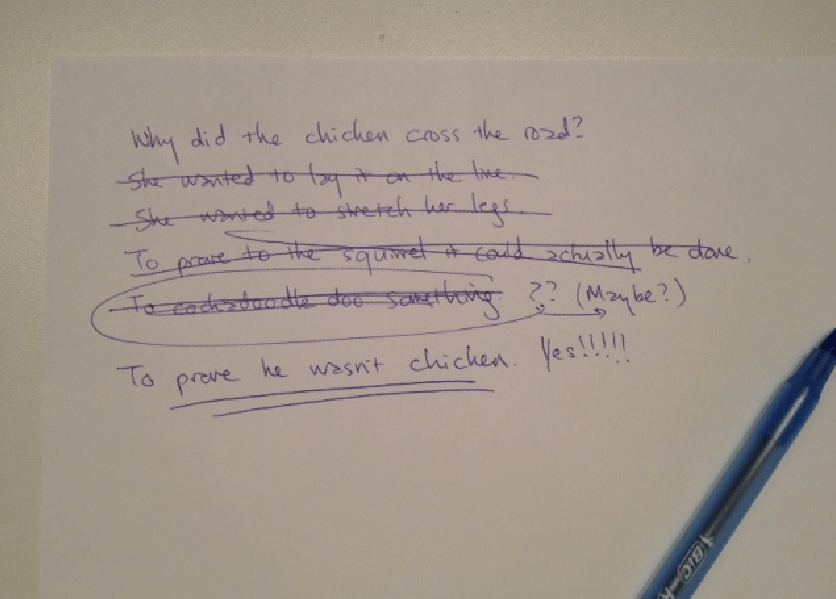
“Writing is rewriting.” – Some Guy

Truer words were never spoken. Or written. (Probably rewritten.)

As this great video from The New York Times shows, even comic giants like Seinfeld can take a while to craft their funny. In his case, two whole years for one joke.

Just another reason why I love improv.

Click here or on the image below to watch.

Chicken Joke

No holiday is complete around here without listening to The Beatles’ Christmas records, which were made for their fan club during the ’60s.

The Fab Four had loosely-prepared scripts, but there was always plenty of improvising in the studio. Apple recently released the complete set on coloured vinyl, or you can search to hear them on YouTube.

IMG_0458

This month’s issue of Vanity Fair is a must-read for comedy fans. Guest edited by Judd Apatow, it’s filled cover-to-cover with funny, from Louis C.K. to Chris Rock to Garry Shandling and the proverbial “and many more.”

Of special interest is a spread entitled Who’s Afraid of Nichols and May?

If you’re not familiar with auteur Mike Nichols and his genius creative partner Elaine May, this article traces their history as the first celebrity improvisers. Starting out with The Compass Players directed by Paul Sills, they quickly took the world by storm.

Their process of using improv to create great sketches is the genesis for Second City today. Google “Telephone Operator,” “Mother and Son,” and “$65 Funeral” to see how they created great two-person scenes with spare environments and lots of specificity.


Check out this great Guest Post by David Razowsky for Jill Eickmann’s Femprovisor™ blog.

Photo © Kevin Thom

Photo © Kevin Thom

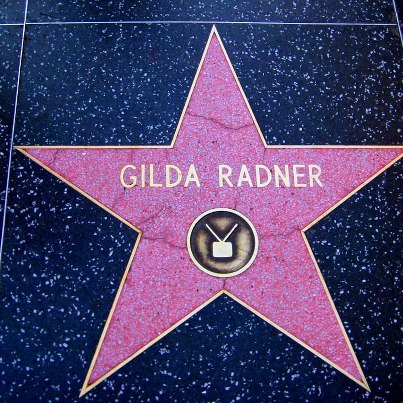
This morning we wrote a post about how Gilda’s Club was changing its name to the generic “Cancer Support Community.”

A lot of people were upset by the news: cancer survivors and their family members, Gilda fans, and Second City alumni among them.

Josh Bowman decided to do something about it, so he created a petition (now closed) to keep the name Gilda’s Club. At the time, he (and we) believed that the name was being phased out, based on various news reports.

Thanks to the petition, the story got huge coverage in both social and traditional media.

Josh contacted the Cancer Support Community, and after speaking with an executive, he’s written a post to set the record straight. You can read the full story here.

The great news is, Gilda’s name is here to stay. The person Josh spoke to assured him they will:

• Correct the inaccuracy online that suggests that individual chapters of Gilda’s Club will be mandated to change their names. Individual chapters will keep the name “Gilda’s Club” unless a decision is made at chapter level to change it. Josh’s understanding is that no more names will be changed, particularly after today.

• Provide clarification as to why the Madison, WI chapter has changed their name. Josh will discuss this further with representatives from the Madison, WI chapter to work towards keeping Gilda in the name

• Keep Gilda in everything they do.

We’re thrilled to hear this – and to see the outpouring of love for a hilarious and brave lady. If you’d like to learn more, her bookIt’s Always Something, is a moving and inspiring read.

We love this video, featuring some of Toronto’s – Hell, make that North America’s – funniest improvisers. (Carmine Lucarelli was born to wear a Phileas Fogg-style top hat and mo.)

Created to help raise awareness and funds for Movember, this is the first in a series, and we can’t wait for the rest! Kudos to everyone involved.


As an improviser, you know the importance of play. If you’re not having fun and being silly, if you’re not in a playful state on stage or in rehearsal – the dreaded “in your head” zone – it’s really hard to have a great scene.

As John Cleese discussed in his brilliant speech on creativity (click here to watch), play is vital not just in the arts, but in every endeavour that requires creative thinking, from engineering to brain surgery.

The problem, according to Ken Robinson, is that creativity is systematically driven out of us by the time most of us are adults. The main reason? Fear of making mistakes; of somehow getting it wrong. And that’s an issue not only for improvisers, but for everyone. Because creativity isn’t just a “nice to have,” it’s a must if we’re to evolve as a civilization.

Of all the TED Talks I’ve seen, this one resonates the most. I’ve probably watched it a dozen times, and will watch it dozens more. Click below to view.

If you enjoyed this video, check out his RSA Animate talk here, and his book, The Element: How Finding Your Passion Changes Everything.

He lives vicariously through himself.

He is left-handed and right-handed.

When he drives a new car off the lot, it increases in value.

In museums, he is allowed to touch the art.

He is fluent in all languages, including three that only he speaks.

His business card simply says “I’ll call you.”

He is The Most Interesting Man In The World, aka actor Jonathon Goldsmith.

The hugely successful ad campaign for Dos Equis is built around a larger-than-life character. So it stands to reason the casting process was unconventional, too.

Unlike most commercial auditions, which leave little or no room for ad libbing, Dos Equis actually required actors to improvise. Goldsmith’s make-’em-ups scored him the role, and the rest is hilarious faux history. Click here to read the full story.

When we saw this photo of Steve Carell, Scott Allman, Stephen Colbert and David Razowsky as the Fab Four, we had to ask for the story behind it. Here’s what David said…

Photo © Jennifer Girard

“[Beatles] was the scene’s name. We tried to get that thing up a number of times. Well, obviously we finally did.

Here was the conceit: It was The Beatles’ debut on The Ed Sullivan Show, and they were just returning from the set. They entered the scene to the screams of the fans, each time the door opened and one of us entered the crowd screams filled the stage. They were exhausted. They talked about how the set went, and they came up with a song idea from it. They sang it, roughly, but “Beatle-y:”

“Squiddy, squiddy, squiddy,
Love my little squiddy
Squiddy, squiddy, squiddy,
Rock-n-rollllll”

Then Paul (Steve) realized he felt weird. Like something happened that he couldn’t quite remember, couldn’t quite identify.

Then John (Stephen) realized that he felt the same way, that something happened that he was unable to pinpoint.

Then George (Scott) noticed that he was going through the same feeling of incompleteness.

Ringo (me), well I felt nothing like that.

The boys (sans Ringo) realized what it was: they were repressing a horrible memory. That memory was that Ed Sullivan had fondled each one of them before the show.

The scene went on in some such manner, and toward the end Ringo realized he was intentionally untouched. He was disappointed. “I wish Mr. Sullivan fondled me.”

It was, if nothing else, a blast to do. Steve and Stephen’s Liverpudlian dialects were wonderful. I tried one, but it sure didn’t feel right. Scott didn’t even try. It was wonderful.”