I got this pillow because it reminds me of pretty much all of my favourite improvisers.
Regardless of their improv training or background, when they get onstage they’re not thinking about rules. They just play.
Cameron was coaching Jason Donovan a few years ago, and he told me proudly how Jason killed it in a competitive jam.
Players had to perform a scene, then do the same scene again, and again. Each time, one person would be eliminated by the audience.
Jason won by doing the same scene but coming in as a different character each time. While everyone else was trying to remember exactly what they did the time before, Jason went in as a robot. Or talked in gibberish. Or whatever.
He didn’t think, “The rules say we have to do the same scene, the same way, every time.” He just had fun. And the audience loved it.
Reminds me of this great quote from Greg Hess, courtesy of Jimmy Carrane:
“Cook County Social Club was just five buddies trying hard to make each other crack up.”
Our coach had a very specific approach to the Harold. We spent months just doing organic openings, while he quizzed us on identifying the “theme.”
When Cameron watched my team perform, I’d ask him afterwards what he thought.
“It looked like you were working up there.”
Not having fun. Not entertaining the audience. And certainly not being in the scene. We were doing everything “right,” but our shows were marked by hesitation and worse (in my opinion), trying to be clever.
The more I tried to analyse sets, the worse I became as an improviser.
I missed edits my body told me to make, forced connections or failed to make others, and spent a lot of time staring at the floor.
It wasn’t until I discovered the organic, respond-in-the-moment style of improv taught by David Razowsky, Jet Eveleth, Susan Messing, Todd Stashwick, and Greg Hess, among others, that I found a way of performing I understood.
It was intuitive, not intellectual; physical, versus formulaic. Most of all, it felt effortless.
When I told my coach how I’d seen and made connections without trying, he shrugged. “Anyone can connect the dots after the fact.”
It made me think of The Artist’s Way. In it, Julia Cameron talks about writing a screenplay. There was a gun in the opening scene and she didn’t know why, but she listened to her muse and wrote it in. As she neared the end of the script, everything came together and the gun made complete sense.
I realized my coach and I had fundamentally different ideas about long-form…and that’s OK.
That’s why I think it’s incredibly important to experience different approaches. Even if you love the way you were taught, it’s good to see how other people play.
A Harold By Any Other Name
Cameron and I took a workshop a few years ago with Charna Halpern, to learn a form called Cat’s Cradle.
Like the name suggests, Cat’s Cradle is a flexible structure that can take many different forms. UCBT describes it as “a fluid, unfolding symphonic long-form of living environments with all performers onstage all of the time.”
It can incorporate just about anything: singing, scene painting, group physicality, silent scenes, monoscenes, monologues…the list goes on.
There’s an opening, but no set beats or group games, per se. The structure is as simple or as complex as it needs to be.
“Cat’s Cradle,” Charna told us, “is a Harold.”
She went on to say that the “training wheels” structure of Opening, First Beats, Group Game, Second Beats, Group Game, Third Beats was just her and Del’s way of teaching people callbacks and connections. It was never intended to be a rigid format.
This was very exciting to us.
Suddenly openings could be anything, not just monologues or organic “whooshing.”
Beats and group games were a choice to be made in the moment, not something that had to be planned ahead.
If the co-creator of the Harold was saying it was more than just a set structure, then the sky was truly the limit.
“Life is a slow Harold.” – Truth In Comedy
In the end, I don’t think it matters where or how you learn the Harold. Not really.
The nuances may be different (at iO, the characters and relationships are heightened in Second Beats; at UCBT, game of the scene is heightened), but the basic structure remains the same.
What matters, once you’ve grasped the basic principles, is that you continue to learn and grow, and stay open to new possibilities. Including the possibility that what you learned is not the only, or best way, to do a Harold.
Organic or structured, left- or right-brained, as every Harold demonstrates, we are all connected.
The Book of Harold
Truth In Comedy is the Penguin Classic of improv books. I’d only ever done short-form when I read it, and it was a year before I did my first Harold, but I knew I wanted to learn more. If you’re just beginning your long-form journey, this is a great place to start.
Hot off the presses is the Upright Citizens Brigade Comedy Improvisation Manual, now available from the UCB Store. Written by Matt Besser, Ian Roberts and Ian Walsh, it includes explanations of the Harold and other long formats.
The book is designed for beginners, as well as experienced improvisers, and with the surge of interest in long-form worldwide it’s sure to become a bestseller.
Frustrated by the way the Harold was taught to him, Hauck decided to find his own method of teaching and performing it. Using a combination of games theory, mathematics and military strategy, he developed an approach that reveres structure above all. Among other things, Hauck recommends:
• Getting the “who, what, where” out in the first sentence
• Taking care of your scene partner before yourself
• Bringing back the same two characters from First Beats into Second Beats
• Monitoring scenes to ensure they have “bilateral agreement”
I confess to breaking out in hives around page 5. Structure is one thing; rules are another. That’s not to say his approach doesn’t work. Judging from the book’s reviews, it works gangbusters. It’s just not an approach that works for me.
As for learning Harold structure, Joe Bill likens it to driving a car.
First, you’re unconsciously incompetent. Then you become consciously incompetent. Next, you become consciously competent. And finally, you’re unconsciously competent.
Such mastery might take months or years, depending on your instructor, your skill set, and your Harold team’s chemistry.
The good news is, once you’ve learned the basics you can start to develop your own style. You might even want to create your own format. The Bat, The Movie, The Living Room, The Deconstruction, The Beast, Armando and many other forms were all inspired in some way by the Harold.
Click below to see one of the best Harolds ever captured on film, performed by legendary iO team, The Reckoning.
Improvisers tend to be oddballs, artists, and nerds. So it’s not surprising most teams tend to dress like college students – or worse.
Even if you do improv strictly for fun, you’re putting on a show for an audience. How you present yourselves is an opportunity to stand out from the dozens (maybe hundreds?) of other teams in the city. Some of the longest-running and best-loved ensembles have a look that’s instantly identifiable…so why not yours?
Jeans and t-shirts are fine, but crazy patterns, big logos, and funny slogans can distract from your character and even “vampire” the whole scene. If you stick to solid colours, you’ll create a unified look without looking stuffy.
And take it from one who learned the hard way: do the “bend over” test in your jeans beforehand. You don’t want your ass crack to be what people remember about your set. (Same goes for the cleav, ladies.)
Some teams kick it up a notch, which – if you can manage it on an improviser’s budget – is a nice touch.
Todd Stashwick’s team, Burn Manhattan, wore Reservoir Dogs-style suits and skinny ties back in the day. And Toronto’s Surprise Romance Elixir dons wedding attire (suits for the guys, dresses for the girls) in keeping with their wedding-themed show.
The best teams manage to look cohesive and comfortable. Their clothes are simple and non-descript enough that they don’t detract from whatever the scene is about.
TJ and Dave’s standard attire of plain shirts, khakis or dress pants, and sneakers or suede shoes, allows them to play a plethora of characters, from the mundane to the ridiculous.
Mantown’s v-necks or checked shirts, jeans, and omnipresent beers are a staple sight for fans of the improvised frat party.
Chicago’s Improvised Shakespeare favours Elizabethan clothing (on stage, anyway).
Pop, Don’t Float
Whatever you choose to wear, remember that people want to see you. You can be doing something crazy physical, but if your clothes don’t “pop” against the background, most of what you’re doing will be lost.
If the curtain or backdrop is black, brown, burgundy, or some other dark or dominant hue, avoid wearing those colours, or you’ll suffer from what Larry Sanders called the “floating head” syndrome. (Think of Zach Braff in Garden State.)
Lastly, you don’t all have to dress the same, but common colours, garments, or other elements will help unify the team visually.
Bottom line? Look like you’re worth paying to see perform.
“Edit with your intuition. Listen to your body.” – Jet Eveleth
It’s Harold night.
You’re standing on the side, watching a scene that’s been getting huge laughs. It’s so hilarious, you’re not even thinking what beat this is, or which character you should bring back, when suddenly…
everything goes to hell in a badly-mimed handbag.
The performers, on fire just moments ago, are now strangely quiet. The audience is even quieter. And the only sound is your own heart thumping as you wonder, “How the fuck do I edit this?”
Or you’re watching a scene that started out shaky and went downhill from there – but still you’re rooted to the spot.
Or maybe you’re actually in a scene that’s well past its best-by date. You find yourself calling for a newly-invented character, miming a noose, or just screaming for help with your eyes for someone to PLEASE. FOR THE LOVE OF CHRIST, EDIT. THIS SCENE.
If any of these sound familiar, here are some techniques that can help. I guarantee your fellow performers will thank you.
Some people say you should edit on a laugh. That’s not a bad thought, but it isn’t a must. Especially if the scene you’re watching has clocked seven laugh-free minutes already.
The best time to edit is almost always before you think “Someone should edit this.”
Replace that thought with “I should edit this.” Better yet, just stop thinking and edit. Starting with the…
Sweep Edit
The granddaddy of improv edits, the sweep often gets a bum rap for being boring, safe, or amateur. Say what you will, but when shit hits improvised fan, a sweep edit will get you out of the way of flying feces every time.
There’s really only two things to remember:
1. Stay in front of the players you’re sweeping, and
2. Jog, don’t walk.
Otherwise you might be mistaken for a walk-on character. And the only thing worse than a scene that’s tanking is a scene that’s tanking with one extra person, aka a clusterfuck.
Sweep 2.0
Some people put their own spin on a sweep.
Improv duo Scratch uses a 360-degree spin to let the audience (and each other) know when they’re new characters, or in a new location.
And we’ve seen a few people put a skip in their first step as they sweep to a new scene. It’s a nice little touch that communicates the performer’s enjoyment along with the audience.
Now that you’ve got that down, the wonderful Jet Eveleth teaches a bunch of great techniques, including…
Vocal Edit
This is one of my faves, because it’s so versatile. All it requires is stepping out and taking focus, either with words or a sound.
Let’s say the scene on stage takes place at a vet. You could edit by making animal sounds. (This could also work as a swarm edit – see below.)
Just make sure to stay downstage, and be loud enough so that you take focus, to make it clear you’re editing.
Maybe the vet scene referenced a song. In that case you could edit by singing the song as you move across the stage.
Now anyone can bring the same song back as an edit, or a song from the same artist, genre or era.
Narrative Edit
You can edit with a brief narration, spoken as you walk confidently from one side of the stage to the other:
“Meanwhile, in a basement in Idaho…”
“A hundred years later…”
“And as the sun set on the horizon, meth lab owner Bryan Hobbs was just waking up…”
The narrative edit is similar to a sweep, but leaves the rest of the team with the gift of a location, character, or other new information.
French Edit
Also called an organic edit, it simply means making a clear, strong initiation as you enter to begin a new scene:
“…and that’s how meringue was invented.”
“This place is filthy!”
“Has anyone seen my bandana?”
Or whatever.
Enter the scene with energy, and you’ll lift the rest of the show with it.
Monologue
You can always edit by stepping out and starting a monologue, until you’re tagged out or edited.
Unless you’re doing a monologue-based set though, this probably isn’t your best option. I’ve seen Harolds where one person did a random monologue, and it stuck out like a sore thumb.
Monologues work best when they’re brought back, either by one person or several.
Swarm Edit
This makes an awesome stage picture, because it involves multiple players. The idea is to move in and edit as a group.
Anything can be a catalyst.
Paloma Nunez initiated a great swarm edit with Little American Bastards. One of the characters on stage started crying. Paloma entered from stage right, saying “Drip…drip…drip…” while making falling teardrop motions with her hands.
The rest of the team followed a beat later, saying “Drip…drip…drip…” and making the same motion. It looked great, and started a whole new scene seamlessly.
You can swarm silently, or with words or sounds. Use your physicality to heighten the effect.
Internal Edit
This is a subtler form of edit, where you change the scene you’re currently in.
Let’s say you’re in a scene where your character’s on a blind date.
You could break the fourth wall, turn to the audience and say, “That’s when I knew I could never really love Brad.”
You could then move downstage and start monologuing, or narrate, or scene paint a whole new scenario.
Or, you could take on the voice and physicality of a totally different character, then begin a new scene as that person.
Line Repetition
This comes courtesy of Dave Sawyer from ImprovBoston. (See our post on the Snatch Edit)
If a scene is dragging, you can take any line of dialogue that’s just been uttered and repeat it as you walk on stage. Use your volume to take focus and let the performers know you’re starting a new scene:
Player 1: I got some vanilla ice cream. You want some?
Player 2: I’m lactose intolerant.
Player 3: (walking downstage, louder) I’m lactose intolerant…but I love Scientology!
You can also repeat a sound from one scene, and heighten – or morph it into something new – to start another.
Sometimes It’s Good To Be An Asshole
One of my teachers said, “When the audience is laughing, you want to be the asshole who edited the scene too soon.”
Trust your gut to know when it’s time to edit. And before you second-guess yourself, just remember Ben Stiller’s Starsky character and “Do it.”
I stumbled across a video recently by Writer/Artist, Austin Kleon.
(If you don’t know his work, stop reading right now and get yourself a copy of Kleon’s book, Steal Like An Artist.)
In the video, called Chain Smoking, Kleon suggests that if you tend to feel blocked between creative projects, try taking something from the project you just finished to kickstart the next.
“Cool,” I thought. “I’m gonna steal this for improv.”
I’ve lost count of the shows I’ve done where we all agreed to do a montage/Harold/other format, only to sputter and hesitate after five or six scenes, unsure of what to do next.
By using something from the previous scene to start the next one, you’ll keep the momentum going.
It can be a character, sound, gesture, location, catchphrase, or anything that inspires you.
If you want to get really creative, Dave Sawyer of Improv Boston teaches a technique called a “Snatch Edit.”
Let’s say you’re on the sidelines, and someone on stage is miming a pen. You can edit by walking on and “snatching” the pen, then using it for something else.
Maybe you use it to write in your diary, or sign a contract, or practise your autograph.
You can also “stretch” the mimed object. Maybe it morphs into a cigarette, a baton, a surfboard, or a light sabre. It’s up to you.
Of course, this is just one approach.
As long as you’re inspired by the previous scene, you’ll prevent the set’s energy from dropping, and you’ll also find that things organically come back.
When Mansical performed at Comedy Bar recently, I couldn’t attend, but Cameron described it for me after the show.
In one scene, a player stepped forward and did a simple dance move. He was joined by another player, who did the same thing.
A third player stepped out and did a different move. He was joined by someone who mirrored him.
The two “pairs” continued to move to the accompanist’s music, timing their actions with both their own scene partner, as well as the other pair.
As Cameron acted out both duos’ movements, I pictured the great “routine” they created.
The next day, a friend who saw the same show described the “choreographed dance number.” When I told her it was improvised, she was amazed.
Cameron and I are your typical white-bread-and-mayo kind of dancers. But when we get on a dance floor, we mirror each other, and suddenly even the weird, angular, and bizarre moves look, well, better.
Two of just about anything looks better, as Jimmy Fallon and Michelle Obama’s Evolution of Mom Dancing video clearly illustrates. (If you haven’t seen it yet, click on the link to watch.)
And more than two people is even better, if you work together and give and take focus.
You can use symmetry to establish group mind, create a dynamic stage picture, or just get out of your head. Try it in your next opening, group game, or two-person scene.
“Who you hang out with determines what you dream about and what you collide with. And the collisions and dreams lead to your changes. And the changes are what you become. Change the outcome by changing your circle.” – Seth Godin
Improv is all about relationships – on stage and off.
When you find people you really click with, pay attention; those connections are comedy gold.
Long-running teams like Death By Roo Roo, The Sunday Service, and Mantown (to name a few) are successful in part because their members genuinely like and respect each other.
So if you find your improv has hit a rut, ask yourself, “Who do (or would) I love to perform with?”
Erik Voss wrote an interesting piece for Splitsider about game of the scene. (You can read the full article here.) Some of the improv community’s most respected performers weighed in, and I agree with their (sometimes differing) viewpoints.
The thing is, I don’t give a fuck anymore.
You see, early in my improv training, “finding the game” was the holy grail. The big cahuna. The mack daddy of all improv wisdom. Or so I thought.
When TJ and Dave taught a workshop in Toronto, I couldn’t wait to ask them about it. David looked thoughtful for a moment, then said, “I don’t really think about game when I’m performing.” TJ nodded.
This should have slapped some sense into my feckless, fearmongering brain, but no. I continued to search for The Game and how to recognize it in all its myriad forms.
One of my coaches routinely drilled us on “beating the shit out of the game.” Rehearsal after rehearsal, two people would start a scene, then others would tag in when they found the game. Afterwards, we were critiqued.
Let’s say Player A had a stutter, then someone tagged in and made a game out of forcing him to stutter. If Player A was also an alcoholic, then beating the shit out of stuttering, versus putting him in situations where he’d be tempted to drink, was deemed “less smart.”
While I understood the value in seeing patterns, few things put me in my head like trying to find the game, never mind finding the “right” game.
When I asked Susan Messing about it, she said that there can be many games within a scene; that each player might have their own game, as well as games that they play together.
The more I watched and performed improv, the more I found myself gravitating towards the kind of scenes where game just wasn’t as important as discovery.
Discovery of who the characters are. Discovery of the world they inhabit. The kind of discovery that happens when things are out of the players’ control and in the hands of the comedy gods.
What I learned, eventually, was that game can happen without effort. And that “finding the game” doesn’t always guarantee a great scene.
How many times have you seen improvisers find a game on stage, only to beat it so relentlessly that the scene loses any point, or dissolves into endless repetition?
Playing the game can be fun. It’s a bit like a ping pong match: I do this, then you respond that way. Repeat. But we don’t have to try so hard to find the paddle.
If we just allow scenes to unfold naturally, games will reveal themselves.
If you can, do yourself a favour and go see TJ and Dave, or Messing with a Friend, or Jet Eveleth and Paul Brittain, or Razowsky and Clifford, or Joe Bill and Mark Sutton’s Bassprov.
There is game inherent in their shows, but it’s not overt. That’s not to say game-centric shows like Asssscat aren’t awesome. They are. But if you’re struggling to find the game each and every time and it’s affecting your ability to have fun in scenes, give yourself a break. Take a breath and just respond to what’s happening right now.
If you do that, if you focus 100% on your scene partner and just react to what he or she says and does, you won’t have to find the game. The game will find you. Or maybe it won’t, and that’s fine. Because it will still be a way better scene than one where you’re not present because you’re too busy searching for something.
In seven years of doing improv, I can recall my best, or at least my favourite, sets in detail. And I can tell you that none of them involved me methodically thinking about The Game Of The Scene. In fact, what they all had in common was that I wasn’t thinking. I was just having fun.
Those are the kind of sets I want to do now. And that’s why I don’t give a fuck about game of the scene anymore.
One last thing. Someone asked TJ what he thinks about before he goes on stage. He answered:
• Don’t panic.
• Make an emotional choice, a point of view, so you’re safe no matter what.
“We think in shapes and pictures. The shape your character takes informs who that character is, and lets your fellow players recognize him/her/it when they see that shape again.” – Todd Stashwick
Physicality is a gift, not just to your scene partners, but to you as well. The second your foot hits the stage to enter a scene, notice what your body is doing.
Is it hunched over, taking small, shuffling steps? Or upright and striding confidently?
Are you snapping your fingers as you walk? Did you prop one leg on your knee as you sat down, or cross your legs demurely at the ankles?
All of these things tell our scene partner, the audience, and – if we’re paying attention – us, who this person is, before we open our mouth.
When we see a shape or image of any kind, our brain immediately goes to work, trying to find a “match” for that image. Todd Stashwick teaches an exercise that demonstrates this.
To begin, one person goes up and strikes a pose, any pose, and holds it.
The rest of the team then joins that person, one at a time.
For instance, let’s say the first person is standing with feet apart, hands on hips. The second person could go behind and stand with their hands encircling the first person’s waist. The third person could stand with one hand on the first person’s left shoulder. And so on.
If someone looks tired holding their pose, you can help by supporting them with the pose you take.
When everyone has joined in, the Coach/Director removes one person at a time, randomly. After each person is removed, pause to observe the new stage picture. It’s amazing how much it changes.
When only two or three people remain, see what the remaining pose suggests – what scene is revealed – then have those players perform it.
The last two people might look like a cop arresting a perpetrator. Or a woman proposing to her boyfriend. Or someone choking a co-worker. Or Kali, the goddess of death.
Even if there’s just one person on stage, their physicality can suggest things too. Stashwick teaches students to look at the negative space on stage, not just the positive.
But besides helping players recognize characters, shape can help your stage picture too.
Stage picture is something that’s often ignored in improv, especially after the opening (if there was one). We’re usually too busy talking to think about what the audience is seeing, and what they’re seeing is probably two people standing around yakking.
The next time you find yourself rooted to the floor, change your physicality and see how it changes the scene. Not only will you feel different, but it will immediately look different than 99% of improv scenes.
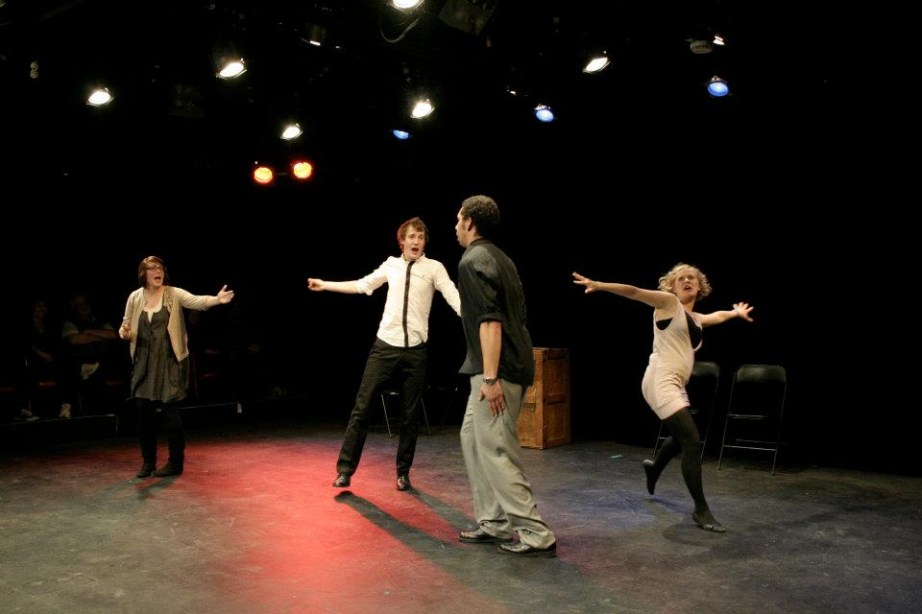
An easy way to create a great stage picture is through symmetry. Susan Messing teaches that doing stuff together makes it look important. If one person goes in as a guard, go in as a guard as well.
Observe what’s happening on stage, then mirror it. If your team is large, and more people mirror a move or a pose, it looks even more impressive. It’s the kind of thing that makes the audience think you rehearsed it.
Try it at your next rehearsal or show. Use physicality to shape your characters, build your environment, and support your team. It’s simple, it’s fun, and it works!











 People and Chairs