Info

Posts tagged improv comedy

Subway

Experts say anywhere from 60-90% of communication is non-verbal (facial expression, gestures, and posture). We take our cues from how people sit, stand or move. But the information doesn’t end there.

“Hairstyle is body language. Clothing is body language.” – Fred Herzog, Photographer

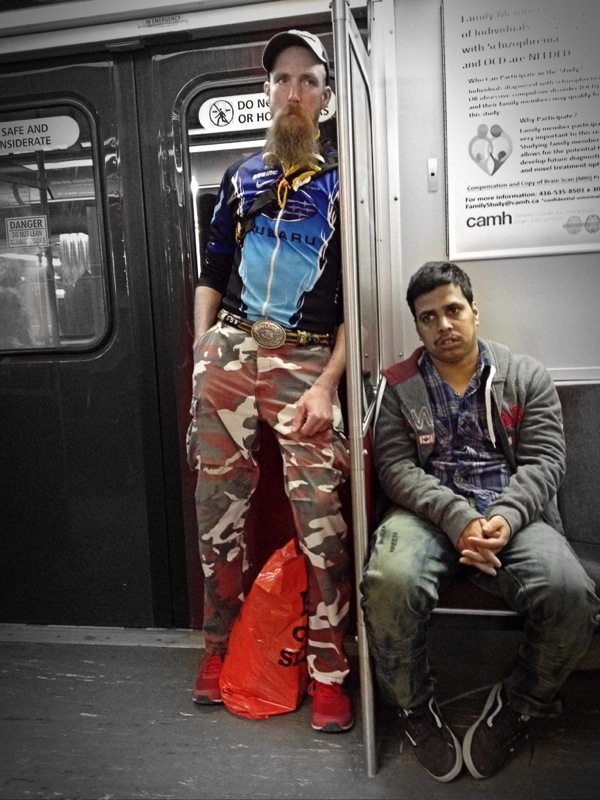
Look at the men in the photo.

The guy with the beard, Subaru shirt and camo pants is worlds apart from the dude with the checked shirt and forlorn expression. If I were to guess their first lines of dialogue, it’d probably be something like:

Guy #1: “I used to ride bikes in the military.”

Guy #2: “I wish Maanika would call me.”

In improv though, it’s rarely this obvious. We don’t have as many physical cues to get a read on someone’s character right away. So what can we do?

Mime An Accessory

In Trust Us, This Is All Made Up, TJ initiates an office worker who wears a beret. With one small gesture, adjusting the angle of the hat on his head, his character instantly becomes more interesting.

Maybe your character likes to stroke his beard, or play with her ponytail. I’ve seen Lisa Merchant mime goatees, while Ted Hallett twirls imaginary locks that would make Kim Kardashian jealous.

Maybe you’re wearing a scarf or a boa that keeps coming loose so you have to keep tossing it over your shoulder.

It doesn’t matter what it is; just reach out into space and find something, then use it to learn about your character.

Scene Paint Someone

If it’s three minutes in and we still know nothing about the people on stage, go in and scene paint something on them. Be specific. Is it a corduroy jacket, or a $6,000 Tom Ford suit? Reveal that they have a secret tattoo, describing what and where it is in detail. Endow someone with a toupée or glass eye.

Give them something to dimensionalise their character, and it will add dimension to the scene.

Study Body Language Like A Thief

There are so many tiny physical clues to how a person is feeling:

• Touching the back of the neck or head signifies doubt or uncertainty.

Improvisers who get in their head often do this unconsciously. If you see this happening to your scene partner, you can snap back them back into the moment by asking them if they need clarity.

• Putting both arms behind the head and leaning back in a chair is a show of status. (Watch for it at your next big meeting.)

• Touching or scratching the top of your hand or forearm signals stress. It’s especially common when people feel anxious or under attack.

Anna Gunn, who played Skyler in Breaking Bad, brushes her forearm ever so slightly when Skyler tells Walt she’s afraid of him.

Watch for these and other clues from your scene partners. You probably know friends or family members with unique quirks or tics; gestures that tell you they’re happy, anxious, sad, or about to explode. Try using some of them on stage, and see where they lead you.

“No scene is ever about the words being spoken.” – Del Close

Ken Hall by Kevin Thom

Photo © Kevin Thom

You didn’t get on a Harold team.

You didn’t make it to Mainstage.

You didn’t get a callback.

Your pilot wasn’t picked up.

Your show got cancelled.

When shit happens, it’s easy to think maybe you’re not cut out for this. Especially when you see your friends and peers doing so much better (at least in your mind).

But the truth is, not everyone who becomes successful in comedy does so because they’re the funniest or most talented. Some people just want it more, work harder, and refuse to quit. They do it because they love it; because they have no choice but to pursue it.

Even when you achieve a goal, there are no guarantees.

Steve Carell was fired from Second City.

Action, Stella, and The Ben Stiller Show were all cancelled after one season.

And Dan Harmon, creator of Community, was fired from his own show.

But perhaps most astonishing is Bob Odenkirk. Though he’d proven himself as an actor and writer with SNLThe Larry Sanders Show, and Mr. Show with Bob and David, he and David Cross were far from wealthy. (Sadly, they don’t earn a penny from Mr. Show.) Until fairly recently the pair couch surfed at friends’ places when travelling or touring, so they could use their money to fund passion projects.

Then Vince Gilligan cast Odenkirk in Breaking Bad, and the rest is history.

When you hit a roadblock, think of it as a redirect.

If you’re just starting out, maybe you need more stage time, more classes, or more life experience. If you’re further along the career curve, maybe your talents would be better utilized writing your own web series, putting together a Fringe play, or even teaching.

Whatever you do, don’t stop.

Just remember that every experience is valuable, because it’s part of your unique story. Even the sucky bits. Especially the sucky bits. And keep going.

“Be the person who wants to do it the most.” – Steve Carell

Here’s a fun project for a lazy Sunday.

We have a ton of comedy ephemera we’ve collected over the years, but it’s just been sitting in a box. I decided to make this simple strip collage using programs from two of my favourite Second City revues, Live Wrong and Prosper and Dreams Really Do Come True! (And Other Lies).

I started by painting a piece of illustration board black (you can also paint cardboard or use black construction paper). I cut the two program covers into strips and glued them down with Mod Podge, or you can use any white glue. Then coat the final piece with glue to seal it.

I love the way it turned out! You can make a similar one with show flyers, posters, programs, or festival schedules. It’s a great way to showcase fond memories.

SC PhotoToaster

We were hoping Second City would release this one day! It’s the “Maya” sketch from their 50th anniversary, featuring Stephen Colbert, Steve Carell and David Razowsky.

Now if someone would just post the full video of Pinata Full of Bees

Early on in my improv life, I did a set where I played a heroin addict. (My scene partner’s character had AIDS, so presumably we needed some comic relief.)

Doing my best Sid and Nancy impression, I mimed jamming a syringe repeatedly into my left leg.

When second beats rolled around, I decided to do a time dash. Hopping on one leg, I held my foot behind me.

The only problem was, in my haste to initiate, it appeared that my right leg had been amputated.

Instead of taking this gift from the comedy gods, I “corrected” myself and switched legs, thus destroying the reality that had already been established – and that everyone had seen.

Things deteriorated from there (if that’s possible), and by third beats…well…to quote Mark Twain, “Let us draw the curtain of charity over the rest of the scene.”

It took me a while to understand that so-called mistakes are a gift.

If I hadn’t been hell-bent on doing the “right” thing, my teammates and I could have played with the fact that my good leg got amputated.

Maybe the doctor was also an addict, and he operated while he was high. Maybe the hospital realised their error, and in the third beat I’d be legless. Who knows?

Not my brain.

The second you find yourself judging what’s already happened, put your focus on what’s here now.

It’s all that ever matters.

“The biggest laughs I’ve ever had in my life are something going off the rails, something going wrong, something happening that wasn’t supposed to happen. And improv teaches you not to fear those moments; that’s where the gold is.” – Conan O’Brien

Photo © Kevin Thom

Photo © Kevin Thom

Photo © Sam Willard

Photo © Sam Willard

There’s a theory in personal finance that says, “Your income is the average of the five people you spend the most time with.”

It’s enough to strike fear in the hearts of actors everywhere.

If you’re not earning big bucks, the thinking goes, you need to seek out people who do and start spending time with them. (What they don’t say, is what to do if those five people are douchebags.)

Before you quit improv to become a commodities trader, there’s another concept that’s far more valuable in my opinion: the idea of “psychic income.” It involves all those things that you don’t get paid for, but which give something back to the world – and in so doing, fill your cup as well.

For most of us, improv pays little (if anything), but it’s off the charts in terms of psychic income.

Few things compare to the high you feel when you’ve finished a great set. The same goes for coaching or teaching. You may not be earning six figures, but where else can you experience the joy of watching grown men and women play “Big Booty”?

Citibank’s slogan used to be “Live richly.” (That was before the whole subprime mortgage meltdown. Then they changed it to “Citi never sleeps” – presumably because no one was sleeping after the subprime meltdown thing.)

If you want a rich life, it’s simple:

Surround yourself with people who enrich you.

People you admire or aspire to be like. People who are smarter than you, who broaden your understanding of the world. People who go out and make things happen, as opposed to just sitting around criticizing. People who make you laugh.

When I look at my favourite improv teams, they’re made up of friends who respect and support each other. They share what they have unreservedly, and celebrate each other’s successes.

That’s living richly.

Bonspiel! Theatre’s Ashley Botting, Alastair Forbes, Rob Baker & James Gangl spin comedy gold

Screen shot 2014-02-13 at 6.50.25 PM

When you hear the word “artist,” what do you picture?

(a) That Picasso guy

(b) That Van Gogh guy

(c) Turtlenecked hipsters who say “juxtapose” and “deconstructed” while stroking their Llewyn Davis beards

It’s time for a new definition.

I don’t care if you’re a barista, a broker, or a shoe salesman. I couldn’t care less if you haven’t picked up a paintbrush since 1992. I don’t give a shit if the last time you did something creative was when Mr Beresford gave you a D minus in pottery.

What you do in your day job is not who you are, even if you work in a so-called “creative” field. Also, fuck Mr Beresford.

Being an artist doesn’t require paint or clay or a stage. It’s not about the medium you choose, it’s about using your ability to create, and using it daily.

That last part is key. Because while you’re an artist, the chances are very good that you’re blocked. Most of us are. We spend hours, weeks, months, years working on other people’s ideas, but somehow we never seem to find the time for our own.

The Artist’s Way by Julia Cameron will unblock you.
It’s a 12-week course in recovering creativity. You’ll learn how to silence your inner critic, make new discoveries as you heal old wounds, and find the joy in making space for art in your everyday life.

As a kid, I loved to draw, write stories, play the piano, and make my own “TV shows.” I did these things every day as far back as I can remember. But when I started working in advertising, I stopped making art for myself.

After 20 years of squeezing what creativity I could into ads for cars and banks and cleaning products, two things helped me find my own voice again: learning to improvise, and The Artist’s Way.

“Every child is an artist. The problem is how to remain an artist once he grows up.” – Pablo Picasso

If you feel like you’ve lost your sense of play…

If you yearn to make short films or decorate cakes or write your own comics or make things from popsicle sticks…

If it’s been so long since you did something creative, not for money or someone’s approval, but just for the fun of it, you need The Artist’s Way.

Just as important, the world needs your art.

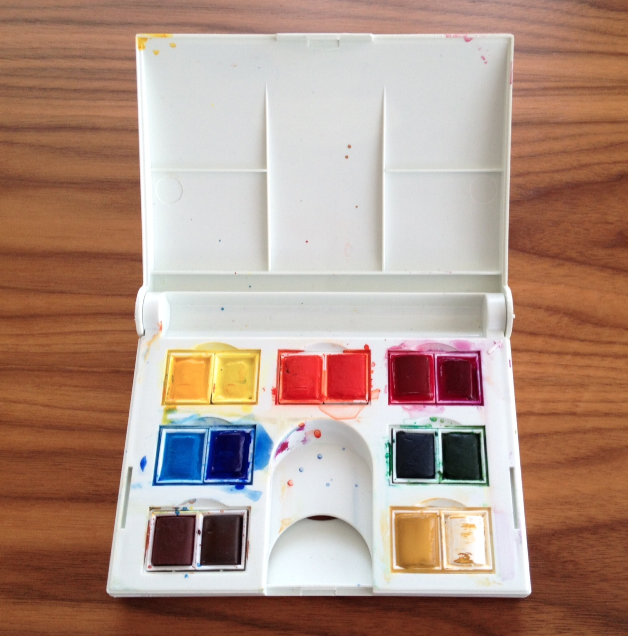
P.S. I bought the watercolour set above four years ago. The colours made me smile, so pretty in their little trays. But when I got home, I got scared. What if I tried to make something and it SUCKED? So I put it in storage and promptly forgot about it. Within two weeks of starting The Artist’s Way, I got over my fear, as you can see.

A special thank you to Shari Hollett for introducing me to it.

We’ve all been there.

Venues where the bar fridge is louder than the performers. Shows where no one shows up. Sets so bad that no amount of alcohol can blot out the shameful memory.

For me, it’s any number of shows that took place at the Savannah Room. It was, to put not too fine a point on it, a shithole.

“You’re crazy if you think I’m touching this filthy stage.”

Photo © Reggie D’Souza

More than once the place had to be evacuated due to flooding. I remember seeing Matt Folliott doing tech, his sneakers submerged in cables and rainwater, and wondering if this was the night we would all die.

Then there was the stage.

It wasn’t large, but this thing had holes that surely led to Middle Earth.

One time Charna Halpern taught a workshop there. Forty or so people signed up. Half of us watched as the other half got on their hands and knees to do an organic opening.

They started pounding the stage with their hands, getting faster and more intense.

We watched in horror as a dust cloud rose from the ancient carpet. Prehistoric molecules, no doubt redolent of polio and semen, stood out in stark relief under the lights.

Oblivious, the players kept pounding. When the dust cloud was finally higher than Charna, everyone started coughing uncontrollably.

But my special and favourite Savannah story involved my first Harold team, Leroy. Rob Ariss Hills, Gene Abella and I were on stage when a cat brushed past my leg.

I was momentarily caught off guard, but went back to killing it with my patented Shaft character. That’s when I saw it again.

It wasn’t a cat. It was a rat. And it was coming back toward us.

I shrieked and jumped into the first row of chairs (empty, of course) as the rat swept the scene. Gene said later he wished he’d tagged it out.

Shortly after, the Savannah Room closed its doors for the last time.

That’s my worst show. What’s yours?