Info

Posts tagged improv comedy

Marcel St. Pierre is a founding member and former Artistic Director of The Bad Dog Theatre, a Second City alumnus, and one half of bacon, music and comedy duo, Egg Zeppelin. You can catch them with special guest-slash-improv legend Colin Mochrie at Comedy Bar on Wednesday, December 5. 

People sometimes ask me, “Has improv changed since you started?”

2012 marks the 21st year that I’ve been doing improv – and by that I mean regularly – at least a couple of times a month. I feel really lucky to still love doing it, and there are probably a dozen or so improvisers I know in Toronto who are right around the 20-year mark, too, and a handful more that are probably around or beyond the 30-year mark.

Other than the occasional audience member being eaten by stealthy dinosaurs that raided our improv caves back then (clever girl…), I’d say a lot of things are still the same in terms of what MAKES a person an improviser. And by improviser I mean a comedic performer who CALLS themselves an improviser first.

I know improvisers today who go from show to show, and sometimes, two to three shows in one night, doing one set at say, The Black Swan at 8 pm, then going across town to do a 9:30 Bad Dog show at Comedy Bar, then going even later to Unit 102. The next night they’re on a Harold team with Impatient Theatre Co., and then it’s a duo rehearsal for a show in two days at The John Candy Box. Luckily it’s not heroin, but clearly, at that stage of the game, improv is your addiction. YAY FOR YOU!

This was pretty much the road I took when I started back in ’91. I was taking classes at least two nights a week, and began teaching intro classes in exchange for other free classes. Then I was doing lights and stage managing shows one or two nights a week with The Chumps at Big City Improv* on Queen Street.

After doing several seasons of Theatresports (which for years was the only game in town other than Second City), I’d been lucky enough to be in one of the city’s premier troupes, The Stand Ins, who took over Big City Improv after The Chumps moved on. We had four weekly shows for nearly a year before Big City closed in 1996.

After that, we continued to produce sketch and improv shows for several years, and guested wherever and whenever we could. We were hungry for stage time and we fought hard to get it.

And that would pretty much be the case until May 3, 2003, when The Bad Dog Theatre Company put up a stage and workshop space on The Danforth. That event was a big game changer in Toronto improv.

I think the current scene in Toronto really flourished because of the existence of an improv training institution that not only offered excellent training, but added as its mandate the addition of giving stage time not only to the cream of the crop, but to students at nearly every step of the way in their training. Imitation is the highest form of flattery, and today there are at least five or six places you can name in Toronto that do this, because it’s such a successful model.

What this has led to is what I think really has changed in Toronto’s improv landscape: the sheer amount of stage time available to improvisers, and in some cases, actual sustainable gigs where you get paid to improvise, which allows IMPROVISERS to continue to be IMPROVISERS!

It’s something I couldn’t even dream of when I started, and it’s a blessing in terms of just being able to get up and do stuff and get better in front of an audience. I think today’s newer improvisers sometimes take that for granted, and when they do, it can lead to some of the laziest, shittiest improv I’ve ever seen.

You know the shows I mean; shows that are promoted by their producers as “the best in the city,” with casts who really have no business being on stage yet, feeding each other’s bad habits and ultimately delivering a product that not only annoys good improvisers watching you, but also makes non-improvisers in the audience hate improv and take their comedy money somewhere else (or stop going to comedy altogether, chew on that!).

If you are that type of improviser or producer in today’s improv scene, you’ve been lucky to have the chance to do that kind of crap more than once and still have places to play. Please knock it off.

In the first 10 years I was doing improv, sometimes there was only one show per week – or even per month. This obviously made us more competitive and only the fittest survived. Ultimately I think the downside of this Darwinian scene meant that we lost out on some potentially great players who needed more time and nurturing to get better. It’s tough to be a nurturing community when you’re all fighting for stage time. So, overall I wouldn’t go back.

I think the improv community is more open and friendlier now, more nurturing and more vibrant than before, and more open to players of all stripes and abilities. And that’s a good thing. I think overall the current amount of talent on many improv stages in Toronto is very high, and it’s nice to have a mix of experience levels to play with…and I’m always learning new things from watching and playing with new players.

My advice to up-and-coming improvisers in Toronto is to never take the amount of stage time you have at your disposal for granted. Take improv seriously because you might be doing it 20 years from now! Play to the top of your intelligence. Be grateful for those in your midst who sacrifice the joy of being able to just show up and perform for the usually thankless job of producing stage time for the rest of you.

To all improvisers: I urge you, know where you are in terms of your experience and ability, and get training OTHER than on a stage. Take more classes, and not just from visiting superstars. Those are good, but consistent training and practice is key. And whenever possible, hug your improv producers.

To all improv producers: Know your show and don’t promote it as “the best improv in the city” if it isn’t. You give improv a bad name to paying audiences who will go somewhere else next time when you do.

And to everyone else: See more improv, and if you even think you might like to do it, come out and take an improv class. Obviously, I think you should do it at Bad Dog Theatre Company, but you get the idea.

* Did you even know there was something called Big City Improv at Queen & Bathurst way before The Big City Improv Festival existed? Now you do. It was a long time ago. All the audience was eaten by dinosaurs.

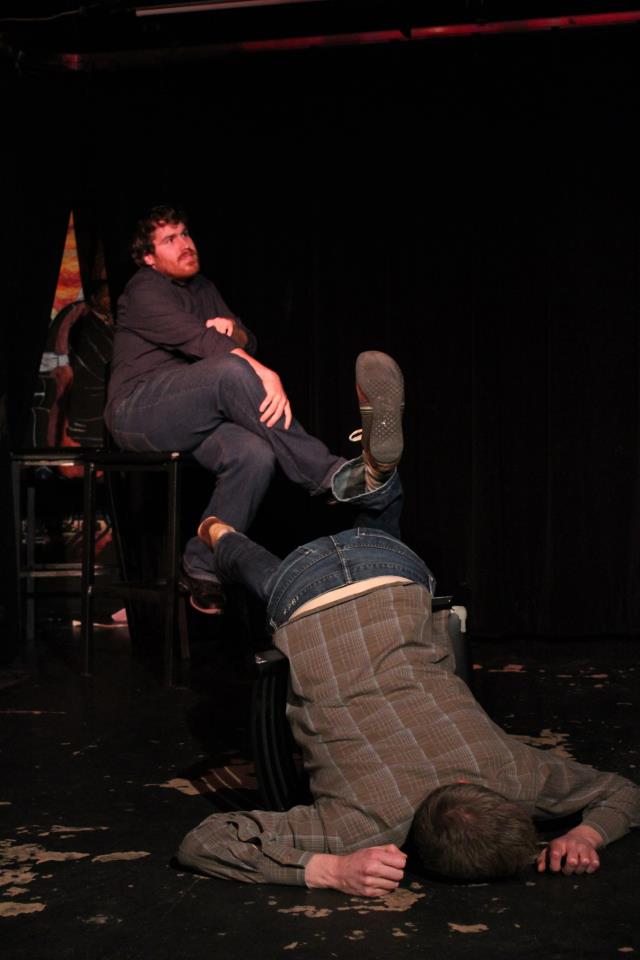
Photo © Adrianne Gagnon

Erik Voss wrote an interesting piece for Splitsider about game of the scene. (You can read the full article here.) Some of the improv community’s most respected performers weighed in, and I agree with their (sometimes differing) viewpoints.

The thing is, I don’t give a fuck anymore.

You see, early in my improv training, “finding the game” was the holy grail. The big cahuna. The mack daddy of all improv wisdom. Or so I thought.

When TJ and Dave taught a workshop in Toronto, I couldn’t wait to ask them about it. David looked thoughtful for a moment, then said, “I don’t really think about game when I’m performing.” TJ nodded.

This should have slapped some sense into my feckless, fearmongering brain, but no. I continued to search for The Game and how to recognize it in all its myriad forms.

One of my coaches routinely drilled us on “beating the shit out of the game.” Rehearsal after rehearsal, two people would start a scene, then others would tag in when they found the game. Afterwards, we were critiqued.

Let’s say Player A had a stutter, then someone tagged in and made a game out of forcing him to stutter. If Player A was also an alcoholic, then beating the shit out of stuttering, versus putting him in situations where he’d be tempted to drink, was deemed “less smart.”

While I understood the value in seeing patterns, few things put me in my head like trying to find the game, never mind finding the “right” game.

When I asked Susan Messing about it, she said that there can be many games within a scene; that each player might have their own game, as well as games that they play together.

The more I watched and performed improv, the more I found myself gravitating towards the kind of scenes where game just wasn’t as important as discovery.

Discovery of who the characters are. Discovery of the world they inhabit. The kind of discovery that happens when things are out of the players’ control and in the hands of the comedy gods.

What I learned, eventually, was that game can happen without effort. And that “finding the game” doesn’t always guarantee a great scene.

How many times have you seen improvisers find a game on stage, only to beat it so relentlessly that the scene loses any point, or dissolves into endless repetition?

Playing the game can be fun. It’s a bit like a ping pong match: I do this, then you respond that way. Repeat. But we don’t have to try so hard to find the paddle.

If we just allow scenes to unfold naturally, games will reveal themselves.

If you can, do yourself a favour and go see TJ and Dave, or Messing with a Friend, or Jet Eveleth and Paul Brittain, or Razowsky and Clifford, or Joe Bill and Mark Sutton’s Bassprov.

There is game inherent in their shows, but it’s not overt. That’s not to say game-centric shows like Asssscat aren’t awesome. They are. But if you’re struggling to find the game each and every time and it’s affecting your ability to have fun in scenes, give yourself a break. Take a breath and just respond to what’s happening right now.

If you do that, if you focus 100% on your scene partner and just react to what he or she says and does, you won’t have to find the game. The game will find you. Or maybe it won’t, and that’s fine. Because it will still be a way better scene than one where you’re not present because you’re too busy searching for something.

In seven years of doing improv, I can recall my best, or at least my favourite, sets in detail. And I can tell you that none of them involved me methodically thinking about The Game Of The Scene. In fact, what they all had in common was that I wasn’t thinking. I was just having fun.

Those are the kind of sets I want to do now. And that’s why I don’t give a fuck about game of the scene anymore.

One last thing. Someone asked TJ what he thinks about before he goes on stage. He answered:

• Don’t panic.

• Make an emotional choice, a point of view, so you’re safe no matter what.

• Remember how fortunate you are.

It’s really that simple.

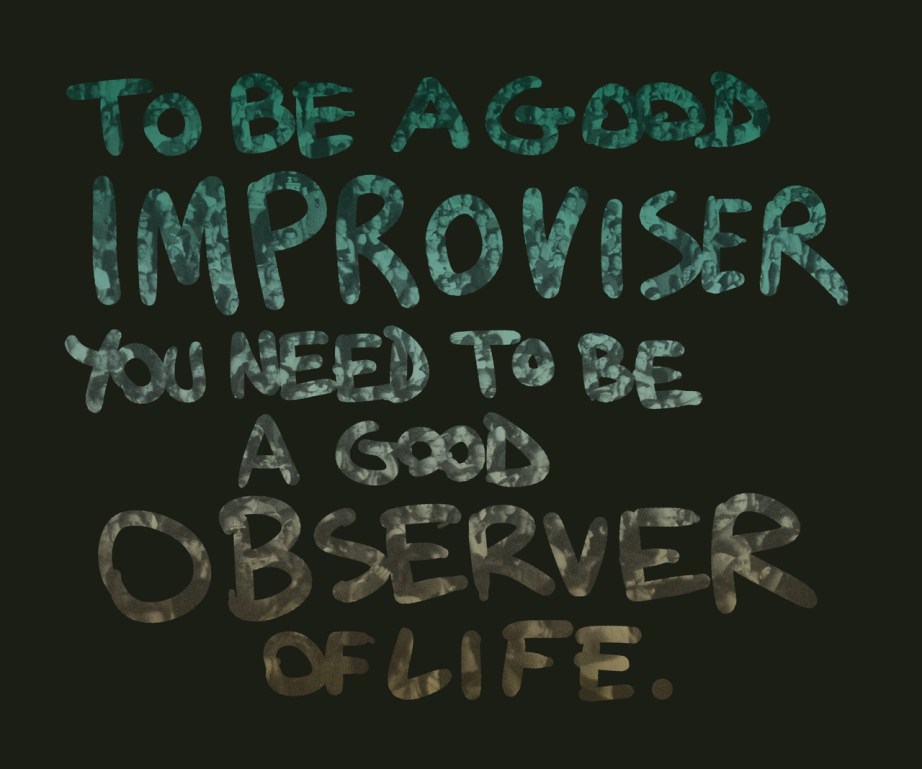
David Kantrowitz has been illustrating respected improvisers’ quotes, with some stunning results. You can follow David’s tumblr here.

Quote by Billy Merritt • Image © David Kantrowitz

Quote by Jason Mantzoukas • Image © David Kantrowitz

Quote by Brian Gallivan • Image © David Kantrowitz

Quote by Jill Bernard • Image © David Kantrowitz

Quote by Seth Morris • Image © David Kantrowitz

“We think in shapes and pictures. The shape your character takes informs who that character is, and lets your fellow players recognize him/her/it when they see that shape again.” – Todd Stashwick

Photo © New York Musical Improv Festival

Physicality is a gift, not just to your scene partners, but to you as well. The second your foot hits the stage to enter a scene, notice what your body is doing.

Is it hunched over, taking small, shuffling steps? Or upright and striding confidently?

Are you snapping your fingers as you walk? Did you prop one leg on your knee as you sat down, or cross your legs demurely at the ankles?

All of these things tell our scene partner, the audience, and – if we’re paying attention – us, who this person is, before we open our mouth.

When we see a shape or image of any kind, our brain immediately goes to work, trying to find a “match” for that image. Todd Stashwick teaches an exercise that demonstrates this.

To begin, one person goes up and strikes a pose, any pose, and holds it.

The rest of the team then joins that person, one at a time.

For instance, let’s say the first person is standing with feet apart, hands on hips. The second person could go behind and stand with their hands encircling the first person’s waist. The third person could stand with one hand on the first person’s left shoulder. And so on.

If someone looks tired holding their pose, you can help by supporting them with the pose you take.

When everyone has joined in, the Coach/Director removes one person at a time, randomly. After each person is removed, pause to observe the new stage picture. It’s amazing how much it changes.

When only two or three people remain, see what the remaining pose suggests – what scene is revealed – then have those players perform it.

The last two people might look like a cop arresting a perpetrator. Or a woman proposing to her boyfriend. Or someone choking a co-worker. Or Kali, the goddess of death.

Even if there’s just one person on stage, their physicality can suggest things too. Stashwick teaches students to look at the negative space on stage, not just the positive.

But besides helping players recognize characters, shape can help your stage picture too.

Stage picture is something that’s often ignored in improv, especially after the opening (if there was one). We’re usually too busy talking to think about what the audience is seeing, and what they’re seeing is probably two people standing around yakking.

The next time you find yourself rooted to the floor, change your physicality and see how it changes the scene. Not only will you feel different, but it will immediately look different than 99% of improv scenes.

An easy way to create a great stage picture is through symmetry. Susan Messing teaches that doing stuff together makes it look important. If one person goes in as a guard, go in as a guard as well.

Observe what’s happening on stage, then mirror it. If your team is large, and more people mirror a move or a pose, it looks even more impressive. It’s the kind of thing that makes the audience think you rehearsed it.

Try it at your next rehearsal or show. Use physicality to shape your characters, build your environment, and support your team. It’s simple, it’s fun, and it works!

Photo © Adrianne Gagnon

This post is a must-read for actors, improvisers, and anyone who’s ever struggled with self-esteem. Reproduced with permission from Jimmy Carrane‘s blog.

I recently had an audition for NBC’s “Chicago Fire.” A security guard, a couple of lines. Pretty easy… or so I thought.

But, whenever I have an audition, I put so much pressure on myself that it’s no longer about getting the job, it’s about my self-worth. The sad thing is I have been going to audition after audition for more than 20 years — for commercials and industrials and bit parts in movies and TV shows — and 70 percent of the time when I leave an audition I sink down into a terrible pit, asking myself why I am even trying to be an actor.

At home, my wife, Lauren, ran the lines with me. It gets frustrating running the lines with her since she can memorize them after four or five readings, but I feel like I am back in high school cramming for a World History test.

We kept going over the script and each time, I wasn’t getting the reaction I wanted from her, so I kept losing confidence. Lately, I have been so needy in my acting and performing, looking for that outside validation from my wife, and when I don’t get it, I am more than willing to blow every opportunity that comes my way. They call that self-sabotage. I left the house feeling like I sucked.

When I walked into the room for the audition, the director and producer sat comfortably in the back on a leather sofa. I tried to find the girl who was going to read with me as someone handed me a tiny microphone to clip onto my shirt. Then I nervously began to read the script.

They let me read it three times, normally a good sign.

The second time, they said: “Don’t bend down when you deliver the lines.” The third time, they said: “This guy is business as usual.”

When I was finished, I felt like I might have a shot. I took direction pretty well and they had asked me to do it three times, which meant they must have seen something they liked.

As I was leaving the room, the casting director, whom I have known for years, followed me out and pulled me into vacant room and said in a very supportive tone:

“Do you know you are reading the first line?”

“Um… um…. No, I didn’t,” I said, feeling like a brick hit me in the head.

“I wanted you to know that. That is how you lost the last job.”

“Is that what I did in there?” I asked.

“Yes,” she said. Obviously, if I had to ask her, I was doing it in there.

“What can I do next time?” I asked, still seeing stars from the brick.

“You know the script. Memorize the first line. Say it to yourself five times in the waiting room before you go in.”

Immediately, my brain went to three places:

1. Oh god, they will never call me in again.

2. I suck.

3. I want to kill myself.

But after a few minutes I realized that her feedback was actually incredibly helpful, and I felt hopefully that she’d taken the time to give me some constructive notes. Maybe it meant she thought I had potential.

The next night I went to couples therapy with Lauren, and I still had a bit of an emotional whiplash from the day before.

At the end of the session I said: “Maybe I am projecting this onto Lauren, but I don’t think Lauren thinks I am a good actor.”

There was a long pause, and I heard her squirm on the couch next to me.

“I have to be honest with you. I don’t think you are a good actor.”

Another brick. Then I went to those three places again. (Refer to above)

I felt angry. She was telling me this now, after we just got married?! She is my wife, she is supposed to support me. I was devastated. What was I supposed to do with this?

Later, I talked to my friend, Dan, who said, “I don’t know what this all means, but I bet it makes you a better actor.” Though I still felt angry about this, I had to agree with Dan.

After a week of wanting to kill my wife for saying this, I started realizing something: What I hated wasn’t her opinion about my acting, it was my opinion about my acting. I was the one who didn’t think I was very good. And though in a perfect world your partner should think everything you do is Oscar-worthy, I would rather have her be honest with me than blow smoke up my ass.

And I started thinking about some of the lessons I’ve learned from other improvisers over the years. Jon Favreau used to be an improviser here in Chicago before he went on to become a hugely successful writer, director and actor. He wasn’t known as a great improviser, and he got lost at iO and couldn’t get any recognition at Second City or The Annoyance Theater. It was safe to say Jon wasn’t getting much validation from the improv community he wanted to to be part of, but he didn’t let that stop him. Favreau believed in himself. He believed he had talent. And he especially didn’t care what other people said. After he got a co-starring role in the film “Rudy,” he went out to LA and made things happen for himself, starting with writing and starring in “Swingers.” He surprised everyone, except himself.

When it comes to confidence, I am a work in progress. The one thing I am clear about is no one is going to have confidence in you, if you don’t have confidence in you.  If you believe you are good, they will believe you are good. Any TV and film jobs I have booked over the years all had the same thing in common: I went into the audition ready to play with confidence.

I am going to be blunt. Working on my confidence takes work. Constant work, hard work, and sometimes I will be able to get help form the people I am closest to and sometimes not. And the more confidence I get, the less I look for outside validation. Even from my wife.

At the risk of sounding like the old man standing on his porch shouting “Get off my lawn, you kids,” I need to kvetch.

One of the reasons many see improvisers as the 19th century public saw actors (“No Dogs or Actors Allowed!”) is that we don’t carry ourselves in a professional manner. We aren’t acting professionally nor are we treating each other professionally.

In the past month I’ve had three groups who’ve hired me to coach them cancel at the last minute. It’s unprofessional and it’s a bad precedent. I’ve lost work, time and money. I and many of the other teachers and coaches and directors that are hired spend a great deal of time preparing for these sessions, thinking about how to help individual casts find their voice, finesse their shows, further their careers, and, perhaps, make money. Yes, make money.

If you’re doing this for the art, cool, I get it. But there’s also a few shekels to be made from some of this work. The more of us who see the possibilities in that, the more the public will respond to the strong work being presented. The more we work on our craft with focused professionals the better we look. The better we look the more the public will see how great this art form can be. Should you blow off rehearsals when you’ve hired someone to come and work with you, you’re not just diluting the power of your work, you’re also continuing this idea that theatrical improvisation is merely a parlor game, or a series of easy jokes, or an evening of sloppy work delivered by shitty actors. I know that’s not who we are. I know we are able to do better.

No one can make you feel inferior without your consent. By the same token, you are the one that’s ultimately responsible for you being treated respectfully and honorably. If I say, “Hey, it’s okay that we scheduled a rehearsal and no one showed up,” that doesn’t serve any of us.

I allow you to treat me the way you do. Should I stand up and say, “No, we can all do better,” that doesn’t just make me stronger, it makes all of us see this work with professional eyes and hearts.

Honor me and my time. In the end that will serve us all.

Photo © Kevin Thom

Jeremy Birrell is an actor, improviser, musician, and avid Beatles fan. Canadians know him as “that funny guy” from a variety of commercials. He is also the star of the long-running improvised spectacle, coincidentally named The Jeremy Birrell Show.

Ahh the beauty of improv. So fresh, so raw, so unpredictable – yet so scary, so harsh, so unorganized. What better tool for an actor to use when entering an audition with the hope of winning some friends, but possibly losing them before he or she can exit the casting room with an awkward “Thanks again guys. Do you want me to leave the door open or…?”

In my experience, being an actor and an improviser go hand in hand. Both are about taking risks.

When I first started out in the biz, I was a young pup: naïve, possibly better looking (?), desperately trying to leave a mark and/or trademark on the vast, gargantuan, evil Dark Lord that was and maybe still is the acting industry.

Whether it was horrible one-liner auditions like, “Hey man, you goin’ to eat that?” or even more horrific commercial auditions like, “Hey man, you goin’ to eat that?” I was constantly trying to add a little extra JB charm. (That’s Jeremy Birrell, not Justin Bieber.)

One time my agent sent me out for a non-union gig. It was your classic cattle call with people wedged in, random sweaty skin, not to mention the whiff of insecurity in the room; either that, or a lack of ventilation and deodorant combined.

When I finally got called in, I found out it was a group audition. People were lined up against the wall like they just murdered someone. Meanwhile the casting table of 10 or so people immediately sized us up, looking confused, semi-pissed off, or both. As I was trying to figure out who the director was, he finally spoke without making eye contact.

“OK guys, I don’t want to spend too much time on this.”

Awesome. So the director is the guy who looks pissed off the most. As we took our group direction (“Dance monkey, shut up monkey, start talking monkey”), one of the actors  delivered a line to another actor. This is where the actor decided to improvise a line or two.

It’s a valid choice; we’re all trying to add a little extra to our current “nobody” status. The problem was, his current audience was in no way forgiving or patient. It’s good to try something new, fresh and out of the ordinary, but when something clearly isn’t working, move on. Or even better, find an ending.

With the director already shifting in his seat, the actor chose to riff a few extra lines in French. Everyone at the casting table shook their heads while he continued his show-off French.

When he finally exited the scene (foreshadowing his no-opportunity with this gig), I decided what better time in my SOC status than to toss in an ad lib myself. I leaned in to the girl beside me and said, “Wow, that guy can speak French?”

There was actual laughter from the other side of the table. The director gave a smirk, like, “You weren’t supposed to say an f’ing word, but that was sort of OK.”  Needless to say, I won me some friends that day, as well as a semi-principal role in a three-day commercial shoot. I also had the pleasure of working with that same director, who might I add, liked to scream “FUCK!” after every time he said “CUT!”  It never got old.

Cut to a year later. I have a really nice director congratulating me on getting a commercial during the wardrobe fitting, and telling me basically why I got the part.

“We liked that thing you did with your hands,” he said, like I should remember instantly.

“Oh yeah, right…the hands thing.”

What the fuck is he talking about? Then, like a fly hitting a windshield: holy shit, he’s talking about a little gesture I did with my hands, insinuating a catfight that was about to take place in a boardroom. (Yes, it was a beer commercial.) Something so simple, so little, had once again won me some friends, and this time a principal role.

Well actually no, it didn’t. The next day, after a second wardrobe fitting, the client decided he just didn’t like the way I looked, mainly in the facial region.

Fast forward a few years later. I suddenly start booking a lot of commercials. All the directors sort of know my name – or at least recognize my teeth. The receptionists at the casting houses actually say Hi, with full eye contact. And they don’t point out to everyone in the waiting room that I’m horribly late. Instead they just say, “So Jeremy, you’ll be going in next…” And every actor in the room hates me. OK, so maybe that doesn’t always happen. Every actor in the room usually loves me when I come in late.

I think what shifted was that I had to work at it. The more rooms I got in, the better I got. I took more risks, which enabled me to be more intuitive with what the director was trying to get across in his or her (very brief) description of a scene.

Don’t get me wrong. I still go in every now and then, completely bomb, and shit all over the audition unintentionally with no clue if I have a serious case of IBS. The point is, when having a bad audition, whatever I brought into it, it’s not working. We performers all know that feeling, and know what we can learn and take from that.

In conclusion, I think that with acting and improv, you’re never going to fully win over everyone. Some will be pleased, and some not so pleased. But in the midst of all that, it’s important to keep going. Keep moving forward. Take all the experiences, all the wisdom you’ve stored so preciously in your head like an owl and f’ing use it. (I said “f’ing” because I don’t want you to think I’m yelling at you.)

We as actors, improvisers, and performers must constantly remind ourselves to dust off any remnants of a possible “chipped shoulder.” If all we see is a jaded industry, then that’s what will continue to suck our souls dry. And before you know it people start asking if you’re a vampire. Or even worse, “Were you in any of those Twilight films?”

Photo © Jeremy Birrell

As an improviser, you know the importance of play. If you’re not having fun and being silly, if you’re not in a playful state on stage or in rehearsal – the dreaded “in your head” zone – it’s really hard to have a great scene.

As John Cleese discussed in his brilliant speech on creativity (click here to watch), play is vital not just in the arts, but in every endeavour that requires creative thinking, from engineering to brain surgery.

The problem, according to Ken Robinson, is that creativity is systematically driven out of us by the time most of us are adults. The main reason? Fear of making mistakes; of somehow getting it wrong. And that’s an issue not only for improvisers, but for everyone. Because creativity isn’t just a “nice to have,” it’s a must if we’re to evolve as a civilization.

Of all the TED Talks I’ve seen, this one resonates the most. I’ve probably watched it a dozen times, and will watch it dozens more. Click below to view.

If you enjoyed this video, check out his RSA Animate talk here, and his book, The Element: How Finding Your Passion Changes Everything.