Info

Photo © People and Chairs

Photo © People and Chairs

Top row, from left:

1. Improvise (inscribed “Fuck it! – Mick Napier”)

2. Burrito, the Official Food of Improvisers

3. Christmas gift (came with Portlandia DVD)

4. Because sometimes a photo booth is more fun than an iPhone

5. Kinder Egg Franken-toy made from two figurines

6. Nug Nahrgang’s Instagram feed

7. High-end U-lock key for piece-of-crap bike

8. Profits from show (split three ways)

2nd row:

9. Business card – Bam!

10. USB with Piñata Full of Bees

11. DIY guitar pick

12. Gum (for post-burrito green room politeness)

13. Old timey postcard for sending message from the past

14. Emergency toothpicks/Christmas gift igniter

15. Jetstream rollerball

3rd row:

16. Best. Show. Ever.

17. DCM wristband

18. Hipster room key

19. Master Class notes

Bottom row:

20. Koosh ball

21. Lucky dollar bill from CIF

22. Deodorant (for rehearsals)


What’s in yours?

I was talking with Suzanne Pope, creator of Ad Teachings recently, when she asked me if improv is helpful in the workplace.

“Hells yeah!” was my professional answer.

“If you could sum up just one thing it can do,” she said, “what would it be?”

“Uhhhhh…”

(So much for eight years of training in “Don’t think.”)

The truth is, my mind was teeming with answers. Because really, what doesn’t it help?

Tina Fey explains the core principles brilliantly in her Rules of Improvisation. If all you did was Agree, Say “Yes, And…”, Make Statements, and remember that There Are No Mistakes, you’d be further ahead than 95% of nine-to-fivers. But it doesn’t stop there. Improv can also help you:

Read The Room

Improv teaches you to pay attention to your scene partner. In real life that could be your client, your co-worker, or your boss. (It could also be your spouse, your child, your pusher or your taxidermist, but for now let’s keep it work-related.)

When you walk into a meeting and everyone’s frowning, the client is nervously fidgeting with his phone, or the person across from you is smiling but her eyes are lifeless circles, all of this is valuable information. Information that can and should be weighed before you open your mouth.

I used to go to client meetings thinking only about the work I was there to sell. Now, my focus is the people I’m presenting to.

You may not always make the sale, avoid conflict, or find a solution on the spot, but taking the time to connect with your audience almost always results in a better relationship.

Give And Take Focus

You know those people who never let you get a word in? You get in an occasional “Mmm” or “Huh,” while they never seem to take a breath. Or maybe you know someone who cuts you off, finishes your sentences, or talks over top of you.

What about competitive listening? That’s when someone pretends to pay attention, but they’re really just waiting for an opening to air their opinion.

We’ve all experienced these at one time or another, and a lot of us are guilty of them, too.

Learning to give and take focus is a skill. The more you practise – especially listening, which is more than just hearing and involves your whole body, as well as paying attention to the other person’s body language  – the better you’ll communicate.

Commit 100%

If you’re reading this on your smartphone while the TV is on and your son is asking you to look at his finger painting, stop. Choose one thing to focus on and give it your full attention.

When you’re not fully present…well…allow me to share a recent interaction:

Me: (looking at iPhone) (groan) I just realized I did something that I had already done.
Cameron: Well, I guess it’s really done now.
Me: (looking up from phone) What’s done?

When you’re present to your choices, it’s incredibly powerful. For you, and your audience – whether you’re on stage, in a boardroom, or sitting across from your loved one.

Try fully committing to your next handshake, hug, or crappy little low-budget, nobody-cares-about-it-so-no-one’s-paying-attention project, and see what happens.

Collaborate

I’ve seen countless ideas whittled away by committees, in brainstorming sessions, new business pitches, and creative presentations.

One person throws out an idea. Someone else says “I like it.” Heads start nodding as people become excited about the possibilities. Then the overthinking begins.

“Why is the dress yellow?”

“That bowl doesn’t celebrate the cereal.”

“How long is the logo on screen? We always super our logo right off the top.”

“I read some research that said people don’t like humour.”

“A Jack Russell terrier is a gay man’s dog.”

“I think these scripts are lame.”

*(All of those comments are actual feedback I’ve heard over the years.)

There’s a big difference between collaborating as a team and nay-saying a concept into the ground before it’s even had a chance to live.

Not every idea is gold. But 9 times out of 10, when something gets pecked to death, it’s coming from a place of fear. Which leads me to my last and favourite reason to take improv.

Take Risks

A lot of us don’t take risks because we’re afraid of failure. But when you realise there are no failures, only learning, it becomes a lot easier to try things. The more risks you take, big and small, the more experience – and experiences – you have to draw from.

Unfortunately, many businesses are risk averse. They’d rather do things the way they’ve always been done than risk possible failure by trying something new. But the truth is, change is constant. And those who embrace change are far more likely to stay relevant than those who cling to the past. (Kodak, anyone?)

Yes, change is scary. But as a wise man once said, “Shit happens.”

Companies evolve. People come and go. What was hot last year (or last week, or this morning) is already passé.

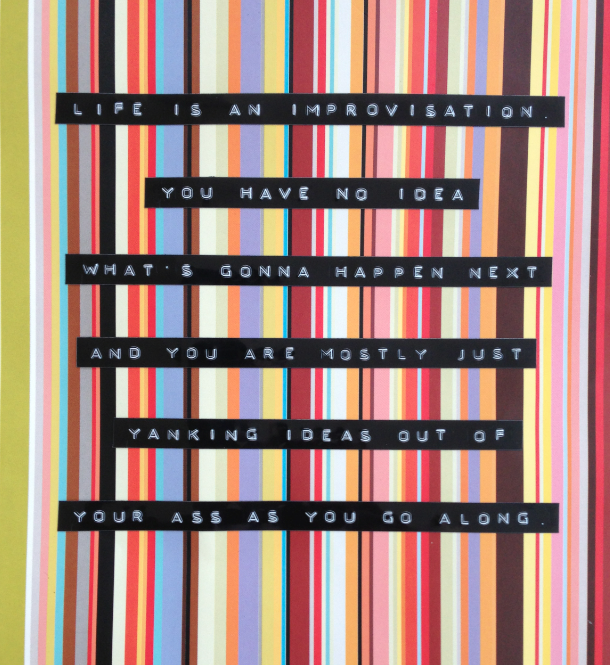
Improv teaches you to respond to whatever is happening, and be cool with it. The next time you find yourself fretting about a meeting, a project, or a new business pitch, just remember the words of Second City alumnus, Stephen Colbert:

Image © People and Chairs

Image © People and Chairs

Subway

Experts say anywhere from 60-90% of communication is non-verbal (facial expression, gestures, and posture). We take our cues from how people sit, stand or move. But the information doesn’t end there.

“Hairstyle is body language. Clothing is body language.” – Fred Herzog, Photographer

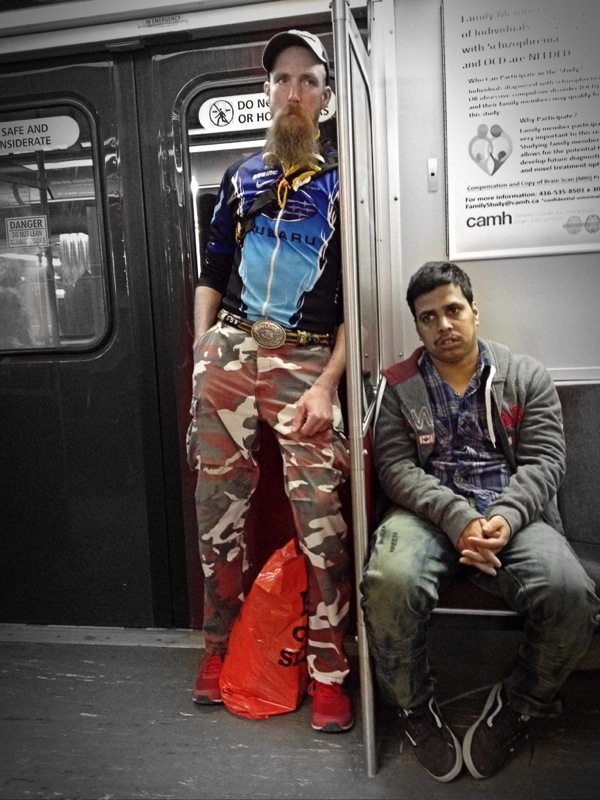
Look at the men in the photo.

The guy with the beard, Subaru shirt and camo pants is worlds apart from the dude with the checked shirt and forlorn expression. If I were to guess their first lines of dialogue, it’d probably be something like:

Guy #1: “I used to ride bikes in the military.”

Guy #2: “I wish Maanika would call me.”

In improv though, it’s rarely this obvious. We don’t have as many physical cues to get a read on someone’s character right away. So what can we do?

Mime An Accessory

In Trust Us, This Is All Made Up, TJ initiates an office worker who wears a beret. With one small gesture, adjusting the angle of the hat on his head, his character instantly becomes more interesting.

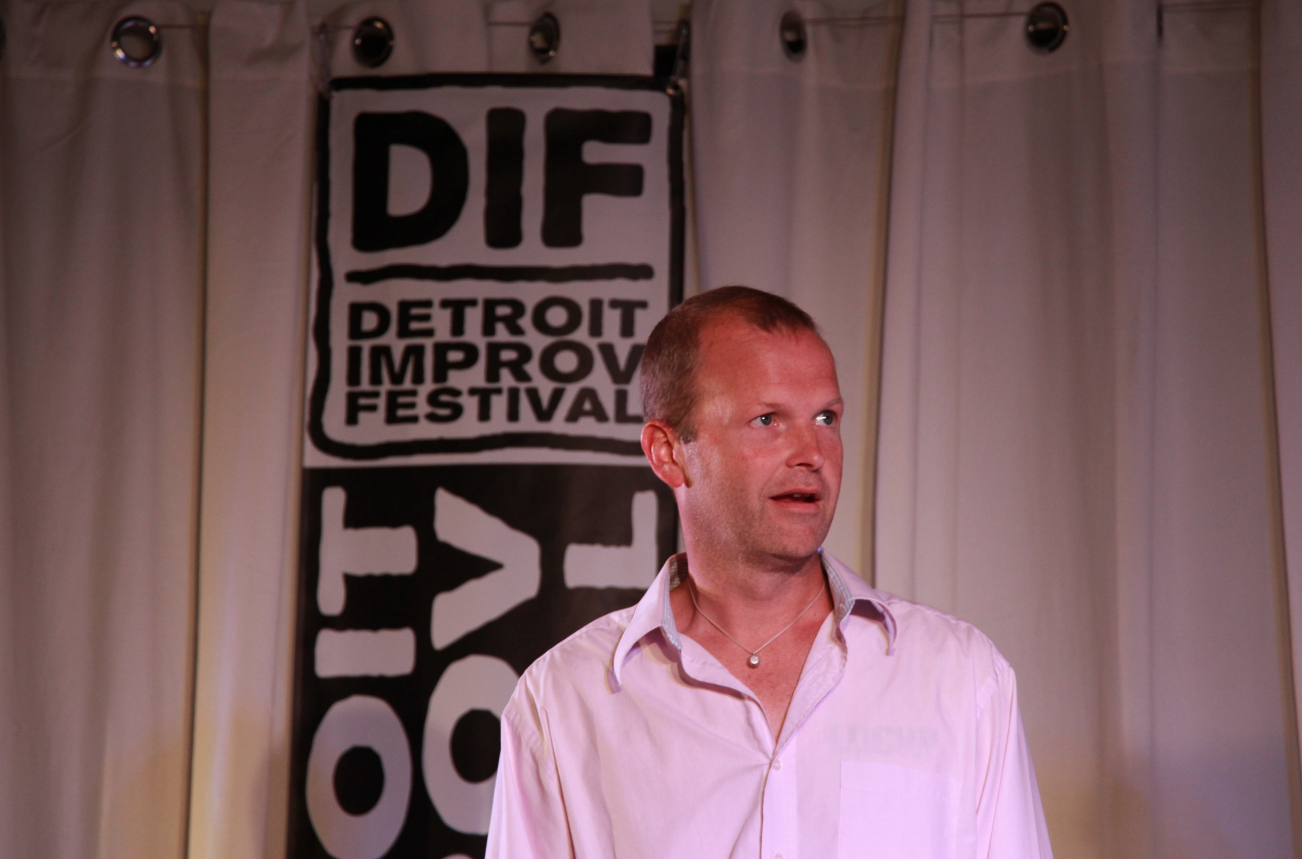
Maybe your character likes to stroke his beard, or play with her ponytail. I’ve seen Lisa Merchant mime goatees, while Ted Hallett twirls imaginary locks that would make Kim Kardashian jealous.

Maybe you’re wearing a scarf or a boa that keeps coming loose so you have to keep tossing it over your shoulder.

It doesn’t matter what it is; just reach out into space and find something, then use it to learn about your character.

Scene Paint Someone

If it’s three minutes in and we still know nothing about the people on stage, go in and scene paint something on them. Be specific. Is it a corduroy jacket, or a $6,000 Tom Ford suit? Reveal that they have a secret tattoo, describing what and where it is in detail. Endow someone with a toupée or glass eye.

Give them something to dimensionalise their character, and it will add dimension to the scene.

Study Body Language Like A Thief

There are so many tiny physical clues to how a person is feeling:

• Touching the back of the neck or head signifies doubt or uncertainty.

Improvisers who get in their head often do this unconsciously. If you see this happening to your scene partner, you can snap back them back into the moment by asking them if they need clarity.

• Putting both arms behind the head and leaning back in a chair is a show of status. (Watch for it at your next big meeting.)

• Touching or scratching the top of your hand or forearm signals stress. It’s especially common when people feel anxious or under attack.

Anna Gunn, who played Skyler in Breaking Bad, brushes her forearm ever so slightly when Skyler tells Walt she’s afraid of him.

Watch for these and other clues from your scene partners. You probably know friends or family members with unique quirks or tics; gestures that tell you they’re happy, anxious, sad, or about to explode. Try using some of them on stage, and see where they lead you.

“No scene is ever about the words being spoken.” – Del Close

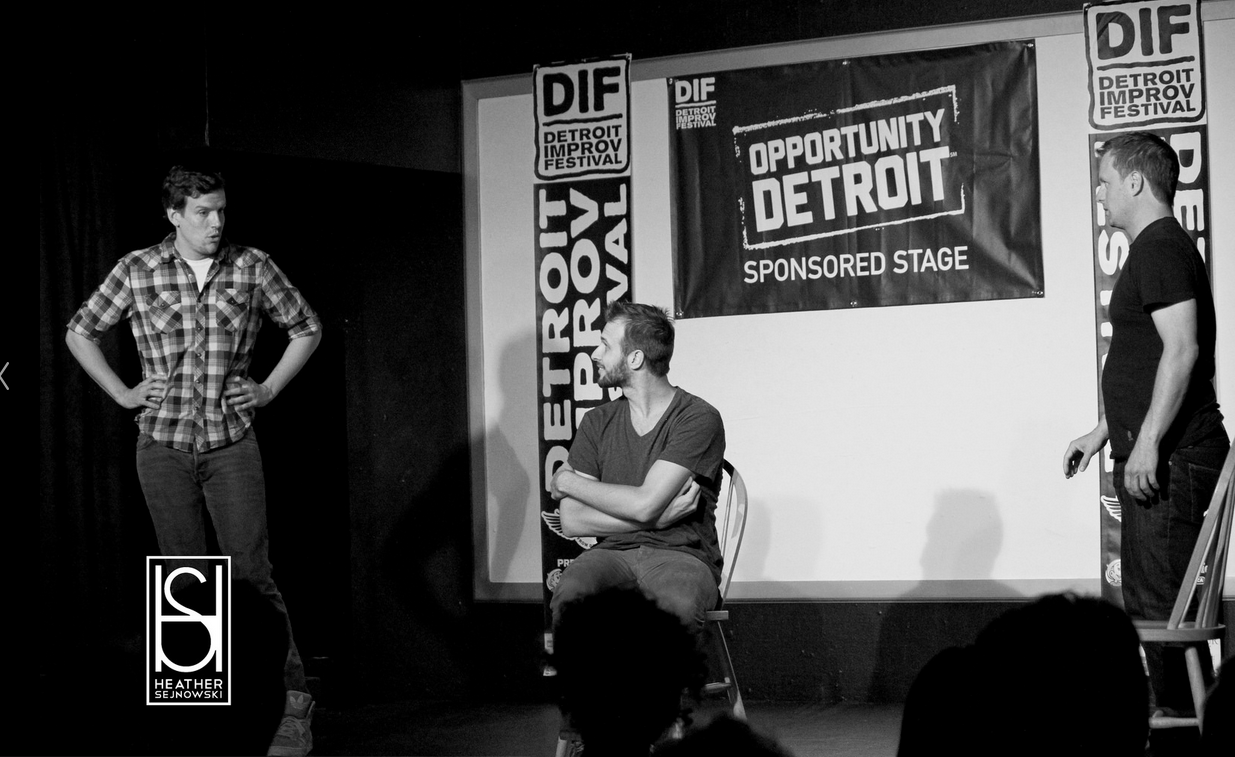
Detroit may be known more for Impalas than improv, but that’s changing fast thanks to Chris Moody. The 2014 Detroit Improv Festival takes place August 3-10, with 200 improvisers from across North America putting on 20 performances and 15 workshops. We spoke with Chris about the festival, rubbing shoulders with improv royalty, and the importance of giving back.

Photo © Heather Sejnowski

Photo © Heather Sejnowski

P&C: Tell us how you came to be involved with the festival, and why?

CM: Well I am a transplant; I grew up in Philadelphia and moved out here about 10 years ago. I started doing improv because I wound up going with my wife to see a show at Go Comedy! Improv Theater when it first opened up. It was a New Year’s Eve show and I [saw] that there were classes.

It just happened that both my wife and I were laid off at the same time, so I was looking for something to take my mind off of job hunting, and improv turned out to be the cure.

My day job is planning trade shows. I’m an Operations Manager, so getting things together, working on timelines and putting an event together was kind of what I’d been doing pretty much my entire professional life.

I approached the owners at Go Comedy! and asked them if they ever wanted to produce a festival, just let me know, and it turned out to be that year. We started four years ago, and each year we try to do something different to bring the best improv from around North America to our community.

P&C: And looking at your guests it looks like you’re doing an amazing job, especially for a festival as relatively new as yours.

CM: We’re extremely fortunate with a lot of incredible improvisers who have gone on to film, television, stage careers returning to the city to perform in the festival.

Keegan-Michael Key obviously, his meteoric rise through Key and Peele, got his start here in Detroit at a theatre that he helped open called the Planet Ant Theater, the longest-running theater that does improv in Detroit.

Tim Robinson knows the guys at Go Comedy, so we had a real good base of improvisers from around the country that helped us produce our first couple of festivals, and from there, through friends of friends we’ve been able to add on and increase the talent.

P&C: This year you’re bringing Fred Willard on opening night for a special screening of Best in Show.

CM: Yeah, we’ve always wanted to do something to attract theatre-goers to improv, because like many other cities, not many people really know what improv is. Some people think it’s stand-up comedy, Whose Line Is It Anyway? is a good resource and a good introduction, but we really wanted to introduce the locals to long form improvisation. And we felt by bringing this improvised film to a large theatre – it seats 1,600 people – we think that might be able to attract new audience members.

P&C: That’s a fantastic idea. Cameron and I know it can be like pulling teeth to get people who aren’t familiar to come see improv. Even my family was convinced it was stand-up with hecklers and they didn’t wanna go near it. Using an improvised film is a fantastically creative way to get new people involved.

CM: We were able to get Fred Willard through some Detroit connections. The Detroit Creativity Project is a non-profit that started teaching improv in the Detroit public schools, complimentary because of school budgetary cuts.

It was started by a gentleman named Marc Evan Jackson who’s a member of The 313 with Keegan. He started his project with the help of many other Detroit improvisers, and had a fundraiser in LA and Fred Willard participated in that. He was introduced to many of the Detroit improvisers in LA, and was kind enough to come out and do a Q&A for opening night, and he’s actually going to perform long form improv with his improv troupe, the MoHos.

P&C: That’s very cool. We just saw him on Andy Daly’s new show, Review.

CM: Yeah, he’s everywhere.

P&C: What have been your favourite performers or shows over the last four years?

CM: Well personally, my favourite thing about the festival has been the appearance by TJ and Dave last year. They came out and did two shows during the festival and they’re my all-time favourites. We had TJ come out the past couple of years, and last year we were able to get both TJ and Dave to Detroit. It was both sold-out performances and I marked it on my calendar not to miss those shows.

P&C: Oh yeah, I envy people who can see them regularly, in Chicago or New York.

Photo © Heather Sejnowski

Photo © Heather Sejnowski

P&C: Who are some of the other guests you’re bringing to the festival this year?

CM: Well we’d been trying to get John Glaser to come back to Detroit for the festival. He grew up in Southfield, Michigan which is about 10 minutes from Detroit, and he has agreed to come out. He asked if a couple of other performers he regularly performs with could come out as well, so Kevin Dorff will come out, Tim Robinson will be joining him, as well as Mike O’Brien from Saturday Night Live. So the four of them are gonna perform together and we’re extremely excited about that.

P&C: Amazing.

CM: Susan Messing has been to our festival each year, and each year she performs with a different person. This year she’s going to perform with Norm Holly, who is head of the Second City Conservatory. He is from Michigan, right outside of Detroit, so it’s a bit of a welcome home for him as well.

And then Colleen Doyle and Jason Shotts, who are two of my favourite performers out in Chicago, will be performing their show DUMMY.

P&C: The festival runs for eight days. That’s long!

CM: We increased the amount of days because of the festival starting on the Sunday night at the Redford Theater for Best in Show. We also wanted to highlight the Planet Ant Theater on Monday, which is their improv night. And Tuesday and Wednesday night we’re going to do a couple of local shows downtown at the Boll Family YMCA Theater.

Tuesday night’s show will be the Detroit Neutrino Project, the improvised film. And Wednesday night we’re going to have a showcase and fundraiser for the Detroit Creativity Project where students and alumni come back and perform, and a few others shows as well. Natasha Boomer is going to come out with Wheel of Improv that evening, which we’re incredibly excited about.

P&C: Oh, very cool.

CM: And then ThursdayFriday and Saturday night we move to Ferndale, Michigan where we have shows at the Go Comedy! Improv Theater, the Rust Belt, the Ringwald Theatre, and we’re going to do a family-friendly show on Saturday at the new ComedySportz Detroit.

P&C: That’s a very full schedule.

CM: It is, and it’s nice because all of the theaters – especially the ones in Ferndale – are just a couple of blocks from each other. So you can go from show to show. You catch the beginning of one show, you can catch the end of another show very easily; it’s very attendee-friendly and performer-friendly.

P&C: That’s terrific. Can you tell us a little about the workshops you’ll be offering?

CM: Sure. Depending on when everybody comes in, we have workshops on FridaySaturday and Sunday. Sometimes if a performer can only come on theTuesday or Wednesday we’ll do another workshop during the week for some of our local improvisers, but our main workshops take place during the day.

The nice thing about our workshops is, not only do you get a two-and-a-half hour workshop, you also get a free meal, whether it be dinner if it’s a night workshop or lunch at our BBQ on Saturday or Sunday.

P&C: Nice. Now, switching gears for a moment, because you’re relatively close to Toronto you’ve had a number of Canadians attend the festival. Do you notice any difference between US and Canadian performers’ styles?

CM: Not so much styles. I travel up to Toronto quite a bit, so I’ve got to know a lot of the improvisers in the area fairly well over the past four years. From Mantown to 2-Man No-Show, Ghost Girls, We’re From Here, Darcy & Bingley, Jess Grant’s solo, POMP… They’re so strong and so character-based, it’s a nice complement to our festival line-up. You can tell they’ve been working together for quite some time and they’re among the most unique and elite improvisers that I’ve ever seen.

Photo © Heather Sejnowski

Photo © Heather Sejnowski

P&C: I think it’s great for Canadians that you have such a rich offering of performers that a lot of us may not get a chance to see very easily or very often, so it’s nice that you also enjoy what Toronto has to offer.

OK, last but not least, DIF is a non-profit. Can you give us a bit of background on that?

CM: The festival is run by the Detroit Improv Collective Inc. It’s a 501(c)(3) non-profit that produces workshops and other events, including fundraisers which we do throughout the course of the year.

Over the past couple years we’ve partnered with Gilda’s Club of Metro Detroit, to help produce the festival; they’re actively involved. We do monthly workshops at Gilda’s Club, and we help out whenever possible.

We have a fundraiser coming up on May 20th for Gilda’s Club and the festival; we’re gonna feature some of our amazing local troupes and Joe Bill from Chicago is going to be in town and participate in the fundraiser. Gilda’s Club means a lot to me both personally and professionally. We’ve tried to do whatever we can to support them.

P&C: That’s fantastic. Well, thanks for your time Chris, and break a leg in August!

For more details, visit: www.detroitimprovfestival.org. Festival Submissions are open until June 8.

Ken Hall by Kevin Thom

Photo © Kevin Thom

You didn’t get on a Harold team.

You didn’t make it to Mainstage.

You didn’t get a callback.

Your pilot wasn’t picked up.

Your show got cancelled.

When shit happens, it’s easy to think maybe you’re not cut out for this. Especially when you see your friends and peers doing so much better (at least in your mind).

But the truth is, not everyone who becomes successful in comedy does so because they’re the funniest or most talented. Some people just want it more, work harder, and refuse to quit. They do it because they love it; because they have no choice but to pursue it.

Even when you achieve a goal, there are no guarantees.

Steve Carell was fired from Second City.

Action, Stella, and The Ben Stiller Show were all cancelled after one season.

And Dan Harmon, creator of Community, was fired from his own show.

But perhaps most astonishing is Bob Odenkirk. Though he’d proven himself as an actor and writer with SNLThe Larry Sanders Show, and Mr. Show with Bob and David, he and David Cross were far from wealthy. (Sadly, they don’t earn a penny from Mr. Show.) Until fairly recently the pair couch surfed at friends’ places when travelling or touring, so they could use their money to fund passion projects.

Then Vince Gilligan cast Odenkirk in Breaking Bad, and the rest is history.

When you hit a roadblock, think of it as a redirect.

If you’re just starting out, maybe you need more stage time, more classes, or more life experience. If you’re further along the career curve, maybe your talents would be better utilized writing your own web series, putting together a Fringe play, or even teaching.

Whatever you do, don’t stop.

Just remember that every experience is valuable, because it’s part of your unique story. Even the sucky bits. Especially the sucky bits. And keep going.

“Be the person who wants to do it the most.” – Steve Carell

When you’re learning The Harold, it can be difficult sometimes to grapple with the structure.

Here’s one way to visualise beats and group games, and how they work together over the course of a show. In this context, “blobs” can be a word, a gesture, a character, a setting, or any other element that becomes part of the set.

LavaLampHarold

When we step on stage, we enter a world with endless possibilities for characters, setting, and story.

Why then, do so many improv scenes start like this?

Standard Set-up

The answer is: it’s safe.

On the up side, it allows you to make eye contact with your scene partner easily. On the down side, it encourages you to stay static for long periods of time.

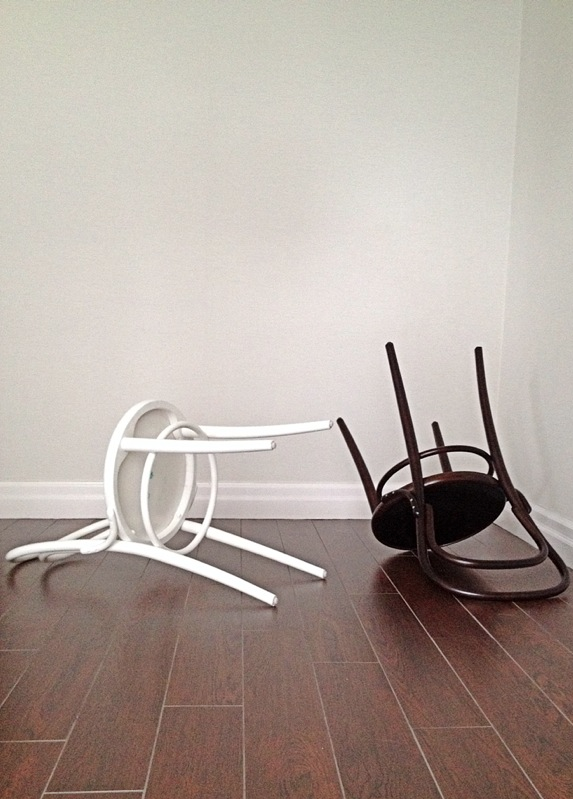
Two chairs facing towards each other could be the cue for a restaurant, a doctor’s office, a job interview, or any one of those undefined limbos where two people just sit and talk and keep sitting and talking that we’ve all seen and done, oh, about a million times.

If you’d like to change things up, take yourself out of your comfort zone, and you’re ready to break some chairs – uh, boundaries – let’s get started!

We Think In Pictures

Look at the examples below. What mise-en-scènes do you see? What relationships do the postive and negative space suggest?

Back To Back

Near & Far

Eavesdropper

Brawl New

Simply moving the chairs further apart changes the dynamic from cosy…

Face To Face

Citizen Kane NEW

…to Citizen Kane “breakfast montage” chilly.

Of course, one chair can also tell a story. And the possibilities multiply when you add a third chair to the mix.

You Are The Architect

Just as you have a relationship with your scene partner, you also have a spatial relationship with the stage, the chairs, the curtains, and any mimed objects that become part of your scene.

In Viewpoints, this is called “Architecture.” Architecture also includes light, shadow, and sounds.

How you interact with your Architecture is important. Do you sit up straight, knees together? Or do you kick back and splay your legs, manspread-style?

How does it feel to be in that physicality? Who is that person?

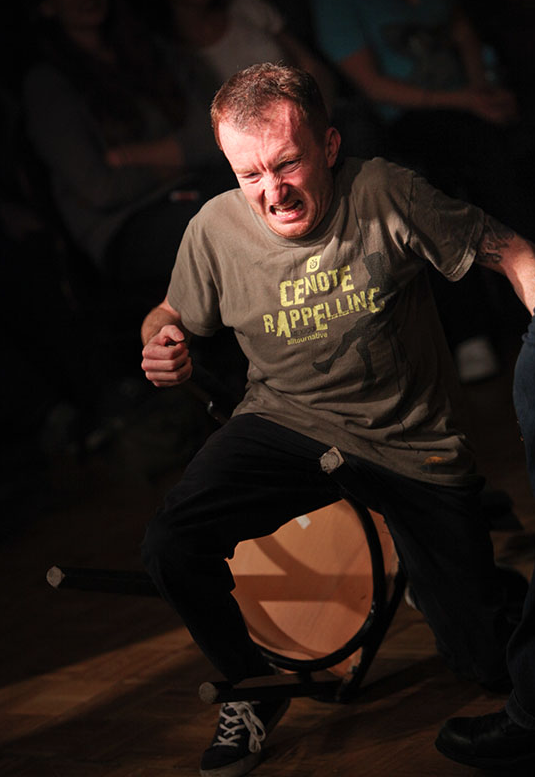
Lean on a chair with one arm and see how that affects you. Place the chair between you and your scene partner. Or pick it up and throw it (somewhere that it won’t hurt anyone).

“Your architecture is an emotional delivery system that lets you express yourself to the audience. It’s your voice. It’s an anchor.” – David Razowsky

Dean Buchanan and Don Gervasi improvised a brilliant scene for their Conservatory show about a cut-rate airline that crams in extra seats. They discovered the scene and their characters by placing their chairs close to one another at right angles.

Dean became a low-status passenger who spent the flight facing Don’s high-status business passenger. The intimacy it created and the resulting conversation were pure comedy gold. (After a particularly long, awkward silence, Dean broke it by saying “You have great hair.”)

Airline

Exercise: Walk With Chairs

My first Harold coach, Tom Vest, taught my team this exercise. It’s a great way to find a point of view and avoid pre-planning.

To begin, two people grab a chair each and walk around the space. The idea is to keep moving, not dawdle or linger too long in one area.

After a few moments, the Coach/Director says “Stop!”

The improvisers place their chairs down wherever they are. After a beat to see what the stage picture and their scene partner’s posture suggests to them, they start a scene.

You don’t have to sit; you can lean on the chair, stand beside it, put one foot up…whatever feels right in the moment.

Cameron and I did a show where we used this technique. When one of us wanted to edit a scene, we just picked up one or both chairs and placed them somewhere else on the stage.

Advanced Chair Work

As we’ve seen, just the slight repositioning of a chair can change the dynamic of a scene. Here are some ways you can use chairs to create different objects. Try them, or experiment with your own:

• as a wheelchair

• upside down on your head with the back of the chair facing forward to become Darth Vader

• place each foot on a chair and hold them as you lift your feet to walk; voila! instant stilts

• grab two chairs and flap them on either side of you for pterodactyl wings

Here’s a fun project for a lazy Sunday.

We have a ton of comedy ephemera we’ve collected over the years, but it’s just been sitting in a box. I decided to make this simple strip collage using programs from two of my favourite Second City revues, Live Wrong and Prosper and Dreams Really Do Come True! (And Other Lies).

I started by painting a piece of illustration board black (you can also paint cardboard or use black construction paper). I cut the two program covers into strips and glued them down with Mod Podge, or you can use any white glue. Then coat the final piece with glue to seal it.

I love the way it turned out! You can make a similar one with show flyers, posters, programs, or festival schedules. It’s a great way to showcase fond memories.

SC PhotoToaster

We were hoping Second City would release this one day! It’s the “Maya” sketch from their 50th anniversary, featuring Stephen Colbert, Steve Carell and David Razowsky.

Now if someone would just post the full video of Pinata Full of Bees

Screen shot 2014-04-10 at 10.16.55 AM

David Razowsky has a wonderful tool that he uses to teach about energy and duration of emotions in scenes. He calls it “The Jerry Chart,” and now there’s a YouTube tutorial courtesy of the Chicago Sun-Times so everyone can learn about it. Click below to view.

Oh, and happy birthday David!