Info

Posts from the Scene Work Category

How often have you heard “Be affected” by what your scene partner just said, or by what just happened?

Playing it cool and reserved in scenes is a go-to for many of us. And yes, it can be fun to play the straight man.

But as this genius tumblr, Reasons My Son Is Crying shows, it’s so much more hilarious when you let the world affect you.

“I don’t like comedy. I like funny things. I don’t like comedy. Like, comedy movies are just, ‘Oh Jesus.'” – Louis C.K.

I know what he means. I’d rather sit through a bad drama than a B-grade comedy any day.

Cameron and I often “overdub” movies, Mystery Science Theatre 3000-style.

We’ve made fun of Tim Robbins in Arlington Road. Adrien Brody in Splice. Even Gene Hackman in Heist.

What makes it funny is the deadly seriousness of the actor on screen. (And really, nothing’s funnier than an Oscar-winning actor in something really bad.) The more dramatic the film is supposed to be, the greater the opportunity for comedy.

“Sometimes things are really funny if you’re absolutely earnest. If you’re really serious, it’s hilarious.” – Christopher Walken

The funniest people I know are great actors. They may be improvising on stage, but they are also acting. It requires a level of commitment to the scene most of us don’t even aim for.

That’s not to say I don’t enjoy goofy improv sets; I do. But for me the biggest laughs, the shows that really resonate, inevitably involve great acting.

One of my favourite movie scenes of all time is Walken as Diane Keaton’s psychotic brother in Annie Hall. (If you haven’t seen it, click here to watch.)

He plays the part like it’s Requiem For A Dream, not a quirky romantic comedy. It’s such a small role, but his commitment to character makes it unforgettable.

Note Woody’s performance, too. Even though he calls out Walken’s character as a freak, he does so in a way that’s understated.

Colbert, Carell, Razowsky, TJ and Dave, Jason Mantzoukas, Steve Coogan, Bob Odenkirk…these people get laughs precisely because they don’t play the scene for laughs.

Subtlety, emotion, and vulnerability, while seldom seen on stage, are all things that elevate good improv to great.

For more inspiration, check out Real Actors Read Yelp Reviews. So many great ones, but #3, read by award-winning actor Brian O’Neill, and #4 by Greg Hildreth are faves. (Canuck improvisers: how much does Hildreth remind you of Jameson Kraemer?!)

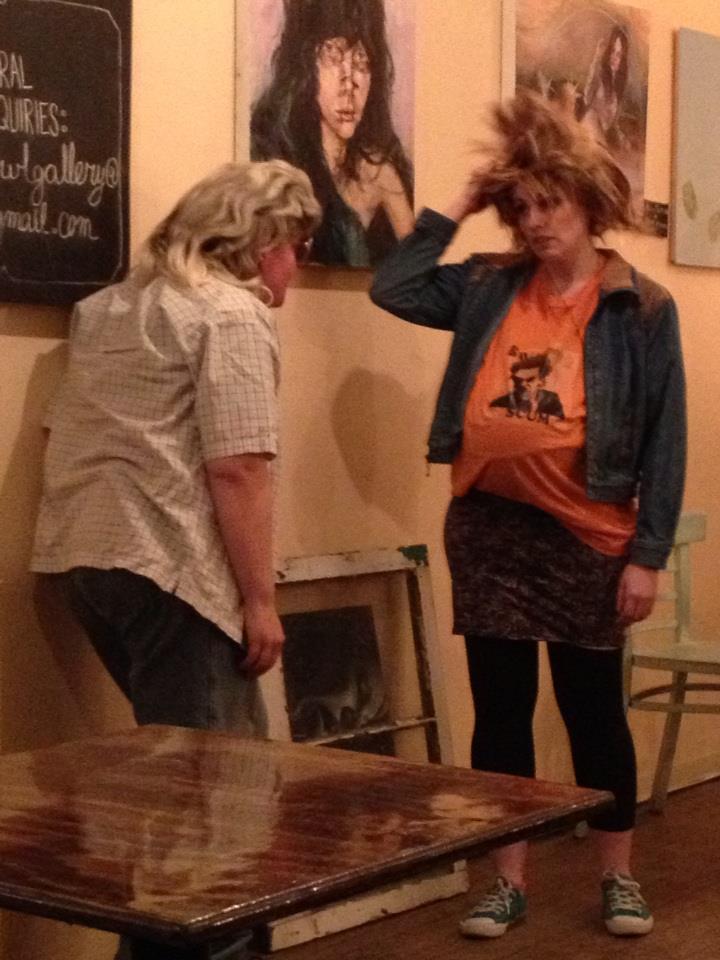
Last night some friends did an improvised version of Degrassi: Junior High. It was hilarious.

With a couple of cheesy wigs and some spandex, the performers had the audience in stitches. And it made me realise what a difference even a little specificity makes.

Sure, they were playing established characters. But it’s not like anyone remembered the original storylines.

What they had were the characters’ deals, or points of view, and a time period (the ’80s) as a backdrop.

5941_10152628393470134_1389934536_n

“Mr Raditch didn’t count on the four J’s: Joey Jeremiah in a jean jacket!” – Jason Donovan as Joey

Think of your favourite fictional characters, and you immediately picture their clothes, their favourite tchotchkes, and their environment:

• Dexter with his “kill outfit,” souvenir blood samples, and Miami bachelor pad

The Wire‘s McNulty and Bunk getting drunk, the omnipresent orange sofa, Omar with his gun, or Senator Davis’s trademark “Sheeeeeeeeit!”

• Don Draper in his razor-sharp suit, downing whisky at 10 a.m. in his hip ’60s ad agency

Any one of those details would add richness to an improv scene. Together, they create a world.

For more inspiration, check out Design*Sponge‘s feature called “Living In…” It’s a visual recreation of the objects from movies and TV shows.

Click on the links to see how they break down the things that make up Best In Show, Downton Abbey, and Bill Cunningham New York.

“Thinking is the enemy of creativity. It’s self-conscious, and anything self-conscious is lousy. You can’t try to do things. You simply must do things.” – Ray Bradbury

Karora

Rodin’s The Thinker is a powerful piece of art. But notice the posture: it’s downward, internal, closed off.

That’s great for contemplating quantum physics or dissecting Pearl Jam lyrics, but terrible for improv.

If you find yourself staring at the floor, or thinking about a scene, you’re in your head. So how do you snap out of it?

Start by breathing to get you back in touch with your body.

Jet Eveleth teaches an exercise that uses breath to reconnect you with your body and your character. Try it the next time you’re stuck on stage.

Inhale deeply and as you exhale, make a sound to accompany the breath. It could be “Aaaaaaaaaaah” or “Hhhhhuuuuuuuh” or “Whooooooooo” or whatever comes out spontaneously.

Use that breath and that sound to organically create your character’s response. For instance:

“Hhhhhhhhhhhow did you know it was my birthday?”  (delight)

“Aaaaaaaaaaaaaaa thousand tulips? You ordered a thousand tulips for our wedding?!” (shock/surprise/fear)

“Ffffffffffffffffffffuck, I burned the risotto!” (anger)

By feeling your response, you’ll avoid overthinking.


“I pretended to be somebody I wanted to be until finally I became that person. Or he became me.” – Cary Grant

This TED Talk is empowering, not just for improvisers, but for every…uh…body.

You’ve probably noticed when you take on a physicality that’s different than your normal one, your character takes on a life of its own.

I’ve propped one leg on a chair, resting my elbow on my thigh, and suddenly become Dick Cheney, a pirate, or a motivational speaker. What’s more, my character’s words flowed effortlessly.

It turns out there’s a scientific link between physicality and personality, as Amy Cuddy explains. You can even use it to boost your confidence in as little as two minutes (good to know if you’re nervous before a performance).

Click below to watch this fascinating talk. Thanks to Mike Riverso for sharing.

Silence is scary.

Silence between you and your partner.

Silence from the audience, punctuated by the dreaded cough.

This is when we usually resort to babbling. But if you can just breathe through it, nothing will give you more confidence than being comfortable with silence on stage.

Here are some exercises to bring out your inner Harpo.

Photo © Kevin Thom

Photo © Kevin Thom

Emotional Object Work

This exercise uses two performers.

One person does an activity they can repeat, e.g. folding laundry, or hammering wood.

The other person’s job is to say things to make that person react. But they can’t say anything; only show how they feel through how they do their activity.

For instance:

(Player 1 mimes chopping vegetables)

Player 2: I saw your ex, Linda, today.

(Player 1 starts chopping faster)

Player 2: She was across the street so I couldn’t talk to her.

(Player 1‘s chopping slows to normal)

Player 2: But then guess what? I ran into her again on the bus.

(Player 1 begins chopping furiously)

So now we know Player 1 has something going on with his ex.

Show how you feel through object work: try chopping a cucumber angrily, then happily, then jealously. And that’s just one activity. Imagine the possibilities with assembling an Ikea Malm dresser…

Variation

Every time Player 1 says something, Player 2 must find a new object in their environment and show how they feel through that object.

If they’re angry, perhaps they find a ball and squeeze it. If they’re happy, maybe they find a bubble wand and blow bubbles.

Third Wheel

This exercise is for, you guessed it, three players.

Two people ask for a relationship (married couple, best friends, co-workers, etc.), and begin a scene.

After they’ve established a conversation, the third person enters. He or she says nothing; the other two immediately stop talking. Everyone stays silent until the third person leaves again.

It might be parents talking about how they don’t have sex anymore, and a kid comes in to grab something from the fridge. Or maybe it’s co-workers planning to quit, and the boss comes in to pour a cup of coffee.

The third person should enter and exit at random, for anywhere from a minute to five seconds.

Catchphrase

The Coach/Director chooses two people, and asks for a catchphrase for each one. It can be anything from random sounds (“Sloopadeeoop!”) to a sentence that defines them (“Dudes gotta be dudes, dude”).

Each player can only say their catchphrase throughout the scene. Tone and body language will tell the story.

Clown Walk

This is a clown exercise we stole from Todd Stashwick. For this exercise, one person will be the clown, and one person will just be him or herself.

Both players begin by simply walking around the space. The person in front is just being themselves, walking their normal walk.

The clown walks behind them, mocking their partner’s walk, heightening and exaggerating it.

After a minute or so, the person in front suddenly turns and catches the clown in mid-mockery. They both stop in their tracks and make eye contact.

The clown reacts by being genuinely and sincerely sorry for what he or she has done.

Staying where they are, both players slowly turn and silently look at the audience. Don’t mug or play to the audience; just be as real as possible.

Repeat these actions twice more, with the clown’s mockery of his partner’s walk getting more and more absurdly heightened, followed by regret.

Then switch roles.

Upstage, Downstage

This exercise works on physicality, mime skills, and giving and taking focus. Oh, and audiences love it.

To begin, two people start a scene down stage. For simplicity, have the players stay seated throughout.

Once the scene has been established, two more people do a silent scene behind them, up stage.

The second scene should somehow relate to the first scene, but take place in a different environment.

For example, if the players upstage are roommates and they mention the neighbours downstairs, the other two can show us what those neighbours are like.

The players down stage should carry on with their scene, while the players up stage show us their world.

Unlike a split scene that takes place on opposite sides of the stage, both of these scenes should play out without pausing. There will still be give and take of focus however, since one pair is talking and the other is silent.

Viewpoints Exercise

Lastly, we asked improv guru David Razowsky for his thoughts on silent scenes. Here’s what he said:

All scenes have dialogue, even – and especially – scenes without “spoken” dialogue.

When you consider that scenes aren’t about what we say, rather they’re about how we say it, then the world opens up for you.

The first line of dialogue isn’t spoken – it’s noticed. I enter a scene and see you sitting, standing, moving, gesturing, and my first line is based on that; that’s how I cast you.

If we are truly in relationship to each other, then the words that come out of our mouths don’t matter. Any Viewpoints* exercise will highlight that.

I enter a scene and stop. You move somewhere on the stage in relationship to where I stopped. I move somewhere on stage in relationship to that.

We’re in the middle of a scene as long as we’re aware of each other’s “Spatial Relationship.” Our “dialogue” is not spoken text, rather it’s our movement toward and away from each other.

A major part of this exercise is to realize that your ego is going to want you to speak, that you can’t possibly be “interesting” because you’re not using dialogue.

That’s creating from lack and in communion with your ego, never a union that creates, always a union that keeps us in stasis.

This exercise requires you to not do anything to make anything happen: no unnecessary grunts or gestures or movements that aren’t based on responding to your partner.

You have everything you need – trust it.

A scene with no dialogue is the greatest expression of trust two or more actors can engage in.

* Viewpoints is an acting method that utilizes nine tenets:

• Architecture (Everything in your environment: light, shadow, sound, objects, the stage.)

• Spatial Relationship (The relationship you have with a person or your Architecture. You are in a spatial relationship with everything.)

• Shape (When you change your shape on stage, you change the scene and your emotion.)

• Gesture (Can be Expressive, such as a “Talk to the hand” gesture, or Behavioural, such as yawning or a nervous tic.)

• Tempo (The pace at which we do things; the speed or slowness with which we breathe, move, talk, stand.)

• Duration (The length of time we hold a shape, a tempo, a gesture, repetition.)

• Topography (Where you move on stage.)

• Repetitition (Of speech or movement.)

• Kinesthetic Response (A reaction, e.g. I drop something, you look. A door opens, you turn. I come towards you, you back off.)

To learn more about it, check out Viewpoints.


“Everybody’s talkin’ at me, I don’t hear a word they’re sayin'” – Nilsson

If the thought of doing a silent scene fills you with nightmare visions of Marcel Marceau, relax. You don’t need to chew the scenery, and not everyone has to be mute.

Even one silent character can steal the show.

Second City actor Jason DeRosse played a baby in a five-person scene. The other performers were hilarious, but the audience was riveted on Jason. He didn’t make a sound; just lay on his back looking wide-eyed and innocent, occasionally grasping a mobile overhead.

When I asked him about it afterwards, he told me “Strength in silence!”

If you want to strengthen your non-verbal muscles, the following exercises can help.

Photo © Kevin Thom

Photo © Kevin Thom


Music is a powerful emotional cue. Some of the most memorable scenes in movie history use music in place of dialogue:

• The shower scene in Psycho

The opening montage from Up    

The iconic slow-mo walk from Reservoir Dogs  

Rob Norman and Becky Johnson did a silent scene with music at Comedy Bar. The audience shouted out “colonscopy” and “Titanic.”

Mark Andrada cued the title song, and Rob and Becky played out a love story between doctor and patient that could only happen in improv.

Now it’s your turn…

Emotional Soundtrack

For this exercise, select two performers.

The Coach/Director plays a piece of music. It can be anything from Carly Rae Jepson to Jay-Z, from jazz to blues to hillbilly music.

The music sets the mood for the scene, which the players perform without words.

They can be sitting, standing, miming an action; it doesn’t matter, as long as there’s eye contact and a connection between the characters. Let the musical changes inform the action and reactions.

Try it with different kinds of music, with or without chairs.

You can also try adding sound effects.

Watch how sound effects heighten the tension (and hilarity) in this scene from Boogie Nights. (Yes, there is dialogue, but the tension is in the spaces between the words and sounds.)

Inside Voices

This is similar to the Gibberish Translation exercise, except the people on stage are silent.

To begin, choose four people. Two will be in the scene, and two will be Narrators. The Narrators stand on either side of the stage or rehearsal space. The other two ask for a location, then start the scene without speaking.

They can be sitting, standing, miming an action; it doesn’t really matter. The only rule is, no talking.

Allow the performers to settle in for 20 to 30 seconds, giving them time to get comfortable with their character and make eye contact with their scene partner.

One Narrator then voices a thought inside the head of the character closest to him.

The second Narrator then voices the other character’s thoughts.

Since all the dialogue is internal, the characters can’t hear what each other is thinking. For example:

Narrator 1: Look at Brad, sitting there all smug. What a d-bag.

Narrator 2: Cathy sure is pretty. I wonder if she likes me?

So we’ve established that Player 1, voiced by Narrator 1, is repulsed by Player 2. Meanwhile Player 2, voiced by Narrator 2, has a crush on Player 1.

From here, both the Players and Narrators can have fun ratcheting up the tension between them, since all of the thoughts – however outrageous they might become – are in the characters’ heads, while their outward appearance might suggest something else.

1 to 50

This exercise demonstrates the importance of tone and body language, and the unimportance of words when we communicate.

Two people start a scene, with or without a suggestion. Instead of words, they can only say numbers. The players take turns until they reach 50. For instance:

Player 1: One.

Player 2: Two.

Player 1: (quizzical) Three, four?

Player 2: (excited) Five-six-seven!

Notice how quickly we become emotional when we don’t have words to hide behind. In order to communicate your point of view, tone and physicality become much more important.

Good Morning Fucko

This exercise is great fun to watch and play. The Coach/Director may side coach, in order to keep players focused on responding to each other, while maintaining their own point of view.

To begin, place two chairs close to each other, facing the audience. This will be the bed.

Two players lie back in the chairs with their eyes closed. They silently choose a deal, or point of view, for themselves as they “sleep.”

After 10 or 15 seconds, the Coach/Director says, “Good morning, Fucko.”

Both people wake up, in character.

The scene plays out silently, as the performers discover where they are, and who these characters are to each other.

Are they married? Roommates? Was it a one-night stand?

Remind players to check in with each other as they go about their day.

Don’t race through activities. If your character makes the bed, don’t just flip the covers and walk away – unless that’s how that character makes a bed.

If you step in the shower, turn on the taps. Then grab the soap. Does it have a hair in it? Ewww. Find the shampoo, and so on.

Or maybe you skip the shower and find yourselves sitting across the table having cereal.

What is the vibe between you? That’s the scene.

(Thanks to Todd Stashwick, Adam Cawley, Rob Norman, Jason DeRosse, Susan Messing, Tom Vest, Greg Hess, and David Razowsky for their help with this post. Stay tuned for more exercises in Part Two.)

“Symmetry looks good to us; we want more of it.” – Susan Messing

Mirroring is a fast and powerful way to connect with your scene partners and, oh yeah, impress your audience.

Photo © Kevin Thom

Photo © Kevin Thom

When Mansical performed at Comedy Bar recently, I couldn’t attend, but Cameron described it for me after the show.

In one scene, a player stepped forward and did a simple dance move. He was joined by another player, who did the same thing.

A third player stepped out and did a different move. He was joined by someone who mirrored him.

The two “pairs” continued to move to the accompanist’s music, timing their actions with both their own scene partner, as well as the other pair.

As Cameron acted out both duos’ movements, I pictured the great “routine” they created.

The next day, a friend who saw the same show described the “choreographed dance number.” When I told her it was improvised, she was amazed.

Cameron and I are your typical white-bread-and-mayo kind of dancers. But when we get on a dance floor, we mirror each other, and suddenly even the weird, angular, and bizarre moves look, well, better.

Two of just about anything looks better, as Jimmy Fallon and Michelle Obama’s Evolution of Mom Dancing video clearly illustrates. (If you haven’t seen it yet, click on the link to watch.)

And more than two people is even better, if you work together and give and take focus.

You can use symmetry to establish group mind, create a dynamic stage picture, or just get out of your head. Try it in your next opening, group game, or two-person scene.

Photo © Kevin Thom

Photo © Kevin Thom

“When we tell a story in cinema, we should resort to dialogue only when it’s impossible to do otherwise. I always try first to tell a story in the cinematic way…” – Alfred Hitchcock

TV has a reputation for just being “talking heads,” while film tends to be about motion and emotion. Canadian filmmaker Deepa Mehta first made me aware of this, and it trained me to study the various techniques in each medium.

Photo © Kevin Thom

Fortunately, in improv we have the flexibility to do whatever kind of scenes we like; we’re limited only by our imagination.

Thanks to the miracles of scene painting, mime, physicality, placement of chairs, verbal and physical sound effects, we can recreate the special effects of Spielberg, the scoring capabilities of Danny Elfman, or the panoramic cinematography of Ang Lee.

The more supportive your scene partners, the more immersive the experience can be.

I saw a set where Matt Folliott and Isaac Kessler lifted their scene partners and moved them around on stage to create a Matrix-style mid-air gunfight in slow mo. I can only imagine how exhausting it was for the lifters, but the audience was spellbound.

(For a master class in movie-inspired improv, go see Anthony Atamanuik and Neil Casey’s genius Two Man Movie at UCBT in New York. What they accomplish in 30 minutes is as mind-blowing as it is hilarious.)

Improv scenes that more closely mimic television are also fun, both to watch and perform.

Sitcoms like It’s Always Sunny In PhiladelphiaLouiePortlandia and The Office feature simple, often banal locations juxtaposed with great characters, dialogue, and physicality. Take away the location and props, and what you’re left with is comparable to a solid improv set.

Some improv shows are purposely built around one construct or the other. Back To The Future: The Improv Show takes its cues from the film franchise, while Channel 5 Action News is modelled after a news program, complete with commercial breaks.

If you find your improv has hit a rut – maybe you’re doing the same form every week and it’s feeling stale – try experimenting with film or TV techniques.

For inspiration, go to the movies or borrow a box set from friends. (Now’s your chance to finally see The Wire, Battlestar Galactica or Breaking Bad.)

Or just look through your own collection. Study your favourite shows and films to see what makes scenes resonate.

Watch how Scorsese uses freeze frame with narration in Goodfellas. Notice the way Mr Show uses organic edits to move from sketch to sketch.

Then steal it for your next set.