Info

Posts from the Guest Posts Category

Amy Shostak is a kickass improviser and the Artistic Director of Edmonton’s legendary Rapid Fire Theatre. She has performed across Canada, the US and Europe. She also created Kiss My Bus, a play literally performed on a bus for the Edmonton International Fringe. A graduate of the University of Alberta, she loves heavy metal and naps.

In a whimsical turn of events, I was given the power to curate a comedy festival. I get to hand-pick people that I deeply respect, people who inspire me, people who I have never met but love from afar, and give them an opportunity to do what we all love. Not to get all mushy, but it fucking slays.

Improvaganza is in its 13th year, and this will be my third time organizing it. Our guests vary from a few celebrities, to relative newcomers, to old favourites, to innovators. But no matter who comes to our festival, the focus is always on showing our guests a good time. And by “good time” I mean to say, we aim to make the festival fulfilling. Fulfilling socially, professionally, and artistically.

I don’t think Improvaganza is perfect, but I am darn proud of it. From my experiences travelling to other festivals around the world (some enlightening, some awful), I have thought a lot about what makes a festival enjoyable. Here is some advice for festival organizers that I think will launch your fest from zero to hero.

1. Have someone you like pick your guests up from the airport. There is no excuse for lost guests. Especially adorable international guests. So, do yourself a favour, and arrange a ride for them from someone you trust and find socially tolerable. No one likes weirdos, not even desperate artists. For an added bonus, have every driver take your guests by the theatre before taking them to their hotel. Once at the hotel, have your driver go into the hotel with them to make sure they check in without incident.

2. House all your guests together. If possible, have your guests stay all in the same place. This creates a sense of community. Billets can be fine, but hotels are better from our experience. If you do billet, make sure no one is abandoned in the suburbs.

If possible, pay for your guests’ hotel. This is a big chunk of change that you can cover with a decent sponsorship. Our sponsored hotel isn’t even nice – it’s on top of a blues bar, and can be described as rustic at best, sketchy at worst. Despite this, the staff at the hotel is super accommodating to our requests, all of our guests stay on one floor (which allows for fun, camp-esque door-knocking) and we are allowed to party in the hallways til 6am. It works for us.

3. Make your guests feel special. Go that extra mile, whatever that means to you. At Improvaganza, upon arrival at the hotel, guests find a six-pack of beer on ice in their sink, a full calendar of events (shows, workshops, social), contact info for important people, an embroidered Improvaganza towel/pillowcase (as I mentioned, sketchy hotel), coupons and gift cards for local restaurants, a map, and a festival pass.

4. Be there and be nice. Have a present and approachable staff. There’s nothing worse at a festival than not being able to get in touch with whoever’s programmed your show, or not knowing who they are. Worse, is being scared of them because they are jerkish. Guests should feel able to ask you for whatever they need: a tech rehearsal, a weird costume request, emotional support, a quiet place to work, anything. Your presence and availability will make your festival better.

5. Program Mixer Shows. Give your guests a chance to perform together – jam shows, experimental concept shows, ensembles – all these things are a great way to give more performance opportunities to your guests outside of their showcases. As obvious as it is, many festivals do not have these at all, or they don’t have enough of them.

6. Give your guests things to do. Care needs to be taken when it comes to the social schedule. If you program nothing, people will want to drink in your theatre every single night because they know no other alternative (which, if you’re providing free beer can become problematic). On the other side of the spectrum, if you program too much, there will be a guilt factor when your guests cannot keep up with you. Emphasize the planned activities are optional, and try to get a few key party people behind them.

In terms of what to program, we recommend: nights at bars with sponsored food and drink specials, or nights that feature your performers (maybe one is a DJ – set them up at a local club, or if you have a house band – get them gigs around town during your festival). Local experiences are good too:  your art gallery, cultural landmarks, etc. We have a barbeque at our GM’s acreage every year – which is one of the highlights of the festival. It is an all-day affair and includes hot tubbing, a poker game, bocce ball, soccer, and getting blotto. Rule of thumb:  if you genuinely think your social calendar is cool, other people will too!

7. Find Work/Party balance. For each of our visiting guests, we offer professional development workshops during the day. These workshops help make the festival full for its participants. They are led by world-class instructors, on a variety of topics. My hope is that when you leave our festival, you feel that you have some new ideas or exercises to take back to your respective cities, so our festival is fulfilling professionally and artistically, as well as socially.

8. Pay people. Ideally, a festival should pay performers. Realistically, a festival should try to make sure performers don’t lose money by being there. I know paying performers is impossible for some groups, but I dream of a day where people don’t have to shell money out of their pocket to come to our festival. We are not completely there yet, but we are getting there. If you can get your guests to teach workshops for other improv groups in the city, do paid corporate gigs, or offer them travel honourariums from public funding or corporate sponsorship, then you are moving in the right direction. If you are making money on box office, your guests should be seeing results… in their pockets.

9. Fill your house. Occasionally, a troupe from Rapid Fire will come home from a festival and say, “It was fun, but we only had eight people at our showcase.” Infuriating! How is this possible? It is not the international group’s job to do their own marketing and promotion. It is the job of the festival organizer. If there are eight people at a show, you have failed. Especially if they are all improvisers. If you can’t fill a house for a visiting troupe, then maybe you are running too many shows, your festival focus is too broad, or you need to seriously rethink your marketing.

10. Prove you’re legit! If you’re a performer in addition to an organizer, make sure you have an opportunity or two to perform at the festival, or at least your company does. Your guests will be curious to see you perform, and, the harsh truth is, it will add legitimacy to your festival if your company’s performances are also good.

11.  Please don’t complain. Whatever it is. A showcase bombs. Someone needs to go to the emergency room. People get in a fight. Do not complain during your festival. Do your best to fix what’s gone wrong, and continue on. Save your negativity for a festival post-mortem with your co-producers, but never let the ire take over in front of guests.

12.  Take care of yourself. A happy organizer breeds a happy festival. I can only speak from my experience, but leading up to IMPROVAGANZA, I like to take a few nights off drinking, sleep more than usual, and stock my fridge with Gatorade. The last thing you should do is get sick at your festival, or worse, be cranky. And, when your festival is done, take a vacation! You deserve it!

Photo © Improvaganza

“Conflict is the essence of drama.” – Aristotle
“Conflict is not the essence of drama. Agreement is the essence of drama.” – Del Close
“My head hurts.” – improv student

Conflict.

Some improvisers love it. Others run from it.

In most performers’ minds, the word “conflict” suggests that characters should disagree or fight.

Most discussions about conflict tend to generate their own conflict: Is it necessary? How does it get started? How do you avoid it? Should it be based on what the story needs or what the characters want?

In order to get a better understanding of conflict, let’s begin with the “Today is The Day” scenario that’s often taught.

Often teachers will frame scene work with the view that “Today is the day things change for your character…a scene should be about a life-altering experience.” Scenes that follow will be inherently interesting because we see the character in a new light.

After all, how exciting can it be to watch a character do the same thing they always do?

We want to see a character finally stand up to his boss, declare his love, get a divorce, get a job, get fired…anything to break the routine.

And I don’t necessarily disagree with this so much as I disagree with how it is handled.

For one thing, anytime you use the word “should” in an improv context, you (inadvertently) set up expectations. (A scene should be about…)

In the rush to get to a life-altering experience, performers get so caught up in the theory that something needs to happen, that they miss out on what already is happening.

Before we focus on “Why is this day different than all the others?” what if we asked “Why is this day the same?”

Life-altering often seem less life-altering when we haven’t even established the life that is getting altered.

When we place more importance on what needs to happen than on appreciating what is happening, we lose touch with an awareness of ourselves in our experience.

And when we lose touch with how we feel about what’s going on, we start to guess. Or calculate what “should” happen. Rather than be ourselves and play from a truthful place, we make choices based on our opinion of what’s best for the scene.

In order for a scene to be interesting, it really helps for the improviser to be interested in what they are doing or what is going on. If they aren’t, then why would the audience be? When an improviser believes in the moment, they open themselves up to transformation, revelation, movement, resolution, agreement, and breaking of a routine.

These events are sometimes referred to as “tilts.”

A tilt can change someone’s status or even change the balance in a scene without conflict.

As long as you are invested in the moment, there isn’t any need to introduce or create conflict. The pressure you place on yourself to find the conflict will remove you from your scene.

As a result, you are no longer inside the scene, but outside of it.

If you construct conflict in order to create a scene, then you are constructing rather than behaving.

Just be.

If that’s not enough, be more.

When in doubt, raise the level of need for your character. If you get lost in the scene, it’s because you’re not in character. Dig deeper into how you feel about what you are doing, or how you feel about what is going on and allow it to inform you.

You don’t need to CREATE conflict; your character needs to need.

Other characters have their own needs, therefore conflict will ensue whether you want it or not.

“Conflict is inevitable, but combat is optional.” – Max Lucade

Steve Hobbs is a wicked smart improviser and an old soul. If you need proof, just read this post. He’s a member of the indefatigable Harold team El Fantoma, the indefinable Jenkins Syndrome, and is a featured player in Pondward Bound’s duos night.

Hi, I’m Steve, and I’m dedicating this blog to a man who doesn’t think he’s read anything good today.

I’ve had an improv-related mental itch that’s needed scratching for a while, but have had a lot of trouble figuring out what it was or how to scratch it. You know what I’m talking about: a real thorn in the brain-paw, something I couldn’t quite get my head wrapped around.

The closest I’ve come to phrasing it is, “How did we/I just do that?” For all the moments where that amazing scenic moment happened effortlessly, or when the audience loves something you’re/I’m/we’re doing when it literally feels like it’s a non-move that’s being made, that question gets asked on some level.

Yeah, we know principles of good scene work, techniques, having a point of view, being “in the moment,” and we learn what works from experience and understanding, and for all remaining occasions those moments commonly get written off as the audience’s energy…but personally? I still ask that question.

There are still moments that don’t add up, and still people that will love how lost in that character one of us was when sometimes it didn’t feel like we were that lost in a character at all.

Am I crazy? Are some of these observations justified? What’s happening in those moments that you can only see from the audience? What am I missing?

It was finally laid out plainly for me (through the most seemingly unrelated scenario possible) when I was playing a 10-minute duo set last week, and found myself in the classic pre-show position of having to take a huge dump (ladies, please, hold your applause).

There was no time, I put it out of mind, and soldiered on. It was a fun set; I performed with a player pulled lottery-style from the audience, we both made some moves (intimate prison cell guard vs. inmate about-to-be-released relationship), and sure enough, I ended up taking some focus to “drop a deuce” in the corner of my cell like a good little bran-filled inmate.

Now, this in itself wasn’t too unusual for me, and I didn’t think twice about it at the time. I’ve become all too familiar with sets becoming affected by topics shuffled around pre-show. In fact, it’s uncanny how in a four-set night, the first group having the over-the-top baby-birthing scene will produce at least two subsequent sets with heavy baby emphasis. Uncanny, but typical as hell. I talked about pooping, I pooped while in character, I went on with my day. So what?

So this: when I got off-stage and the intermission came, I was completely empty. There was no round in the chamber, the kids were unavailable for the pool drop-off, the turtle had defied aquatic science and was no longer in the shell somehow. “Large intestine? Cancel my one o’clock”. Totally empty, totally satisfied. That’s not normal for me, or anyone, I think.

Now, with respect to the average person’s intelligence, I’m not suggesting that my colon became some magical gateway to another universe’s toilet, or that my asshole is the Matrix and that particular load realized there was no spoon and woke up in the asshole of the real. This article isn’t (supposed to be) about poop.

What I’m saying is, this realization brought me face to face with an entity that I have a lot of trouble perceiving, and is frequently danced around while left unidentified in my own improv equations. What am I talkin’ ‘bout Willis? I’m talking about my/the unconscious.

Having taken psych classes and group-dynamics training as a camp counselor, I’ve known for a few years that a) the unconscious mind isn’t supposed to be perceivable (memory and sub-conscious recall memory recall fits into the “pre-conscious” in Freudian models), and b) one of my most difficult challenges has been learning to perceive the things I don’t know I’m doing that others can already perceive. (Take a gander at the Johari window for a crash course in that perception relationship.)

image courtesy Wikimedia Commons

In fact, I made it a goal of mine to spend the last few years coming to better understand and harness those intricacies in general. But I hadn’t previously considered that, with regard to show tendencies and perception, it’s possible the difficult-to-perceive thing coming through is my unperceivable unconscious mind (which explains a lot, and may or may not have let me poop without pooping)!

Is that what’s being seen? Is my unconsciousness making subtle moves on stage that my conscious isn’t registering? It’s like being Bruce Banner and finding out that Hulk has been taking chemistry classes while I’ve been dreaming. “Have I been sleeping later? Have I been Hulking out longer and longer?”

It fits though – we go to improv school and get trained in all these techniques and skill sets (callbacks, dialogue patterns, scene structuring, thematic work, even “Yes and” etc.), hoping to imprint it so we don’t have to think about it (arguably accessed through the pre-conscious), and meanwhile, what do we value most in longform scenework? Affecting each other. Discovery. Relationships. Truth in comedy. Things that aren’t pre-thought out, and shouldn’t be (formula can be cancer in these moments if it undercuts commitment to the moment).

In a world where we’re trained to both make choices and have points of views while truly reacting in the moment, maybe it’s the sincere presence of the unthinking unconscious in these characters/moments that makes them powerful.

Now, I’m not the first person to write about art and the unconscious, and don’t profess to be an expert on the topic, so I’m going to try to steer clear of getting further nerd-booky and technical with all of this. I can only speak to my own unconscious, and mine freaks the shit out of me.

I could be wrong, but I’m pretty sure the “id” lives in there, which means mine is selfish, and makes me want to punch enemies arbitrarily, and cheat on my girlfriend, and scream out during a school assembly as a kid because it’s too quiet, and be late for every event in my life, and fight bears for fun, and not care about anything, and a million, much more horrible things (these aren’t things I go out and do*, but they’re in there). If I let every scene run wild with unconscious, there’d be a lot of offended, unhappy audience members.

And I’ve had that moment of asking “how can this chaotic, compassionless beast be the missing part of the equation?” I mean, even if these impulses are the interesting, reactionary character elements that help make scenic moments great, there’s a bittersweet taint to it. Not just from needing to rely on part of yourself that’s largely un-fake-able and unquantifiable, but from selfish, consciousness-loving pride.

Consider for a second that the part of you that’s trying to make moves and be amazing – hell, the part of you that learns – could be doomed to come second place to the part of you that isn’t.

Realistically, I’m sure it’s a marriage. Just like the fun iO West team-dynamic discussion of teams balancing out highly structured robot players with highly impulsive pirate players (and silent credit-less ninja thinkers of course), a balance between the unconscious and consciousness in scenes is the best route to goodness.

I’m not sure what the balance is (is training just conditioning for the unconscious, or a series of filters?), but I know it’s there. I’ve done my best to look my own unconscious in the eye, and I think we’re coming to terms…though factoring in my frequent lateness, un-wake-able dreams, constant impulsive behaviour, and recently acquired ability to mentally cancel shitting, I’m pretty sure it’s a juggernaut and wearing the pants in this mental relationship.

Oh well.

HULK SMASH.

*I may or may not fight a bear in my lifetime. I might actually go out and do that one.

Photo © Becky Feilders

Tom Vest has been improvising in Toronto since 1997. As one of the admins of the TJ & Dave fan page, he has been dubbed the “Official Overlord of the Electronic TJ & Dave Empire” by TJ. 

I’ve been a fan of TJ & Dave for a few years now, and yet for the life of me I can’t remember when and how I first heard about them. It must’ve been around 2004 on the “yesAND…” forum boards. The discussion was probably something like “Best Improviser(s) in the City.”

In those days I was even more dedicated to unravelling the mystery of improv and all its secrets than I am now, so when I came across the comments on why they were so good, I was intrigued. It wasn’t long after that I went to their Myspace page (yes, 2004 seems about right) and purchased a few of their shows on DVD. They were everything people had said they were.

When they came to Toronto for a workshop and show, I was asked to pick them up at the airport. Some people thought I did it so I could ask them a bunch of improv questions, but the opposite was true. I picked them up so they wouldn’t have to talk about improv at all. I can’t imagine anything worse than having to travel to another city, only to get trapped in a car, answering questions about improv the whole way.

Instead, we talked about the details of what was right in front of us: the outdated decor of the waiting lounge, the parking lot and its confusing enter/exit lanes, various sights on the way in to Toronto. David admired the wind turbine at Exhibition Place and was very outgoing, while TJ was more quiet. They were both pretty laid back and fun to talk with.

When it was time for them to leave a few days later, I drove them back to the airport. This time the conversation went all over the place. It felt a bit like doing a three-person set, only no one was watching.

Last summer I performed with my group The Seedlings at the Del Close Marathon. On my last day in New York, I was walking down Fifth Avenue towards the Flat Iron when I spotted David about to enter a coffee shop. My mother and brother were with me, and they continued walking as I stepped over to say Hi. When I called his name he turned around and recognised me right away, to my relief. It’s always fun to run into people, but he seemed genuinely pleased to see me in a way you don’t encounter often.

We talked briefly before I mentioned I was on my way to the airport, and had come to the city with my mother and brother. Immediately David wanted to meet them, so we went over and I introduced everybody. We’d gone to see him perform with TJ the night before at the Barrow Street Theatre, and it was probably the best 50 minutes of improv I have ever seen. My mother and brother both liked it, and had fun talking about their favourite moments after the show.

Without doubt, David has a unique way of paying attention that makes you feel like you are really being listened to. It’s a really genuine way of relating to another person, and something that’s very rare. To take time to meet my mother and brother wasn’t something he had to do, but he has a way of making you feel like he has all the time in the world for you.

I came away from the encounter wanting to have that kind of “availabilty.” To be more open, genuine and considerate. It’s qualities like these that help to make a TJ and Dave show what it is, and I don’t think they could do it on stage if they weren’t like that in real life.

When they returned to Toronto for a show at Second City, they both spotted me in the line-up and came over to talk. After the show TJ invited me out with him and David, and we went to a local bar where we talked about a variety of things. For such funny guys, I really like how there is no “ON” button. The conversation may be funny, but nothing is ever forced and the easiest thing I found was just to “go with.” (TJ also paid for my 7Up before I even knew the bartender had asked. You’ve got to be alert with these guys!)

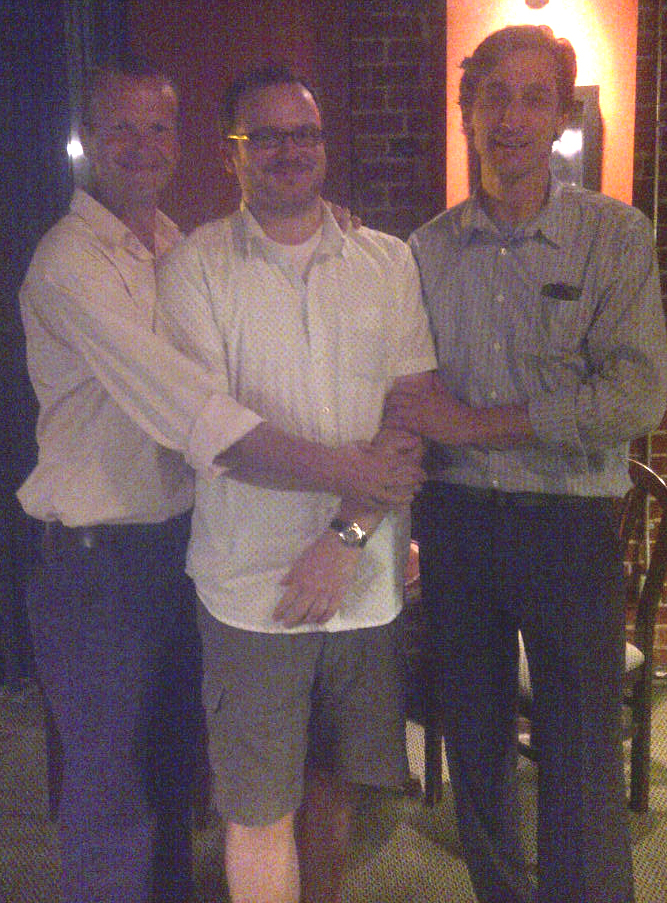
Before the night was over, we got a picture of the three of us, and while there may be a story behind it, that’s one I’ll keep to myself. : )

Tom James Vest

TJ, “TJ” and Dave

Julian Frid is an aficionado of the art of improv and the founding member of Sex T Rex. He’s performed on stages across North America, and is a student at U of T, focusing on the structure and cognitive effects of storytelling, specifically in film. He is proud to say he consistently pays improv teachers good $$.

Teaching improv at U of T, I’ve encountered many people who want not so much to be improvisers (in the sense of going onstage to improvise regularly), but to use the tools of improv to hack social sitches.

Does this work? Debatable. I don’t see the “after,” just the “before,” but improv games tend to loosen people up and teach all those Batmans out there to consider the question “Why so serious?”

The greatest thing I think these classes teach is respect for creative (weird) people. Teaching the course, I can see the status shift from being closed off and knowing what is “good” and what is “not.” At the end of eight weeks, these people wade into scenes and give their fellow performers wide-eyed attention. It brings out the child in them, though I’d never tell them that outright.

These students are less concerned with comedy than with possibilities of game, of exploration, and getting to do what they’ve always wanted to do. I had a student who loved the idea of opening up a closet and having a live bear inside. This was a frequent but hilarious occurrence.

For students like this, improv is a novelty. As an improviser, and after watching a fair amount of improv over five years, I wonder how much of a novelty it remains for some, when all we see is people and chairs.

Depressing? Hopefully not. After examining and practising an art like improv, one, even though they may not be able to articulate it, gains a nuanced and elemental understanding of the art. How to move the people and the chairs to make the most entertaining arrangement or dynamic possible.

Good film is best when it remains good even when muted. This is because elementally, film is images moving on screen.

Improv is elementally people with chairs. Our whole life is people with architecture, furniture, navigating and using these spaces. Improv requires exploration.

Photo © Joe Pack

Josh Bowman is a professional fundraiser, storyteller, comedian, improviser, and blogger. He also writes for tenthingsivelearned.com, The Huffington Post, The Good Men Project, and improvises around Toronto, including regular shows with Opening Night Theatre and Surprise Romance Elixir, and when he tricks other better improvisers into performing with him.

Note: Any scene can be terrific if it’s played enthusiastically and intelligently, but generally when I see players initiate any of the scenes below, it doesn’t end well. PS: I’ve done most of these myself. Blergh to me.

  1. A married couple arguing because the husband came home late from work. He was likely having beers with “the guys”
  2. People just arguing in general for no apparent reason
  3. Somebody teaching somebody else how to be cool
  4. Any combination of two or more of the following: robots, pirates, vampires, Jesus, explosions, time travel, a funeral
  5. Somebody on the toilet sitting beside somebody else on the toilet, talking about toilets
  6. People waiting for the bus
  7. “This is the best (blank) ever!!”
  8. Somebody calling somebody else fat/ugly, and helping them be prettier
  9. Too much talking
  10. Scenes where people keep saying “I don’t understand!” “I don’t know what’s going on here!”