Info

Posts tagged improv scene work

“Symmetry looks good to us; we want more of it.” – Susan Messing

Mirroring is a fast and powerful way to connect with your scene partners and, oh yeah, impress your audience.

Photo © Kevin Thom

Photo © Kevin Thom

When Mansical performed at Comedy Bar recently, I couldn’t attend, but Cameron described it for me after the show.

In one scene, a player stepped forward and did a simple dance move. He was joined by another player, who did the same thing.

A third player stepped out and did a different move. He was joined by someone who mirrored him.

The two “pairs” continued to move to the accompanist’s music, timing their actions with both their own scene partner, as well as the other pair.

As Cameron acted out both duos’ movements, I pictured the great “routine” they created.

The next day, a friend who saw the same show described the “choreographed dance number.” When I told her it was improvised, she was amazed.

Cameron and I are your typical white-bread-and-mayo kind of dancers. But when we get on a dance floor, we mirror each other, and suddenly even the weird, angular, and bizarre moves look, well, better.

Two of just about anything looks better, as Jimmy Fallon and Michelle Obama’s Evolution of Mom Dancing video clearly illustrates. (If you haven’t seen it yet, click on the link to watch.)

And more than two people is even better, if you work together and give and take focus.

You can use symmetry to establish group mind, create a dynamic stage picture, or just get out of your head. Try it in your next opening, group game, or two-person scene.

Photo © Kevin Thom

Photo © Kevin Thom

“When we tell a story in cinema, we should resort to dialogue only when it’s impossible to do otherwise. I always try first to tell a story in the cinematic way…” – Alfred Hitchcock

TV has a reputation for just being “talking heads,” while film tends to be about motion and emotion. Canadian filmmaker Deepa Mehta first made me aware of this, and it trained me to study the various techniques in each medium.

Photo © Kevin Thom

Fortunately, in improv we have the flexibility to do whatever kind of scenes we like; we’re limited only by our imagination.

Thanks to the miracles of scene painting, mime, physicality, placement of chairs, verbal and physical sound effects, we can recreate the special effects of Spielberg, the scoring capabilities of Danny Elfman, or the panoramic cinematography of Ang Lee.

The more supportive your scene partners, the more immersive the experience can be.

I saw a set where Matt Folliott and Isaac Kessler lifted their scene partners and moved them around on stage to create a Matrix-style mid-air gunfight in slow mo. I can only imagine how exhausting it was for the lifters, but the audience was spellbound.

(For a master class in movie-inspired improv, go see Anthony Atamanuik and Neil Casey’s genius Two Man Movie at UCBT in New York. What they accomplish in 30 minutes is as mind-blowing as it is hilarious.)

Improv scenes that more closely mimic television are also fun, both to watch and perform.

Sitcoms like It’s Always Sunny In PhiladelphiaLouiePortlandia and The Office feature simple, often banal locations juxtaposed with great characters, dialogue, and physicality. Take away the location and props, and what you’re left with is comparable to a solid improv set.

Some improv shows are purposely built around one construct or the other. Back To The Future: The Improv Show takes its cues from the film franchise, while Channel 5 Action News is modelled after a news program, complete with commercial breaks.

If you find your improv has hit a rut – maybe you’re doing the same form every week and it’s feeling stale – try experimenting with film or TV techniques.

For inspiration, go to the movies or borrow a box set from friends. (Now’s your chance to finally see The Wire, Battlestar Galactica or Breaking Bad.)

Or just look through your own collection. Study your favourite shows and films to see what makes scenes resonate.

Watch how Scorsese uses freeze frame with narration in Goodfellas. Notice the way Mr Show uses organic edits to move from sketch to sketch.

Then steal it for your next set.

Photo © Keith Huang

Photo © Keith Huang

Quick!

Think of your favourite improv scene ever. (If that’s too hard, the best one you’ve seen recently.)

Whether it featured a couple of co-workers, conjoined twins, or the Ikea monkey and his Mom, I’ll bet dollars to donuts it wasn’t about a “special day.”

Many of us were taught every scene should be “Today is the day that…” Unfortunately, that can lead to forced or clichéd scenes.

“Today’s the day we’re finally going to get married!”

“Today’s the day I quit my job to become an astronaut!”

“Today’s the day I win the Nobel Peace Prize!”

Any of these scenarios could turn out to be great. And there’s nothing wrong with making a huge offer at the top of the scene. But there’s also nothing wrong with starting small and finding the “what” along the way.

And if the what turns out to be nothing more than discovering a woman has married an exact carbon copy of her shouty father (as happened in one of my favourite scenes), that’s just fine.

“Be so believable it hurts. Don’t just play the idea of the scene. Dive deep into the scene. The relationships are what’s important. Simple scenes are all you need; it doesn’t have to be ‘about’ something.” – Greg Hess

If you can get your hands on a copy, watch TJ and Dave’s show entitled Before The Party. The entire 50-minute set revolves around two guys getting ready for some kind of shindig.

We never actually find out what happens at the party. Who cares? It’s all about these two characters, from their music choices to their fear of failure with women.

The more you focus on what’s happening right now, the more we’ll lean in to learn more.

Jason Mantzoukas’s one-man Hermit show (described here) is another great example. While it did turn out to be an unusual day, he didn’t start by declaring that right off the top.

Instead, the scene built to a climax slowly and methodically. And how much more powerful was it because the audience discovered the “what” with him?

When you’re fully present and immersed in what’s happening on stage, you’ll create something people remember – because they experienced it too.

Photo © Kevin Thom

Photo © Kevin Thom

We’ve all seen shows where someone decides to use a real prop on stage.

It’s usually small, like coins or a cell phone. And once it’s introduced, everyone tends to fixate on it: the players, as well as the audience.

I’ve seen seasoned performers kill it with props, but more often, props kill the scene.

Props work well in shortform games, like the one from Whose Line Is It Anyway? If everyone knows up front that they’re part of the show, the results can be frickin’ hilarious.

But using props in longform tends to throw players and audiences off a little. When everything else in the scene is imaginary, bringing in something real is a bit like shining a light on shadow puppets. The magic and mystery disappear.

Besides, as I’ve learned from writing for radio, it’s way cooler to let people imagine their own version of your world.

Of course, there are exceptions, and the photo above is one example.

Revel Theatre hosted a show recently where there happened to be books and a table on stage. Kevin Whalen literally stumbled on his character. When the lights went up he stumbled a little, and reached out to steady some books that were falling.

“Sorry! Soooooorry!”

His character was born in that second, when he organically reacted in the moment. Kevin’s scene partner, Reid Janisse, endowed him as an author.

As the scene progressed, Kevin alternated between haughty high status befitting a new author, and the grovelling apology he established in the first few seconds.

The scene worked, for two reasons:

1. Kevin didn’t decide to incorporate books into the scene. The prop more or less incorporated itself by falling over, and Kevin simply reacted to and embraced what happened.

2. While Kevin occasionally picked up a book, the scene wasn’t about the props. It was clearly about a weirdo author and his relationship with his agent, the bookstore owner, and his fans.

It definitely helped that Kevin and Reid are both pros.

Bottom line? When in doubt, leave it out.

If you’ve seen Inglourious Basterds, you know how incredibly powerful the opening scene is. (Spoiler alert: If you haven’t seen it, stop reading and get thee to Netflix.)

A farmer and his family are doing chores when Nazis pull up to their humble dwelling in the French countryside. The Colonel, played Oscar®-ly by Christoph Waltz, asks for a glass of milk. The farmer obliges, and the two men trade pleasantries. But beneath the bland words, tension is building.

Tarantino, though, is in no hurry to cut to the chase. He’s content to simply sit in that tension. Scratch that: he revels in it. Over the course of fifteen minutes, he builds the suspense in tiny increments.

Fifteen minutes. Of two men sitting and talking.

While it’s not uncommon in improv, it’s unheard of in feature films. And we’re riveted for every deliciously agonizing second.

This is drama at its finest, and great comedy works the same way.

“You don’t have to keep explaining every little detail. You’re there to enjoy the discovery as much as the audience.” – David Pasquesi

The Nazi Colonel could have got what he came for in the first three minutes. But then we’d be deprived of the slow – and terrifying – realization of the farmer’s situation for ourselves. (Not to mention one of cinema’s greatest scenes.)

Most of us have been trained at some point to get the “who, what, where” out there, sometimes in the first three lines.

This might rid the scene of ambiguity, but it also takes away a lot of the discovery.

TJ and Dave know who they are to each other right off the top of a scene, simply by the way they are sitting, standing, or moving in relation to each other.

You’ll never hear David blurt out “Hey John, as your boss I just wanna congratulate you on fifteen years working here at Wal-Mart as a greeter!”

Take a tip from the masters: make assumptions, as opposed to declaring everything overtly.

“Slow down and taste your food.” – Susan Messing

Just as Tarantino isn’t afraid to stay on one scene, don’t be afraid to sit in your scene as it unfolds. Instead of being in a hurry to get through it, look for ways to slow down.

Remember how the Colonel took out his pen and ink, unscrewed the ink bottle, unscrewed the pen, dipped it ink, and screwed the lid back on the bottle? How the farmer unwrapped his pipe from its pouch, filled the bowl with tobacco and lit it? All of this happened in real time.

The time it takes to fill a pipe and light it is the scene. It’s not “getting in the way of” the next thing.

Object work can help ground you on stage, so reach out into your environment and find something, then let it inform your character.

Enjoy The Sounds of Silence

The conversation between Nazi and farmer is punctuated by pauses. Strong verbal initiations are great, but sometimes silence is the strongest response of all.

How many times have you walked into a scene and waited for your partner to speak, only to have them stare at you and say nothing?

There’s a difference between staring blankly because you’ve got nothing, and staring silently because staring silently is your thing.

If you can push through the initial discomfort, when one of you finally does speak, it will almost always produce explosive laughter as a result of tension being broken.

Hold Your Fire

Tarantino films are famous for blood, knives, and Mexican stand-offs. But unlike a Bond film that opens with all guns blazing, Tarantino plays it slow. So he shows us a bunch of guys dissecting a Madonna song, long before we see Mr Blonde sever a cop’s ear.

Sometimes it’s fun to go all James Bond. But when you start your scene at a 10, the only place to go is down.

Try building your scene one brick at a time, and before you know it, fifteen minutes will have flown by.

Now if you’ll excuse me, I’ve gotta go watch Django again.

Screen shot 2013-06-27 at 3.33.16 PM

Photo © Ari Scott and The Improvised Shakespeare Company

“We think in shapes and pictures. The shape your character takes informs who that character is, and lets your fellow players recognize him/her/it when they see that shape again.” – Todd Stashwick

Photo © New York Musical Improv Festival

Physicality is a gift, not just to your scene partners, but to you as well. The second your foot hits the stage to enter a scene, notice what your body is doing.

Is it hunched over, taking small, shuffling steps? Or upright and striding confidently?

Are you snapping your fingers as you walk? Did you prop one leg on your knee as you sat down, or cross your legs demurely at the ankles?

All of these things tell our scene partner, the audience, and – if we’re paying attention – us, who this person is, before we open our mouth.

When we see a shape or image of any kind, our brain immediately goes to work, trying to find a “match” for that image. Todd Stashwick teaches an exercise that demonstrates this.

To begin, one person goes up and strikes a pose, any pose, and holds it.

The rest of the team then joins that person, one at a time.

For instance, let’s say the first person is standing with feet apart, hands on hips. The second person could go behind and stand with their hands encircling the first person’s waist. The third person could stand with one hand on the first person’s left shoulder. And so on.

If someone looks tired holding their pose, you can help by supporting them with the pose you take.

When everyone has joined in, the Coach/Director removes one person at a time, randomly. After each person is removed, pause to observe the new stage picture. It’s amazing how much it changes.

When only two or three people remain, see what the remaining pose suggests – what scene is revealed – then have those players perform it.

The last two people might look like a cop arresting a perpetrator. Or a woman proposing to her boyfriend. Or someone choking a co-worker. Or Kali, the goddess of death.

Even if there’s just one person on stage, their physicality can suggest things too. Stashwick teaches students to look at the negative space on stage, not just the positive.

But besides helping players recognize characters, shape can help your stage picture too.

Stage picture is something that’s often ignored in improv, especially after the opening (if there was one). We’re usually too busy talking to think about what the audience is seeing, and what they’re seeing is probably two people standing around yakking.

The next time you find yourself rooted to the floor, change your physicality and see how it changes the scene. Not only will you feel different, but it will immediately look different than 99% of improv scenes.

An easy way to create a great stage picture is through symmetry. Susan Messing teaches that doing stuff together makes it look important. If one person goes in as a guard, go in as a guard as well.

Observe what’s happening on stage, then mirror it. If your team is large, and more people mirror a move or a pose, it looks even more impressive. It’s the kind of thing that makes the audience think you rehearsed it.

Try it at your next rehearsal or show. Use physicality to shape your characters, build your environment, and support your team. It’s simple, it’s fun, and it works!

Photo © Adrianne Gagnon

Jeremy Voltz is a wicked funny, crazy smaht improviser, singer, and mathlete. (Check it: He’s currently studying for his PhD in the subject.) He is a member of acapella singing group Countermeasure, and the improv singing sensation JerJosh and the SteveCams.

While you’re getting notes, how often have you heard “You guys were tentative out there,” or “You were in your heads”? It happens to all improvisers at some point, and even though we can point it out when it happens, it’s not so clear what causes it, or how to fix it. But let’s talk about it anyway!

Here’s my take on what goes on in your brain when you’re on the side of the stage, watching a scene. Of course you listen intently to what’s happening on the stage, because that’s what you’ve been trained to do. You’re listening for an idea so that when that scene ends and you find yourself on the stage, you’ve got something great to initiate. You’re listening for inspiration.

For example, you’re watching the scene and you hear one of your teammates, fed up with their crappy doctor, shout, “What, did you get your medical degree at clown school?” And instantly, you picture clown medical school, the whole thing, with doctors all dressed as clowns, administering 50cc of seltzer to the face, and you love it and want to see it and want to play with it. Oh crap, what’s happening in the scene now?

This is your conscious mind doing all of this extrapolating and laughing at how funny your inspiration is. You can try to turn it off, but clown medical school is fucking funny, so don’t beat yourself up over thinking about it. Cool, we’ll come back to this whole inspiration thing.

There’s also a completely different background process in your brain, at an unconscious level, which is silently evaluating the current scene for an edit. IT IS CRAZY GOOD AT KNOWING WHEN A SCENE IS DONE. You just feel it, you know, it’s instinctual, basal. It’s just a bell that goes off when the third hilarious heightened thing happens, or the angry character shoots the other in the chest and then just stares hauntedly at the gun he’s holding. You know when that scene is over, in your gut.

Now, when your explosive desire to edit a scene lines up with that great, hilarious thing you’re compelled to initiate (clown medical school), it’s magical. But most of the time, they don’t happen at the same time. My belief is that often, hesitancy on stage is the inability to deal with the fact that these two things happen at different times. “I know the scene needs to end, but that funny thing I was inspired to do doesn’t make sense anymore, so I can’t edit!”

It’s a pickle, no doubt about it. Both of these feelings you get are compulsions. If you subscribe to the Dave Razowsky style of play, you follow your compulsions. But these two compulsions are sort of at odds with each other. Though if you subscribe to Dave Razowsky, then you also kind of subscribe to Buddhism (at least on stage). Don’t believe me? Read this interview. His improv philosophy greatly reflects the Buddhist mentality of being completely in the moment, and being completely aware of the impulses you’re feeling. Not judging them, just being aware of them.

So here’s another piece of Buddhism for you: It’s impossible to solve all of your problems. The desire to do so is in fact a problem. But instead, become aware of problems, without judgment. “See them.” I’ve outlined a problem for you, and it’s often an unconscious one. Do I know how to solve it? Nope!* But I do know how to make you aware of it, and in gaining awareness, you may lose your fear of it.

Here’s an exercise. It gets players used to:

(1) Playing from their gut and tapping into their compulsions

(2) Realizing when a scene needs to end, independent of everything else

(3) Evaluating whether or not their idea is good for the show and still relevant

Have your group do two-person scenes. During each scene, have players on the backline raise their hand when they think the scene should be edited. When a few players raise their hand at the same time, that’s probably a good spot to end the scene.

As a bonus, take note of who is raising their hands and when. (It’s an interesting insight into how you collectively play.)

Ask for a new scene, and repeat this a few times. Players will put their hands up at different times, and that’s OK. There can be a few good places to edit. Once players feel comfortable with calling for edit points, change gears.

This time, have them put up their hand during scenes when they’re inspired to do something. When a few people have their hand up and the scene reaches a good edit, pause the scene, ask a player with their hand up if their idea is still relevant or if they still want to do it, and have them come in. It might be that the time has passed, in which case, move on to the next person with their hand up. Do this for a while.

After this is comfortable, put the two together. Have players raise their left hand if they think the scene is done, right hand if they have an idea. Ask them to put their hand down if they are no longer compelled to follow the idea. The coach should call the scenes when a few people agree on an edit point, and ask somebody with their right hand up to initiate their idea.

This sounds clunky, and it is. It’s not really how an improviser should improvise, as it requires some mental juggling on the backline.  Its goal is to make improvisers aware of what’s happening inside them. The purpose of the exercise is not to fix anything. It’s not to make people think more, or less, or play differently. Just to “see”, as a Buddhist might say. Just to become aware of what hesitancy is at its core. I was surprised at the results when I did this with the longform team I coach, Surprise Romance Elixir, and they were too. Give it a try, and lose your fear of being on the backline!

*OK, I said I don’t know how to deal with these two competing compulsions, but that’s not exactly true. In certain situations, I do. And the balance changes depending on the type of show I’m in.

If it’s a Harold, then it’s extremely important to edit in a timely fashion. And you don’t need a fully-formed premise to initiate a scene in a Harold, either. So I’m letting my editing compulsion dominate.

But if I’m doing a narrative show, where the team is crafting a story around a protagonist, then I better have an idea in mind for where I’m taking the story if I initiate a scene, even if it means letting a scene go a bit longer than it should. And if I don’t have a good idea of where to take it, well then, I’m gonna hope somebody else does!

But how you personally balance these two compulsions is a tough conversation to be having unless you can actually recognize when these compulsions happen. You should be able to point to them and say “That’s when my brain thought this scene was over, and that’s when I got the idea to initiate clown medical school.” Which is precisely the point of the above exercise. Try it!

Photo © Kevin Patrick Robbins

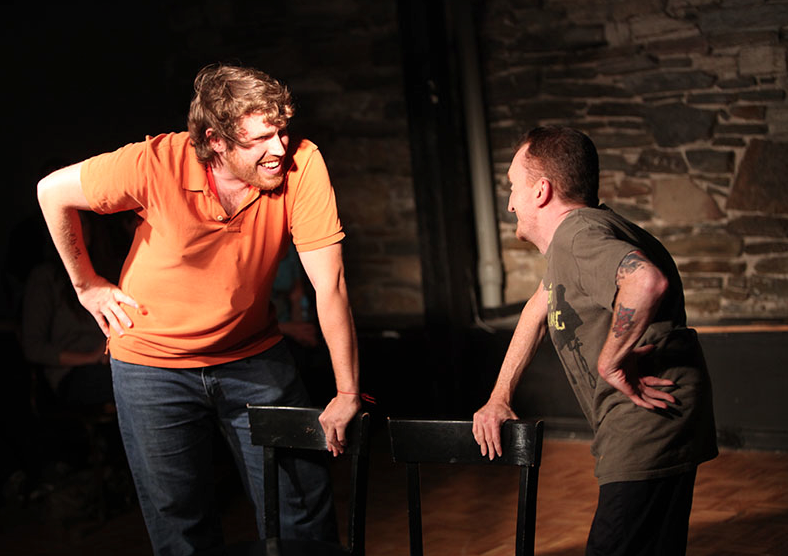
Politeness is important.

Politeness evolved so we don’t tear each other’s heads off. It’s part of the culture in cities like London, where queueing is almost a religion. (Legend has it British men were too polite to fight for seats on Titanic’s lifeboats.)

Saying “please” and “thank you” and holding the door for others are all things we should all strive for.

But politeness in improv? Not so much.

The next time you find yourself holding back while you politely wait for the scene you’re watching to die, remember these words:

That doesn’t mean you should stomp on stage and grab focus like Gary Busey on…whatever he’s on.

It means stepping out and doing something when you know the time is right. It means offering support in the form of a character, scene painting, sound effects, or simply an edit. It means fully committing, on stage and in rehearsal, instead of just pussyfooting around.

So go ahead, fuck polite. I guarantee your team – and the audience – will thank you.

Carmine Lucarelli is one of the smartest, funniest, most enjoyable performers you’ll ever see. He consistently kills as a member of The Get Ready For It Experience, Lashings of Apologies, and Painter’s Radio. He’s also a respected teacher, and is rumoured to own some fancy jeans.