Info

Posts tagged improv comedy

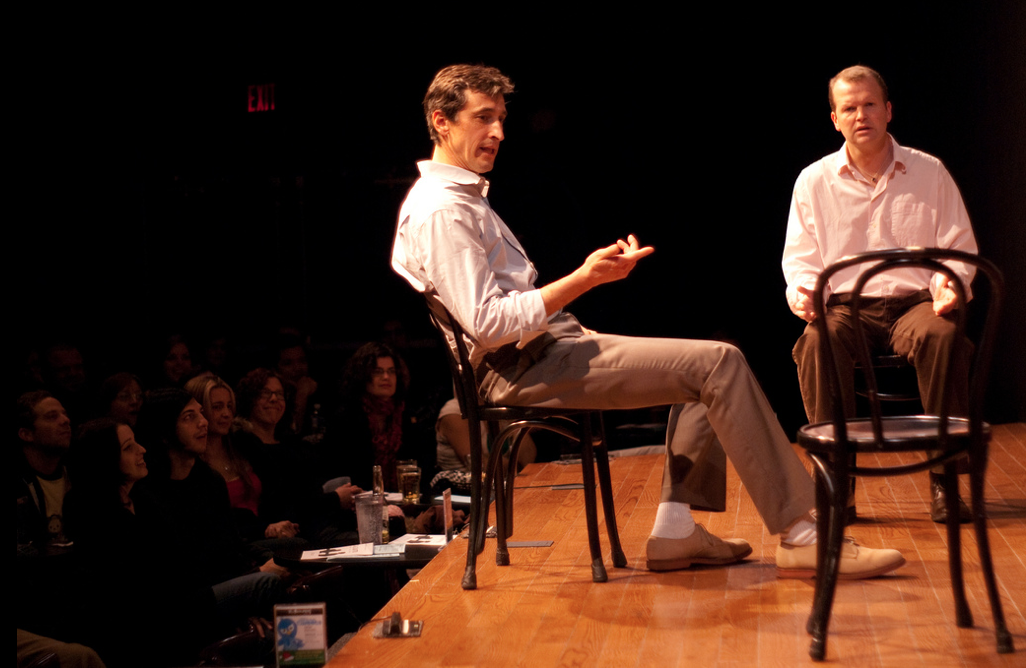
Photo © Mae Martin

Photo © Mae Martin

If you’re me and you like to write, you’ll rewrite something over and over again. In improv we don’t have this option. We are writing in the moment with no editor and sometimes no forethought whatsoever.

When we start off as improvisers doing this crazy thing like writing in the moment with others on stage, we often dislike or forget to honour and explore the first few things we offer up. I mean, why would we? We are just dumping our mind garbage, to quote my friend Freddie Rivas, all over the stage and hoping that within that heap of waste there is something worth taking a deeper look at.

We often run past or own brilliance at the top of a scene with blinding speed and agility. We think it can’t be that easy. That look, that line of dialogue, your body language. No it can’t be that simple. Let’s find something else to explore! We are complicated begins and when we make stuff up we often bring our own complexities on stage and forget to listen to the precious, brilliant and simple things we offer each other.

Everything we say and do on stage is precious.

Every look, every line, every movement or gesture can be the key to unlocking the greatest scene you’ve ever played. Stop running past the top of your scene and start being precious with every moment.

In improv you’re right. It’s not like the outside world, where we are constantly told we aren’t right, and that we aren’t good enough and that we have to be better. In improv we are always right.

The choices you make and the choices I make are right and they were never wrong, we just have to stop and recognize how beautiful, how simplistic and how precious these moments really are.

Only you can give yourself an improv scene, start trusting that your offers are good enough, start being precious with the things you say and do on stage, but remember: they are precious only in the moment. When that scene is over it will never be done again and there is no going back. That is when we no longer need to be precious. We celebrate the moment and move on, hopefully taking a lesson learned with us to the next.

This is The Precious Nature of Things, and I’m David Suzuki.

Kidding. I’m Matt Folliott.

Matt Folliott is an actor/improviser/comedian, and member of Standards & Practices. He’s performed in festivals across North America, including DCM, CIF, VIIF, Out Of Bounds, Improvaganza, and Mprov.

After eight years of doing improv, I’m finally comfortable on stage. Sometimes I still get butterflies before shows, but gone are the sweaty palms, the dizziness in the green room, the sudden urge to stay in the bathroom all night.

For a long time, just the act of getting on stage felt risky. Now I feel it’s time to push myself further.

This year, I want to do things I’ve never done, done only once, or never thought I could do. Things like…

Ghosting

TJ and Dave regularly incorporate ghosting in their sets. So does Toronto’s El Fantoma.

Both are masters at creating clearly defined characters whose posture, timbre, and gestures are easily identifiable. That’s important, not just for the performers, but so the audience knows what’s happening as well.

Definitely a skill I’d like to work on.

Using A Mic

Most venues have a microphone on hand, and savvy tech guys like Comedy Bar’s Mark Andrada will turn it on if they see an improviser wants to use it.

I’ve seen mics used (generally offstage) for the Voice of God, an airplane captain, a lounge lizard, and sound effects like wind, rain, a train, a gong, and beatboxing.

It looks like fun, but for some reason I’ve never dared try it. This year I will dare.

Interacting Directly With The Audience

I’ve done this once, maybe twice with my team, and never on my own. The idea of going into the crowd and mingling or talking with someone terrifies me as much as it probably does them. Which is why I have to do it.

Leaving The Stage Completely

Occasionally someone will exit the stage and never return (well, not for the rest of the set anyway). It always seems like a gutsy move, but somehow I felt if I tried it, I’d be abandoning my team.

When I think about it though, the people I’ve seen do it weren’t screwing over their scene partners. If the opportunity presents itself and it doesn’t feel forced, I’m gonna go for it.

Performing Behind The Curtain

For some reason, playing behind the curtain while staying in the scene scares the bejeezus out of me. Whenever I see people do it I think, “How do they know what’s going on? Can they really hear back there? What if the scene gets swept and they don’t know?” 

(Ahh, “What if…?” The birth – and death – of so many great things.)

Some people go one further and do their scene from the green room. This terrifies me even more, so I guess I’ve gotta try it at some point.

Making Bold Choices…And Sticking With Them

David Pasquesi sometimes plays with his back to the audience.

Anand Rajaram once stood motionless for a whole scene while saliva slowly dripped from his mouth to the floor.

Alex Tindal regularly hoists himself up to the rafters, and he’s even been known to get naked on stage.

While I’m not quite ready to get naked, I am ready to make changes. For years, I’ve struggled with “adaptive improviser” syndrome, where I come in with a strong character and then drop it when I think my scene partner’s offer is so much better.

This year I want to make brave choices and stick to them.

Taking Risks And Trusting

When S&P performed in Chicago a few years ago, Isaac Kessler played a character who died while seated. As his character stood up and slowly moved towards the light, Cameron came in behind him and slumped in the chair.

It was beautiful to watch. Not funny, but inspiring.

He told me after that he wondered for a split second if the team would know he was Isaac’s body, and not a new character, but he quickly dismissed the thought and made the move.

This year I want to make moves like that. I want to stop playing safe.

A friend on TourCo very kindly invited us to do the improv set after the show. As I feel my comfort with being on stage suddenly dissolve in a wave of nausea and sweaty palms, I’m contenting myself with the fact that I can always do it from the green room.

“The job is not to succeed, but fail more interesting than the last time – in a more subtle fashion or in a more intriguing way.” – TJ Jagodowski

1. Nobody forgot their medication. They’re always like this.

Photo © Kevin Thom

2. You don’t need to look for it. It’s right in front of you.

Photo © Kevin Thom

3. You have a surprisingly strong opinion about what your partner is doing.

Photo © Kevin Thom

4. If you really don’t want to do something, do it.

Photo © Kevin Thom

5. Yes, you should have edited there.

Photo © Kevin Thom

6. If you do it twice, you have to do it three times.

Photo © Kevin Thom

7. No house painter has ever had an amazing new house painting technique.

Reid&Jen@RevelbyKThom

8. You’re never just doing stuff. Figure out why you’re doing it the way you’re doing it.

Ken@RevelbyKThom

9. We don’t care about what you don’t care about.

M+A@RevelbyKThom

10. Why you do what you do is what you’ll do next.

Screen shot 2014-01-19 at 2.58.10 PM

All photos © Kevin Thom

Doug Sheppard is a Web developer by trade, and a writer and improviser by vocation. He lives in Toronto and considers it one of the finest places in all of Canada. You may also be amused by his twitter.

Gwinn

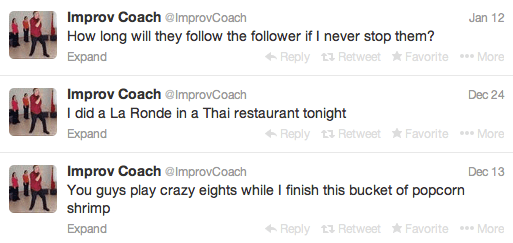
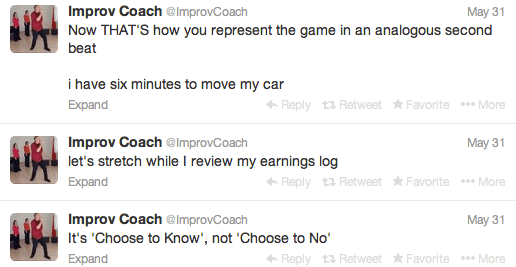
This is our new favourite thing. If you’ve ever coached a team, or been coached, these are right on the money. Follow on twitter @ImprovCoach.

NEW 1st IC
NEWER 2
NOW THAT'S
New SHORTY
NEW Valiant

“When the rational mind is shut off, we have the possibility of intuition.” – Viola Spolin 

Group mind, in my opinion, is one of the coolest things in improv.

When group mind is present, you don’t steer scenes: you’re compelled to move, together. It’s about letting go of consciously thinking and being in a state of flow.

If that all sounds a little “woo-woo” for you, here’s a true story:

When Cameron worked in advertising, he was part of a small creative department. They worked together, ate lunch together, and generally hung out together.

One day Carla, an art director, looked up from her layout and asked,

“Who’s that painter guy?”

Without hesitating, Cameron’s partner Matias blurted “Ansel Adams!”

Carla smiled and said, “Right. Yes, thank you.” Then she went back to her layout.

Cameron spun around, speechless. He kicked his chair over to Matias and said, “I was gonna say Ansel Adams!”

Now, if you asked me, or, oh, probably a million other people to name a “painter guy,” they’d probably say “Da Vinci” or “Warhol” or pretty much anyone other than Ansel fucking Adams.

Cameron and Matias knew Adams was a photographer, but they didn’t give their brains a chance to override their response with “That guy’s not a painter!”

Is that an example of group mind? I think so. (And if not, then what the hell is it?)

I’ve seen and experienced group mind many times, on stage and in rehearsals.

Devon Hyland and Matt Folliott did a show where Devon stepped out to initiate a new character. He’d barely gestured when Matt stepped in, and – knowing the move that was in Devon’s head – fleshed out the scene in just a few words.

To those of us in the audience, it was stupefying. We could see from Devon’s reaction that Matt had articulated what Devon intended, but how?

When I asked Cameron about that scene, he said, “I don’t remember. We were all so in the moment.”

That, for me, is the essence of group mind.

It’s like a school of fish, or a flock of birds. They’re so connected, so seamlessly entwined, it’s impossible to know who moved first. They could only be moving together.

In fact, scientists have built computer models that prove birds in flight are not merely watching and responding to one another. Their moves are so flawlessly synchronized, they could only be coming from some deeper, intangible level within.

So how do you cultivate group mind?

There really is no substitute for spending time together. Not just rehearsing and performing, but hanging out socially as well.

Go bowling instead of rehearsal one night. Take a road trip together. Host a potluck. Or just get drunk and play board games. The more experiences you accrue as a team, the more you’ll bond.

On the other hand, if you don’t like, trust, and respect each other, you’ll never achieve group mind; at least not on a consistent basis.

“Good chemistry is worth 100 practices.” – Will Hines

When you’re starting out in improv, chances are you’ll be thrown on a team with a bunch of random people. Some you’ll click with. Others you won’t.

When that team is dissolved (as most teams are), don’t let those relationships die. If you need to, form your own team with the people you clicked with, and keep playing together.

Chemistry lets you shorthand things. It makes things effortless. It’s why Seth Rogen, James Franco, Jonah Hill and Judd Apatow keep doing projects together. The same goes for the cast of Anchorman, the UCB four, and countless other ensembles.

Like twins or couples who finish each other’s sentences, you can develop an almost psychic rapport with your…giraffe. (Turns out Sally was gonna say “teammates.”)

Del Close described group mind as “One mind, many bodies.” The Caligula exercise can be sweaty and exhausting, but it’s great for connecting non-verbally.

Count To 20 is a good warm-up for quieting the brain and feeling the next move. (If you really want to swing for the fence, try counting to 50 or more.)

“Fall, then figure out what to do on the way down.” – Del Close

When you tap into group mind, you step into the unknown and enjoy the act of falling, together.

What’s your view on group mind? Have you had any interesting experiences? Leave a comment below, we’d love to hear them.

Photo © Keith Huang

Photo © Keith Huang

Wherever you are on your improv journey, these tips can help you get more joy.

1. Support the shit out of each other.

Photo © Kevin Thom

Photo © Kevin Thom

When someone makes a move, be the first to support it. Don’t wait to figure out what they’re doing, just respond.

Match their energy, heighten the move, scene paint, narrate…anything to add to it. It should look like you knew the move was coming, and love the idea. Move as a team.

Sometimes support means knowing when to edit. Your gut always knows when it’s time, so don’t hesitate if it’s telling you to sweep.

And support doesn’t stop with your team.

Attending other people’s shows adds your energy to the room, not to mention the show. Even better, bring friends and family from outside the community to share the experience.

And why not buy your favourite improviser a beer after the show? You can’t afford it? Oh. Then just tell them you liked the set and offer a sip of yours.

2. Be on time.

Yeah, we know. Improv sets are notorious for starting 10, 20, even 30 minutes late or more.

Some players are habitually late, so their team can’t start without them. If that’s you, make a new year’s resolution right now to be professional. You think TJ waits anxiously before every show, wondering where Dave is?

Being punctual shows you respect the audience, and your team. Also, be on time for rehearsals. Yes, even rehearsals.

For producers, don’t hold off the show waiting for more audience to arrive. Train your audiences to be on time by starting shows on time.

3. Don’t talk shit about your set.

Cameron’s first coach, Rob Norman, shared this pearl of wisdom: If you just got off stage and think you had a bad show, shut up.

Everyone experiences things differently. So while you may think you had a crap show, your teammates may have left the stage on a high. Don’t be a Betty Buzzkill. Or Danny Didn’tliketheshow. Or Maset McSucked.

Same goes for your audience. If someone compliments you after the show, don’t shake your head and start mumbling about how terrible you were. Just smile and say “Thank you.” (Try for that free beer!)

4. Stop “should-ing” on yourself.

You should have come in as the mad scientist. You should have brought back the pirate character. You should have swept before that scene died a slow, painful death.

Shelve your shoulds.

“There’s no ‘should have;’ there’s always a ‘could have.’ You should’ve been someone’s father, or you should’ve been someone’s boyfriend… But no. I could have, and it might’ve gone a different way, but you can’t judge yourself like that or your’re gonna not be entering.” – Scott Adsit

While you’re at it, stop comparing yourself to others in the comedy community. There is no one else on the planet like you, so comparing yourself is an exercise in futility.

When you find yourself thinking “How did he get on a Harold team and I didn’t?”, “Why did my web series not get a jillion hits?” or “I’m 25. How come I’m not already famous?!” – stop.

Instead of focusing on what you don’t have, make a list of what you do. We’re serious. Get a pen and write it down: your friends, your family, your cat,  your health, your encyclopaedic knowledge of Batman. Then read Mike O’Brien’s advice for aspiring comedians. And as David Razowsky says, “Replace ambition with gratefulness.”

5. Broaden your horizons.

When Standards & Practices were invited to perform at Improvaganza, neither Cameron nor I had ever been to Edmonton. It turned out to be inspiring and life-changing for both of us.

We laughed our asses off, made new friends, and walked away with a new perspective on our craft.

Improvaganza, CIF, DCM, and Out of Bounds are amazing opportunities to connect with others who share your passion. If you’ve only ever studied or performed in one place, you owe it to yourself to see how others play, and festivals are a great way to do that.

6. Take notes. (Part One)

If you want to remember stuff from workshops or classes or rehearsals, write it down. When you’re trying to remember how to do a Deconstruction months from now, you’ll be glad you did.

I use Moleskines, or you can just press “play” on your smartphone’s voice memo app. Of course, you’ll still have to transcribe it, but it’s a great tool that lets you stay focused during class.

Take notes. (Part Deux)

Whether it’s an instructor, a coach, or an out-of-town improviser teaching a master class, when someone gives you a note, take it.

Chances are they’ve identified a tendency or behaviour that’s limiting you in some way. The least you can do is listen. When you argue, you miss an opportunity to learn. And take time away from others who want to.

7. Learn something new.

Improv is awesome, but to be really good at it, you need other things in your life.

So sign up for singing lessons, learn to juggle, join a softball team, enrol in cooking classes, make short films using Vine. It doesn’t matter what it is, as long as you’re stretching your synapses by trying something different.

Here’s one that’s simple and costs nothing: Try using your non-dominant hand for everything for a week. Cameron did this on a regular basis and now he’s pretty much ambidextrous. (Editor’s note: By ambidextrous, Sally means I can masturbate with either hand.)

8. Live boldly.

Every time we’ve done something that was a stretch for us, in work, in improv, or in life, we’ve grown exponentially. From signing up for Level A at Second City, to quitting a full-time job to pursue our true passions, it’s scary sometimes. But so worth it.

“We are not on this planet to make little, tiny moves.” – David Razowsky

Photo © Kevin Thom

Photo © Kevin Thom

You may also like Eight More Ways To Be Good With The Improv. Thanks for stopping by.

“I think of it like dance, or like a basketball team. A good basketball team has practised so much and knows each other so well that they know where they’re gonna be at any given time, or they understand the rhythm of each player. And they’ve worked so long putting it together slowly that it’s effortless, or it seems effortless.”

Screen shot 2013-12-12 at 6.58.27 PM

Your favourite improv nerd already owns the Game of Thrones box set, a sonic screwdriver, and every volume of Axe Cop.

Fresh out of ideas? Well relax. There are still a few goodies we guarantee they’d be happy to find in their stocking.

Second City Gift Certificates

Experiential gifts are some of the coolest things you can give. So why not share the joy of clapping along to Big Booty with a bunch of strangers?

Like a lot of people, we fell in love with improv at Second City Training Centre. From Level A for beginners, to writing, acting, and specialty classes, you can give a gift certificate for any of SCTC’s awesome courses. Click here for info on Chicago, LA and Toronto.

Screen Shot 2013-12-05 at 4.11.25 PM

Jimmy Carrane’s Art of Slow Comedy

If your friend lives in Chicago, a gift certificate for any of Jimmy Carrane’s Art of Slow Comedy classes is just the ticket.

Upright Citizens Brigade Comedy Improvisation Manual

Authors Besser, Roberts and Walsh have poured 20+ years of knowledge into this mutha of all improv books. Coming in at just under 400 pages, it covers everything from two-person scenes to Harold structure, and was designed for beginners as well as seasoned improvisers.

Improvise. Scene from the Inside Out

We’ve said it before: no one writes more engagingly about improv than Mick Napier. Like UCB’s manual, Improvise appeals to both novice and seasoned performers. And at 144 pages, it’s the perfect companion for those improv festival road trips.

Trust Us, This Is All Made Up

If you’ve ever seen TJ and Dave perform, you know you’ve witnessed something profoundly unique and brilliant in the world of improv.

Watching them play is like a master class in itself. Which is why every improviser should own a copy of Trust Us, This Is All Made Up, a documentary of the duo performing live at the Barrow Street Theatre. We’ve probably seen it a dozen times, and still learn something with each viewing.

Screen Shot 2013-12-05 at 4.20.40 PM

Photo © Crista Flodquist

Mr. Show: The Complete Collection

True, it’s not improv. But Mr Show With Bob & David redefined comedy for a generation.

Younger audiences may recognize Bob Odenkirk from Breaking Bad, or David Cross from Arrested Development. But between 1995 and ’98, the two of them created one of the most subversive sketch shows ever imagined. Multiple viewings are a must, due to the insane amount of creativity jammed into each episode.

The Larry Sanders Show – Complete Series

Without Larry Sanders, there would be no Office. No Alan Partridge. Even, some suggest, no Deadwood or Oz. In fact, it’s impossible to conceive of a world TLSS didn’t influence.

Long before reality TV, The Larry Sanders Show was a groundbreaking satire combining social commentary and “faux reality,” with a cast so talented it boggles the mind. Garry Shandling, Jeffrey Tambor, Rip Torn, Janeane Garofalo, Bob Odenkirk, Wallace Langham and Sean Thompson shared the screen with some of the greatest actors and musicians on the planet.

The box set contains all 89 episodes, plus commentaries and a feature-length documentary. Give it to really someone special…if you can bear to part with it.

Photo © Kevin Thom

Photo © Kevin Thom