

Photo © Brian McConkey
The improv blog with attitude.
Photo © Brian McConkey
Today marks the launch of Toronto’s new independent improv fest, Big City Improv Festival. We asked Gary Rideout Jr of Comedy Bar for the 411.
P&C: This is the first annual Big City Improv Festival. What’s different about it from festivals Toronto has seen in the past?
GRJ: I think the thing I’m most excited about is the production team. There are a lot of passionate improv people involved, and everyone’s not afraid to share the workload so that everything gets done with plenty of time and attention. As someone who’s been an Associate Producer with Toronto Sketchfest since day one, I know it takes great leadership and a solid support team to build a great festival.
Julie Dumais produced the Combustion festival for a few years and she did a great job. I think it took something like that to prove we could put on a world class improv festival here in the city of Toronto. Something that would help our reputation in other markets, and something that would show the international acts that we have great audiences who do support good improv.
P&C. Comedy Bar has become a hub for improv, attracting some of the best local and out-of-town talent. What kind of acts can people expect on both the main stage and side stage at this year’s festival?
GRJ: I can tell you that with the production team involved, cultivating submissions from the best local, national and international acts won’t be a problem.
That said, coming up with a great festival schedule is like coming up with a good running order for a sketch show, or composing a great piece of music. There’s ebb and flow, and there will be both massive highlights and hidden gems. There’ll be party shows and thought-provoking shows, all with the onus being on what is funny and now, and what, with this great opportunity, can we present to the public to get them coming out to see improv, not just every night of the festival, but year round.
Festivals are a great place to showcase local favourites or have a local show become a new local favourite. The lingering effects of a great performance here can translate into continued success for that act.
P&C: Are there any special guests planned?
GRJ: We’re tinkering with the idea of some special guests. Bringing in someone famous helps get press for the festival as a whole, and gives a bunch of improvisers the opportunity they might not have otherwise to perform with someone cool. That said, with this being our first year it’s also important to focus on all the already-great local acts that exist in this city, and help expose them to the general public and let them know they can see those acts year round.
P&C: There’s been an explosion of interest in improv in the last few years. What do you think accounts for this?
GRJ: It’s crazy. I’ve always had a theory that the interest in styles of comedy goes in waves. For awhile, everyone’s doing stand-up, then sketch gets big for awhile, right now we’re in an improv boom.
The Second City Training Centre expanded and always seems to be full, and everytime I see a Bad Dog class in the cabaret at Comedy Bar, it’s full. It’s a great time.
I think before Comedy Bar, there were opportunities to perform improv but you really had to be pro-active in terms of finding a space where you could produce an “improv show.” In some ways improv was being looked at as an exercise you do just to get better at improv. So you go on stage for 25 minutes and then sit around and get told by someone else what they would have said or done in that situation.
With Comedy Bar, it’s kind of paint by numbers; you pitch a “show concept,” then you produce and perform that show for an audience. Bad Dog and National Theatre of the World have strived to put a focus on the value of improv as the presented artform, not just the vehicle to get to the content. Other acts see that and are doing the same thing in their own way. Improv is the show.
One of the first things I did with Catch23 when we brought it to Comedy Bar was move it from Mondays to Fridays. I wanted more people to see the show and the stories that come out of it, not just in the scenes but in the fake competition and relationships between judge, audience and players. It’s always packed, and almost always a great show. (I said “almost” there on purpose, I can’t help being a little bit critical.)
P&C. What’s the vision for the future of Big City Improv Festival?
GRJ: Big City Improv Festival has an opportunity to be the improv festival that properly represents the city, and all the great performers that call Toronto home. It’s something we’ve desperately needed for a very long time, and something that could go a long way to help Toronto’s reputation internationally
The festival runs October 15-20 at Comedy Bar.
Image © Big City Improv Festival
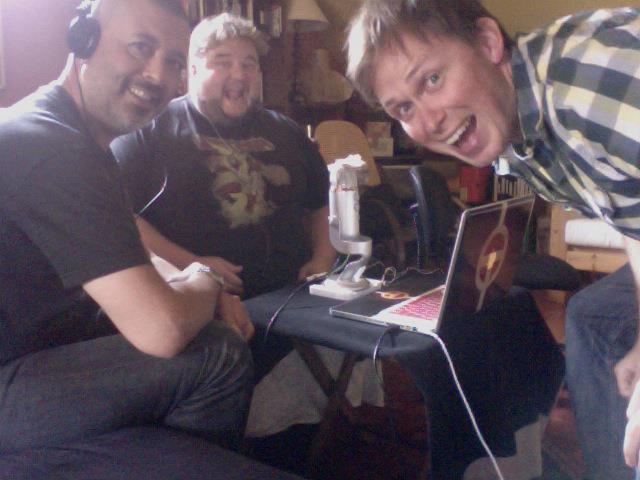
Illusionoid is an improvised comedy podcast that’s a mash-up of every sci-fi/fantasy show you’ve ever seen, and a bunch we guarantee you haven’t. We caught up with the hilarious Paul Bates, Lee Smart, and Nug Nahrgang after their show featuring special guest, Colin Mochrie.

P&C: How did Illusionoid get started?
NN: We got together the first time for a Globehead improv tournament at the Bad Dog Theatre when it was still out on the Danforth.
PB: How many years ago was that?
LS: God, 2008?
NN: 7 or 8. And so we did it for fun. Just like, “Oh, we’re gonna throw a team together.” And we wanted a name that was magic and science together.
PB: Well, we used an online science fiction name generator…
NN: …and “Illusionoid” came out and we’re like, “We love it!” And then I think it was literally seconds before we went on stage: “Well, what are we doing?” “Everything’s Doomsday!” We just decided everything was gonna be going bad. No matter what, it was gonna go evil. Everything was Twilight Zone.
LS: Yeah, dystopia.
NN: Dystopian future. And we did real well, and we did not win.
PB: We got beaten by Lisa Merchant and Alex Hatz…
NN: …playing immigrant characters.
PB: Yeah, you can’t beat immigrants.
LS: You can’t beat immigrants…
PB: It’s against the law.
NN: And then we didn’t do it the next year, because we were all doing other things.
LS: And we were still mad.
PB: Still mad at immigrants.
NN: And then in 2010 we got back together to do it, and did we win?
LS: Yes, we have the picture of us winning with the streamers.
NN: Yeah, we got magic tricks from Morrissey’s Magic Shop up on Dufferin, and we just did terrible magic tricks. Glowing thumbs, and streamers coming out of our mouths.
LS: The concept was that it was somehow illusions. We riffed on that; magic and those things.
PB: And then we went back and did it again this year and won again.
NN: So we’re two for three on Globehead champions.
P&C: When you did that, were you physically improvising, or was it [improvising in front of mics, like the podcast]?
NN: No, we were physically improvising.
PB: A while after that Globehead, the 2010 one, so I think in 2011, Nug was like, “We should do things. We should record things.” And [he] bought a microphone, plugged it into a MacBook and we just met at Lee’s place and we just did a couple. And then we sat on that for something like…
LS: A year.
NN: We recorded four at [Lee’s] place, and then three…our friend Ted Sutton had a studio at the time and we went in and did three in the studio, because he was like, “Yeah come on in, I’ll record it.”
PB: And sat on those for years…
NN: …because I went away on cruise ships with Second City.
PB: We sat on those and we didn’t know what to do with them, and again, Nug is the driving force in a lot of this…
LS: Oh gosh, yes.
PB: …Nug set up a website and an iTunes account and we added sound effects and we just started putting them up to see if it was fun or not.
NN: We made an intro, we recorded that and we added the music.
PB: And there was that long day of breaking the story of what Illusionoid is.
LS: (laughs)
PB: He’s an insane computer in the end of the universe, at the end of time…
LS: We tried to rationalize the plot line.
NN: So we have, like, an overall story for the whole show. It’s like Twilight Zone or Tales from the Crypt.
There’s a host, and it’s this man from the future, the last surviving human, and he’s sending these stories backwards in time to us now, in hopes that we’ll prevent these horrible things from happening.
But yet there’s no real chance for anyone to prevent this.
P&C: (laughs)
LS: Plus, the stories are so cryptic and disconnected, no one could understand. You would never, ever…
NN: “What of that am I supposed to stop?”
PB: “A mermaid isn’t supposed to fuck a guy?”
NN: “And why am I supposed to prevent this? The hotel is what I’m supposed to prevent?”
LS: “Which part of this…?”
NN: And the most fun for me is because we say, like, all of these stories somehow lead to the creation of Illusionoid. Then we put these stories online and I’m writing the…you know…[synopsis] for each episode and I’m like, “How does this connect to Illusionoid?”
I have some friends who are fans of the show, and they think they have parts of it figured out; parts of the overall story. “Ah, Carstairs is involved somehow!” And then I go, “Sure!” Because we don’t know. It’s just a fake story to get all these fake stories a home, really.
LS: It’s a paper conceit.
PB: Very simply, we really enjoy screwing around together and improvising, so it’s a lot of fun.
LS: And the tone of it…all of us are such nerds, and all sort of thrive on the ideas of science fiction and thinking about the future and dystopia. We’ve been steeped in that stuff and we send it up at the same time, because the tropes are so obvious to everyone. It’s fun to invert them and play with them.
P&C: I heard a little bit of Mystery Science Theatre 3000 when we were [inside Comedy Bar] so I thought, these guys are probably fans of that too.
LS: Well we did call Bob [Derkatch] Manos: The Hands of Fate
NN: That’s a classic. It’s the one movie that everyone remembers being the worst, and that they had the most fun making fun of. You can buy it on, I don’t know what season it is, but you can buy it as part of that season. But you can also buy just Manos as a two-disc set kinda thing. So on one side it is the horrible Manos movie, and then on the other side it is them making fun of it.
PB: Oh, that’s wonderful.
LS: Tonight though, I loved the Trouble Brothers. (two characters played by Nug and Paul)
NN: And I killed them! We had to. We were playing too many guys already. We had to kill those guys.
P&C: How many characters do you usually play?
NN: It depends. We’ve done episodes where we’ve all only played one character, but then we’ve done other ones where – and then with the benefit of editing after the fact – we can actually make Paul’s voice sound like a girl, or Lee sound like a monster, or…
P&C: Oh, you really do that?
NN: Yeah, we add effects when we record in the studio. When you’re Googlon the Robot…
PB: We android-ize my voice.
NN: And you can change the pitch to make a monster sound lower, or a guy sound like a girl.
PB: Yeah, like [in] the first one I play a Moon Spider.
NN: (high-pitched voice) “I’m a Moon Spider!”
LS: The improv is the raw material. Then we affect it afterwards.
NN: And even the raw material we barely edit. Somehow we’ve gotten really good at coming in at 20 minutes, around 20 minutes. So there’s some episodes that are like, maybe 15, and other episodes that are 22, but we always land around the 20-minute mark and if it’s a little longer we’re like, unh, who cares.
P&C: And are Bob [Derkatch] and Jay [McCarroll] normally both…
NN: No, tonight was real special to have Bob. I was talking about it one night when I saw Bob here because he wanted to come see us perform…
P&C: He was loving it!
NN: He wanted to see it, but he was like, “Hey if I’m coming, why don’t I bring my theremin?”
LS: So cool.
NN: And I went, “Oh my God, please bring your theremin!”
PB: Bob’s awesome.
LS: It added an amazing element. I was telling him that that scoring, which we don’t usually have throughout, really imbues it with a tone that we haven’t had before, live anyway.
NN: Jay usually does it live with us. But I remember when Bob volunteered I got hold of Jay and said “Hey, Bob wants to bring his theremin to our next show. Is that cool? I don’t wanna step on your toes,” and he was like, “Oh my God, the more the merrier. A theremin? This is the best.”
So just to have two nerd musicians… And I know Jay just thinks Bob is the greatest, so that’s a real fun time, too, for Jay to work with Bob. Just like for us to work with Colin [Mochrie].
PB: Jay’s getting good on that Moog.
LS: He certainly is. He was touching in at just the right times…
NN: He doesn’t get enough time to play. I think if he ever bought himself one, he would buy that app and then play with it forever.
LS: It’s an app for the iPad that emulates an old Moog synthesizer, which is from the ‘70s, so if you heard shows like Space: 1999 or Dr Who, essentially that is the sound of those things, and it adds such a retro, weird element to it.
P&C: I was amazed watching him, because he’s so fast. I know Mark Andrada when he’s in the back is fast, but [Jay’s] really on top of all those sound effects.
LS: Yeah, he was anticipating tonight, too. Some cool stuff; there was not much lag.
NN: There’s like a little delay on the app for the sound effects. So you can load up whatever sound effects are inside your iPad. So I put a ton of sound effects on the iPad, and then you can put a picture on the button too, so I can program each thing. So he can just reach up and go “Sub Door,” or “Torpedo,” or “Sonar.”
And there’s a little bit of a delay between touching it and playing, so Jay has been getting better at, “Oh, they’re gonna mention a torpedo,” so he’s already got it there, so he’s actually pushing it before we finish the word now, which is really amazing.
LS: And sometimes that pushes us to reference what the sound is as well. That happened a couple of times tonight.
NN: Like when Colin said, “I’m gonna sprinkle this on…” (explosive sound effect) “Guys, when I said ‘sprinkle’…” You’ve gotta justify the noise, too.
LS: Well the best thing for a musician to add is to be a player, as well. Not just to be following along, but to be someone who’s working and adding something that you can react to as well, so they’re actually improvising with you.
NN: We gotta get them jackets.
PB: I think I have a coupon.
P&C: And are you all friends with, or have you all performed with Colin before?
NN: Yeah. Colin’s a friend of mine. Colin and I have actually been comic book shopping together. Colin’s a big nerd; I’m kinda outing him this week. I did another interview this week where I kinda outed him as a huge nerd.
PB: Oh yeah, I ran into him once at the Silver Snail.
LS: Colin hired me for Second City. He was in the, he was the guy directing the Touring Company when I auditioned, so he hired me for the job.
PB: And in my case, if you’re a Second City actor, sooner or later you’re just friends with Colin, just because of his generosity. It’s not like I ever worked with him really, in any capacity that was significant. He’s just like, he’s just a guy that gets to know you and he’s super nice and generous with his time.
NN: I think Colin and I had run into each other a few times, and then we were both on The Tuxedo with Jackie Chan on the same day, and he was like, “Oh, someone I know.” And then we started hanging out. And then we went comic book shopping and now he and I are working together on a TV show in Sudbury for most of the summer.
LS: It’s probably the best job you can have, to be able to make a living as an improviser, and he’s done an exemplary job of doing that.
NN: Absolutely.
LS: Here, in the UK, and touring around…
P&C: The States…
LS: It’s so rare. It’s so rare to make your living improvising.
PB: One of a handful of human beings.
LS: Amazing.
NN: And you know, even talking to some people tonight, “How the heck did you get Colin?” “Oh, we asked him. We asked, then he said yes.”
P&C: Is he actually living in Toronto again?
LS: Always…
NN: He has never not lived in Toronto. He maybe lived in LA years ago, but no, he lives here, his son just graduated from NYU film school, and he’s just back home, and he and Deb live up, I think in Leaside.
PB: He’s a terrible racist though.
NN: Oh, the worst. He hates anybody not white. That’s the worst thing about Colin.
LS: Talk about, “You can’t beat an immigrant.”
PB, P&C: (laughs)
NN: You can’t tell him that. Horrible racist.
PB: You know, but he’s just such a generous guy. We forget…
NN: It makes you forgive the racism.
LS: The iron fist in the velvet glove.
P&C: That’s all going on the blog.
PB, NN: Nooooo…
LS: Disclaimer, disclaimer.
P&C: So how many episodes have you done now?
NN: This week will be 25.
PB: So we’re a month away from…
LS: …our first year.
NN: By the time number 27 comes out, that’s our first year. We’re gonna call it a season and start Season Two.
PB: See if Jay wants to do a new theme for us.
P&C: Anything else you want to mention?
LS: We were nominated for a Canadian Comedy Award…
P&C: Oh yes! Congratulations.
NN: Podcast. When we lose that…
P&C: What other podcasts are you up against?
NN: Well, we’re up against Stop Podcasting Yourself from Vancouver, which is huge. They’ve signed on to a network of podcasts that puts them out, so you can subscribe to the network and get all of the podcasts. They’re part of Maximum Fun, which is really great.
Maximum Fun has Jordan, Jesse, Go!, and so many other great podcasts. It’s gonna be real tough. If all of their listeners listened to us, we would be millionaires. I don’t really know how it works with a free podcast. But it would be the greatest thing in the world.
We’re up against Hold Your Applause, but they’re not even doing that podcast anymore. We’re up against Sean Cullen and The Seanpod. And Sean’s done our show, too.
LS: He’s very funny.
NN: He’s very funny. We just recorded with Scott Thompson this week; we did three with Scott, which was a really good time.
PB: We’re always trying to think what else to do with this. I love the podcast as it is, and we think about, “Can we pitch this as radio? Can we pitch this as TV?” But whatever comes…because it’s mainly for fun.
LS: There’s something pure and fun about putting it out there, but obviously we all have to make a living somehow. It’d be great to convert what we love into something we can get paid for.
P&C: Well, look at Comedy Bang! Bang!
NN: That is one of my favourites to listen to, and I’m so happy they got a TV show.
The other podcasts I think we have something in common with [are] Superego, because they record it and then add the sound effects later. But they just do bits, they don’t do stories like we do. And then Thrilling Adventure Hour, where they’re doing new scripts, like new radio shows, but scripted and do it live… I love those shows so much.
LS: It’s a Golden Age.
PB: It’s the Wild West, man.
NN: Other cliché!
LS: Well, the amount of creativity. There’s never been an avenue for people to create stuff and put it out there… Ten years ago we would never had the facility, the ability to do what we’re doing.
PB: Anybody who wants to be on the radio can be on the radio. It’s awesome.
LS: It’s amazing. People can listen to us and go, “Hey, I’m listening to Illusionoid this week,” and it’s a real thing. Whereas you had to go through the channels to get into radio before.
PB: It blows my mind to think that we get people writing on our pages: “I listen to this on the train in Brooklyn.” Y’know? People in Brooklyn listen. And then you check the stats; it says people in China listen, people in Ireland listen. That’s so cool.
P&C: Wow.
LS: How the hell does a guy in Ireland hear about this?
NN: I’d love to have more listeners, but we’re closing in on 25,000 total downloads. And I know there are other podcasts out there that get that every time they put out a podcast.
PB: If you get 700 people listening to a podcast, that’s still one of the biggest audiences I’ve ever had. So it’s great to have that reach.
LS: Surprisingly we have a lot of listeners in the Netherlands, and places like Sweden and Norway. I don’t know if it’s because it’s weird, and they’re sort of, they love the weirdness and the sci-fi…
PB: We should do a Girl With The Dragon Tattoo-style one.
NN: We can make that happen guys…
Illusionoid performs bi-weekly at Comedy Bar. Join their facebook page for show details, and download episodes of the podcast free from iTunes here.
Matt Besser‘s martini-dry humour will have you laughing out loud and curling up in the foetal position simultaneously.
This round, Matt and the kids of the Master Class take turns calling out the unusual thing. Click below to watch all four episodes.
Todd Stashwick teaches and performs improv in ways you’ve never seen before. In Part Two he talks about his acting influences, his Victorian-inspired improvised show, The Doubtful Guests, and why he has sympathy for the Devil.
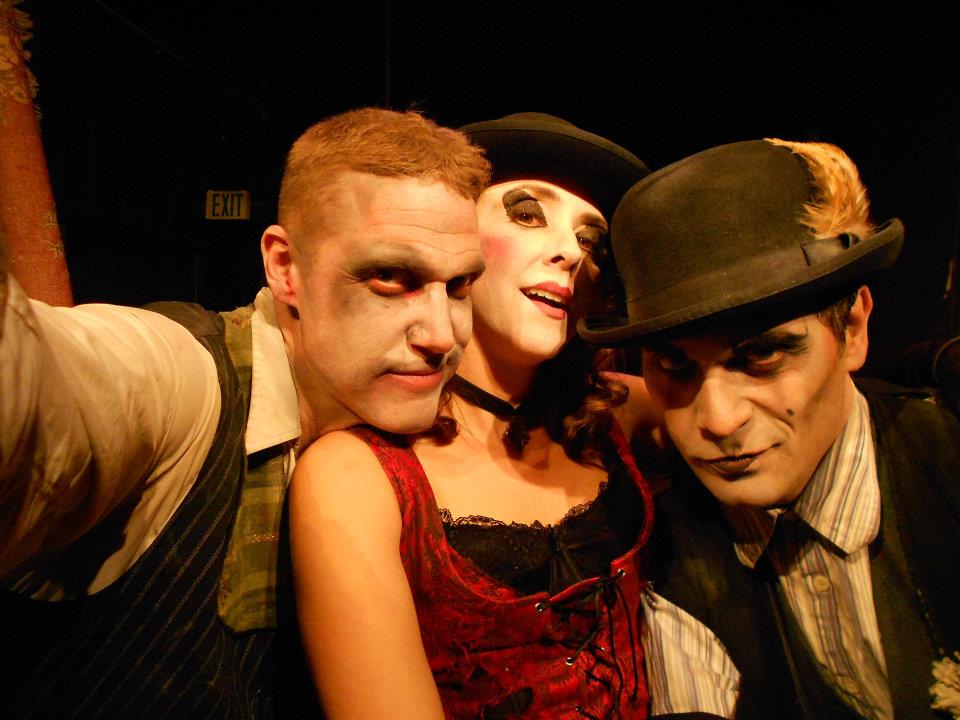
Photo © Sabrina Hill Weisz
P&C: How do you find improv has helped you as an actor?
TS: A friend of mine said, “Acting is improv where you happen to be saying what the writer wrote.” And so when I’m doing a scene with somebody, even if someone gave me the lines, I’m doing all the things: I’m listening, I’m heightening, I’m exploring, I’m pretending. So the same act is in play, it just often yields a different results or the decanter is a different shape.
I’ve done projects where I’ve been told, “This is an improvised show,” like, Curb Your Enthusiasm. Well, not an improvised show like Doubtful Guests or an improvised show like Mayfly. They already decided where the scene is going; they’re just letting me write my lines.
And then they’re saying, “Say that one again,” and “Don’t say that one,” and “Now do it again.” So we’re just scripting on our feet, that’s all we’re doing, in a quote-unquote improvised show. It’s not like they grabbed a camera and just chased a story down, and then figured it out in the editing room; that’s completely improvised…like The Neutrino Project.
The act of improvising is contained within acting, and when I’m “acting” on a scripted piece, I’m improvising. You cannot do an improvised show without acting the roles that you’re playing. If I go to a 40-seat basement and do an improvised show, I’m acting.
I think there’s some people that don’t consider… “Oh I’m not an actor, I’m an improviser.” I’ve never understood that phrase, because it’s like, “Well aren’t you on stage performing a character that people are watching in a live experience?” Then how are you not?
It goes back to, I believe it’s a shame-based art form, and so I think a lot of people don’t wanna consider it real theatre or real acting, even though it is. And I think in many ways it de-legitimizes it in a serious sense. That’s why there’s a lot of spoof and sketch attached to improv, so that we can… Even though the performers – I’m tangenting right now, I apologise.
P&C: Please do…
TS: Even though the performers are deeply committed to what they’re doing and really engaged in the moment because they have to be listening like a thief to everything that their partner is saying, somehow they don’t consider it theatre, or they don’t consider it acting. It’s an “improv” show. It’s improv, apostrophe. I never understood why people de-legitimized something they spend so much time doing.
P&C: I know some people who are very good, very seasoned and very respected, who don’t like the term “actor” applied to themselves.
TS: But what are you doing? Are you saying lines that are… you’re not having a legitimate conversation; it is a pretend conversation. It’s not My Dinner With André,
You’re playing another role and you’re saying lines and you’re telling a story through a performed act. But somehow that’s not theatre. Theatre’s for, like, fuddy-duddies? It’s pretension? I dunno.
Then they twice remove it and then attach it to something like a parlour trick or a sporting event, where it’s scored and adjudicated, and competed against… It’s very confusing to me. When I say, “I don’t understand,” I legitimately don’t understand where the line started, where people stopped thinking that improvisation was theatre. Or improvisers weren’t actors. I don’t understand when that happened, or why that happened.
P&C: Who has influenced you the most as an actor? I feel like you’re going to say Bill Murray…
TS: That all depends on when you asked me. I’m a thief. I just like what people do, and so I could not say one actor. If you wanna say “influenced,” who blew the initial wind into my sails that influenced me to go into acting? Yeah, again, I wanted to be Bill Murray. So that was the first, growing up. And Star Wars and The Muppets…
Now as I get older I look at the work that guys like Daniel Day Lewis do, even Jim Carrey does, Kevin Spacey… I dunno. I continue to be astounded and amazed by actors, individual moments and performances. Idris Elba right now is blowing my socks off.
P&C: Who is that?
TS: If you saw Prometheus, he was the ship’s captain. He was Stringer Bell on The Wire…
P&C: Oh, oh, yes!
TS: He’s a force of nature. Tom Hardy… God, I don’t know, I can’t pick one. Heath Ledger. Daniel Day Lewis. Johnny Depp. But then you go, uh, Andrew Scott who’s playing Moriarty on Sherlock. Benedict Cumberbatch, who’s played Sherlock. David Tennant…
P&C: There’s so many…
TS: It also depends on the role, who I’m gonna steal from, you know?
P&C: I’m going to jump to your non-improv stuff. You have a very varied acting career; you’ve done drama, comedy… Is there a genre you prefer, or do you enjoy playing as many different roles as possible?
TS: I like working. (laughs) Again going back to that blue collar thing. I like being employed. And the diversity allows me to be employed more often, because I can go do a half-hour sitcom and then I can go kill somebody with a hammer.
P&C: (laughs)
TS: I came up through comedy, and then I think because I have a deep voice and dark circles around my eyes and I have theatre training, it lends itself to villainy.
Right now if you were to ask me “What do you want to do?” I wanna do an hour-long supernatural or science fiction show. That’s what I enjoy. Like if I could be Dr Who I’d be thrilled.
P&C: I could totally see you doing that.
TS: But they’ll never hire a Yank, so I’m trying to make my own version of it. But I like anything allows me to enjoy what I’m doing.
I like the cerebral gymnastics and dexterity of half-hour sitcom, because all that is just math and music, and finding where the joke lands and double-flips and stops and starts. I love doing that. But then I also love being covered in mud at 2 o’clock in the morning while my father is dying in front of me in the middle of the woods as a sociopathic hillbilly.
I don’t know, I don’t wanna pick one because then I’d miss the other one.
P&C: That was actually one of my questions. You’ve played a sociopathic hillbilly, a replicating carny, the editor of an alternative newspaper… Do you have a dream role? You probably don’t want to limit yourself, I just wondered if there was one specific role?
TS: I’m getting too old now for it, [but] the role that I would love to do and develop the script for… Well, two of them. Because I write a comic called Devil Inside where I’m the Devil, and it’s about the Devil having a crisis of conscience and going on the lam in the Southwest desert. Our joke is it’s Breaking Good.
P&C: (laughs)
TS: It’s that kind of show; it’d be a Breaking Bad show with a supernatural element. That is a thing that I created with Dennis Calero; [it’s his] amazing artwork. We met when he was illustrating the Heroes online comic. He’s my collaborator, he’s drawn for DC and Marvel. He’s the best.
UCP, Universal Cable Productions, has optioned it to pitch as a TV series. So that would be a dream role.
And then the other role, that I’m probably getting too old for, is George Tilyou, the guy that started Steeplechase Park in New York, Coney Island in 1897. That’d be a dream role to play.
P&C: Why that particular role?
TS: I’m fascinated with turn-of-the-century Coney Island. I’m fascinated with the people that worked very hard to… they worked very hard to create entertainment. To alter one’s experience in a whimsical way. I find those people fascinating. P.T. Barnum…
And he in particular, he fought corruption and then became corrupted, and then finds his way back. There’s a lot in his story, and I also love that era. I love Coney Island at the turn of the century. I just find that a wonderland. I’m sure it smelled awful, but in the fog of nostalgia it holds a very high place in my heart.
And then Jack Springheel, which is the Devil; just the ultimate crisis of conscience. Having the Devil not wanting to, you know… We have a line in Devil Inside where he says, “Evil isn’t a force, it’s a choice. I’m just weighing my options.”
I like that kind of conflicted… y’know, I always play villains, and villains always wind up with a bullet in their head at the end of the episode. And so I thought how do I create a character who lives with that conflict, is the ultimate villain, in a supernatural setting, but doesn’t die at the end of the episode – in fact, is the protaganist?
So that was the genesis, no pun intended, of the idea of Jack Springheel in Devil Inside. So I would like to play that in a TV series.
P&C: I was gonna say, he looks an awful lot like you, so did you have a movie planned?
TS: I would see it as a series, like an FX-type, AMC-type series where we could be poetic and beautiful, as well as brutal and dangerous. We quote Kerouac an awful lot in the series, so we wanted to have that kind of Americana road thing and then at the same time have a crow-headed demon shove his beak through someone’s face.
I love walking that line. Like Stephen Moffat, Neil Gaiman, and those guys, they’re onto something.
P&C: Devil Inside has fantastic artwork, it’s extremely tight writing, and one of the things I love about it that it has in common with Sandman and Hellblazer for me, is a sense of humour. You have the dark and then you have this very dry sort of…
TS: For me, obviously I’m a comic book kid from the late ‘80s, early ‘90s. I was weaned on Sandman, I was weaned on Hellblazer, and Alan Moore and all of those existential comic books. And Batman and Frank Miller.
And so given the chance to write a story… but it’s an American version, and it’s funny because you read Preacher and you’re like, “Oh well that’s a Brit interpreting America.” And so it’s interesting for me to go, well, here’s how I see the American Southwest.
But the lineage is there and the DNA is there. And at the same time – and I reference Moffat and Davies – there’s a Dr Who thing going on, too. So you have this extraordinary eternal guy who has a smartmouth sidekick. And he’s on the run. I’m mixing all my influences in one place.
So I think if you can wring terror and comedy out of the same second, there’s something there. And I think when you’re dealing with mythic structures like Biblical characters and you’re reducing them into human shapes, and limiting them to human language, the jokes write themselves.
And then you have a character like Sophie who the safest person in the universe that she trusts is the Devil. And to me there’s something so wonderful about that, and the idea that, Hell, if the Devil can seek redemption – self-redemption – then we all can. Then anyone can.
Because I don’t believe this idea that “the Devil made you do it,” and I state this overtly in the strip. That he doesn’t make anybody do anything. Everybody makes a choice.
He can make it harder. I would say it’s like throwing the drunk his car keys. He can cloud your judgement, but still there’s a voice in your head that says, “Maybe I should give my keys to my sober buddy.” Or you go, “Screw it, I’m getting in the car and I’m gonna wreck it.”
I still have that choice because it’s all about choice. People choose to behave poorly to each other; they choose to behave kind to each other. And on a daily basis, a moment-to-moment basis, we have to make that choice: to make the world better or worse. In a microscopic and a macroscopic way.
I think by reducing the idea of evil and the Devil into a man who’s also making choices… the humour I think is what makes him relatable. So if I can relate to this mythic character of the Devil, then maybe I can tell my story and people will be willing to go along for the ride.
P&C: There’s a thread of the macabre that runs through a lot of your work. What is it about that sort of goth/steampunk/Victorian aesthetic or history that appeals to you?
TS: I don’t know. For me, I think it’s… I was very blessed. I grew up with very little darkness. Much like Tim Burton. Not saying I’m Tim Burton, but he grew up in Burbank. And so I grew up in a lovely quaint suburb of Chicago, riding my bike… There was not a lot of darkness in my life.
So because I’m a person and duality exists… I was never a goth kid. But I’ve always been tickled by dark whimsy. Like Something Wicked This Way Comes. Circuses. It always felt forbidden. And I think through literature, through film and whatnot, it was a safe way for me to explore a darker side of life.
I certainly am not a violent person; I’m a vegetarian. I’m not morose, I’m not depressed. I was the kid who listened to The Cure, but I wasn’t mopey, I’ve always been optimistic and uncynical. But I’ve gotta be honest that I have canines; we were built for ripping flesh so that has to come out somewhere. And for me it comes out playing violent video games and it comes out loving zombie movies and exploring the darkness of steampunk and Doubtful Guests.
I like that dark whimsy; Edward Gorey, Stephen King. I like the salty and the sweet.
And I think when you get to macabre, it is salty and the sweet. There’s something circuslike and playful, and at the same time it’s like It: like the clown has sharp teeth.And I think there’s something really fun about that, because it’s provocative, literally meaning “to provoke.”
I love being scared. I love that jump-out-of-your-seat stuff. I love a really good, scary horror film.
I think horror and comedy are the two things that provoke each other. Comedy elicits a response immediately, and horror elicits a response immediately. And if you talk about macabre things, like The Joker… Going back to Doubtful Guests, if I can elicit horror and comedy at the same second, well then I’m hitting you on two angles.
And those are the two biggest, most involuntary reactions as an audience: a scream or a laugh. And so I’m fascinated by both of those. I like to do both of those. I seek out things that will make me laugh hard, and things that will make me terrified.
P&C: So you do The Doubtful Guests once a year?
TS: We bring it out around October. It’s a Hallowe’en show. [It’s me and] Sabrina and Ezra Weisz, and Jason Ades.
P&C: So the inspiration for that was everything you’ve been talking about?
TS: Well, going back to what I was saying about Burn Manhattan, I had seen a show called Shockheaded Peter with a band called The Tiger Lilies. It was puppets and macabre; it was German children’s stories set to the music of The Tiger Lilies, done in this Victorian-macabre fashion. So I just said, “I wanna do an improvised show like that. How can I improvise that? What kind of stories would I tell? What would the show look like?” Bring some production value to our improvised piece. And then I pitched it to three other people and they were on board as well, and that was kind of the genesis of it, was taking that Moulin Rouge-y, turn-of-the-century thing… So that was the impetus for The Doubtful Guests.
I had come from New York having done Burn Manhattan which was really high tech: we had video, electronica, guys in black suits. And then I said, “Well, what if I went low tech? What would happen, what would it look like?”
Well, first, “What would an improvised show look like at the turn of the century?” So it limited all of our references to, nothing can be post-1888. And then what kind of storytelling that does lend itself to, and what kind of costumery and music and what does a band have to sound like, and that.
P&C: You still do Mayfly?
TS: Yep, got another one on the 7th.
P&C: Can you tell readers a little bit about it, for people who aren’t familiar with it?
TS: The genesis of Mayfly was, I had gone to an improv festival in Chicago with Doubtful Guests and some of my old Burn Manhattan cohorts were there from New York as well, and we all got onstage and played together. And everybody just sort of got the form. And so people that had never met were able to jump into this deep, physical, absurd thing.
When I got back to Los Angeles I thought, If it works and if people are willing to go along for the ride, why don’t we just throw together new people to do an improvised show with an improvised band? And it’s called Mayfly because it just lives for that 24 hours. That group will never be reassembled, and it’ll be dead, and then we’ll get another group of six people to play together.
So it’s basically the Burn Manhattan/Beast format, but with people who’ve never performed together, and never done this. We do it at Bang once a month. We get a band together, and then the show goes for an hour without suggestions and it ends when we say it’s over.
The idea was, I wanted it to feel like you’re in a pub in Ireland and everyone’s drinking, and then suddenly people just sort of stand up and grabs instruments and jam together, and when they’re done they just go back to drinking. They sit back down in the crowd at the different tables that they came from. Just this sort of pub-punk-improvised jam.
P&C: Is there anything else you’d like to mention before we go?
TS: We’re selling a printed copy of Chapter One of Devil Inside. It’ll go on sale after Comic-Con, July 11. We’ll make those available online. That’s exciting because we’ve assembled the first year’s worth of strips into one book.
P&C: I am a paper person. I think a lot of people will love that. Well, thank you so much for your time, Todd.
TS: Nice chatting with you again.
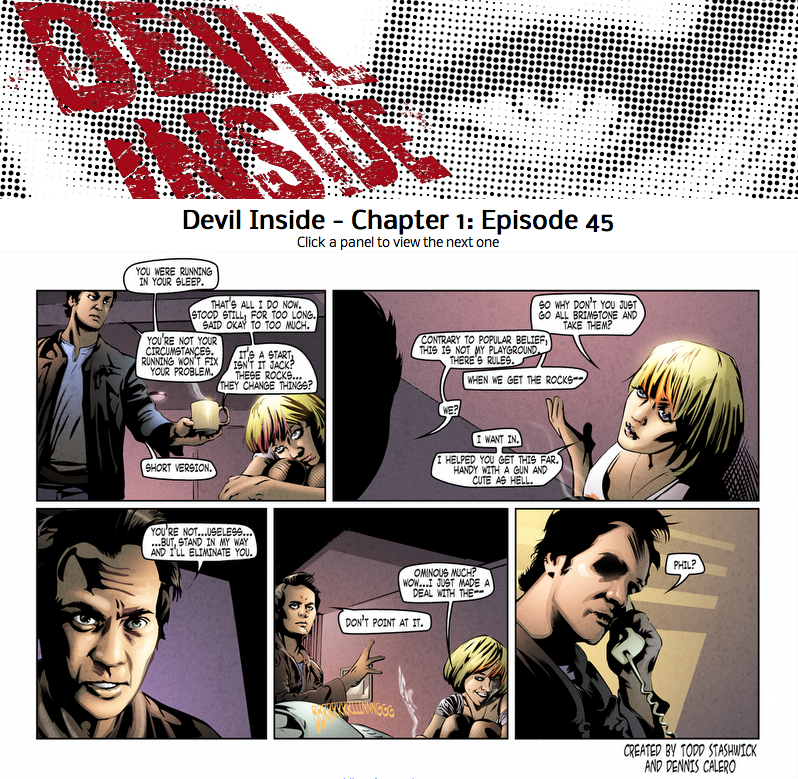
Image © Todd Stashwick & Dennis Calero/Devil Inside
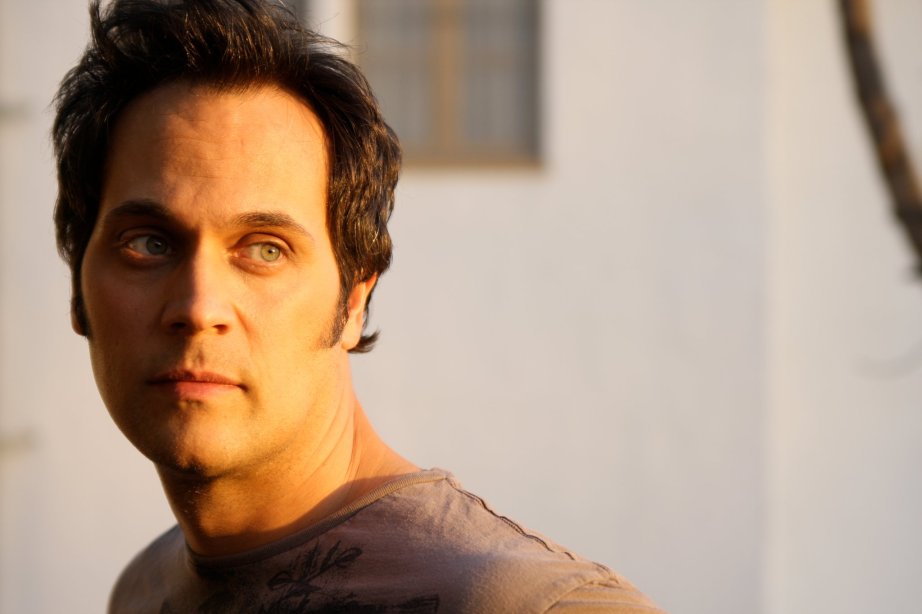
Photo © Lorenzo Hodges
Todd Stashwick is an actor/improviser, and the co-creator of Devil Inside, an online horror/action comic that launched at San Diego’s Comic-Con in 2010. His acting credits include The Riches, Heroes, Justified, Childrens Hospital and Curb Your Enthusiasm.
P&C: I read that you started tearing tickets at Second City when Steve Carell was on the Mainstage.
TS: Second City Northwest. And that cast was Dave Razowsky, Steve Carell, John Rubano, Ken Campbell, Claudia Smith-Special, and Fran Adams, and that was back in the summer of ’90.
P&C: When did you know you wanted to be on the Mainstage; was it when you took that first job, or had you known for a long time?
TS: Meatballs.
P&C: (laughs)
TS: When Meatballs came out, and Saturday Night Live, and I was watching Bill Murray. I was watching Bill Murray and I had a great deal of affinity for this Chicago jamoke.
Entering through, like, Stripes and Meatballs, which led me to going back – because I was too young when he was on SNL – but going back to then investigating his trajectory. And then Ghostbusters sealed the deal.
I just wanted to be Bill Murray growing up, so I just figured out what his trajectory was, and it was like, “OK, well he went to Second City.” So that always was dog-eared.
Before I worked there, I was in college and I went to see Second City Northwest and Joel Murray, who I’m now friends with, he was in the cast. And I just was like, “That’s a Murray! That’s a Murray!”
And I remember going to Loyola… The first day of school when we had freshman orientation, the Second City Touring Company performed and I walked to the front of the stage. And Holly Wortell was, after the show she was putting her shoes on, and I asked Holly, “How do you get into Second City?” And Holly said, “I would get a job there, like tearing tickets, so you can watch the shows and know what it is you’re auditioning for.”
And so literally the first day of college I had tucked in my head, “Well, when I get out of college I’m going to Second City.”
Because y’know, I always walked that line; I’m a blue collar performer. Amongst my family I’m the arty one, but in the world of theatre I’m a blue collar one. I’m like, “Oh, OK, do that?” Like a carpenter. “Go to Second City, learn that trade? OK. Then apply that trade? OK.” And don’t complain about your job.
For four years I was studying Stanislavski and watching these people rip themselves in half for these roles, but in the back of my head I’m like, “This is cool and awesome and I’m glad I’m learning all this training, but I just wanna be Bill Murray.”
So literally the day after I graduated college, I went and applied for a job at Second City Northwest, and they hired me to tear tickets. And I started watching Carell and all those guys, and studying.
So I was studying at Second City Northwest, then I moved downtown and transferred the job, then I was studying at Second City downtown, and then I was studying with Del and Charna at Improv Olympic, performing at Improv Olympic, and then performing at Second City in the students’ programs. And then I was hired into the Touring Company.
For two-and-a-half years I toured, then I did Second City Detroit, then Second City Northwest. Then I understudied Mainstage and then I moved to New York because I was up for SNL in ’95.
P&C: You studied with Del and Charna, and I think there’s a lot of fascination with Del because he’s almost such a mythical person now. How did he influence your approach to improv?
TS: I would say I didn’t really get to apply the stuff that Del was imparting [to] me until I was doing Burn Manhattan in New York. I think there’s something so… I get in trouble when I talk about this. (laughs) There was something so… That which was being rewarded and encouraged, often, often, onstage in Chicago, felt antithetical to what it was that Marty and Del and Donny DePollo and Viola Spolin were teaching.
There was a lot of… It’s just naïve performers – I don’t mean that in a bad way, I just mean young – who were being moved up through the ranks and rewarded for being really clever on their feet. And what I found that those guys were teaching me was much more physical, was much more listening-based, was much more discovery-based.
It’s not “The who, what, where in the first three lines of dialogue,” which I found a little fascistic. And I thought, Well that’s one way to start a scene. But it seemed to be the only way to start a scene. And I always found that would put me in my head and so therefore antithetical to being out of your head, which was what Del wanted you to be, in raw discovery. Del wanted you to find your demons and rip them out on stage.
For four weeks he had us…he thought this was a really great idea to go, “What if you could catch mimes?” “I caught a mime and now a mime is just mocking me everywhere.” So people would do scenes and we would do the scene behind them, mocking them in mime fashion. But then after a month he was like, “Well, this is not getting us anywhere.”
And at the time it just felt like the ramblings of a crazy man, but it was that spirit of experimentation, and that spirit of “There’s not only one way to do an improvised scene,” there’s not only one version of improvised theatre, that I think Del taught me. Take a risk. Be hard on yourselves. Take it seriously.
The people that I know that are really devoted to the art form, a lot of them studied with Del. Del took the art form very seriously. He did not think of it as a second-class form of theatre; he felt that it was very legitimate. So I think that sense of experimentation, and just a very liberated view of the work. It was punk rock.
P&C: It sounds like the same sort of thing you were excited by when you visited Scotland, and saw a fringe play that changed your idea of what improv could be. Could you tell us about that?
TS: In Chicago before I went to Scotland, I had done a show called Mobius American Theatre. And Mobius was a form that we had developed where we would rehearse different playwright styles in non-spoof fashion. Like legitimately go, “OK, let’s take Mamet, let’s take Tennessee Williams, and what are the tropes?” As opposed to pointing at the tropes, like what truly are the types of themes that recur in these stories, in a non-satirical way. There were some great people; Brian Boland and Gwynne Ashley were in that group.
We would improvise a final scene, and then go back to the beginning of the play and justify that final scene. So that we would go back and improvise, slowly build, over the course of an hour. And so I was already kinda dismantling what I thought you could do. And we would have act breaks, we would have set changes, and it felt like a real play.
Then I went to Scotland and I saw these guys doing a three-act play with just the three of them. This was Rejects Revenge. They would create a swing and a butterfly and hieroglyphs with their bodies, and this very European clown tradition of physical theatre.
And what I always do is I look at something that is not in the improv world and go, “How can I improvise that? I want my improv show to look like their scripted show.”
The seeds got planted with doing Mobius, and then it carried through like, “OK, well we could do an improvised play, but we could be all the things. We don’t need props, we don’t need anything.” And not just Spolin-based object work, but like (mimes a butterfly flapping its wings) butterflies.
And that fascinated me, how those three could take us to the tombs of Egypt in a Victorian adventure. It blew me away, and so like a barnacle I attached myself to their neck and bled them for all information they would give me, and that’s what I carried with me into New York… So I just had to reverse engineer.
P&C: And that became Burn Manhattan.
TS: Uh-huh.
P&C: So when you moved to New York, the improv scene there at the time was not what you were doing, obviously.
TS: It was game-based, and sketch-based, and there were whispers of a Harold finally making its way east.
But going back to what I was saying about… And again I’m not slagging Chicago. There were places like The Annoyance that were really trying stuff, but it was just harder because you had this Holy Grail which was Second City, so so much of people’s work in the outside groups was designed to get us ready for that Second City audition once a year, or twice a year.
And New York didn’t have a Groundlings; it didn’t have its one thing that sort of set the benchmark for what improvised theatre is. There were pockets of lots of game-based improv, and a lot of great, amazing improvisers, but they were hungry for something else.
So we were able, having gotten the whole Second City thing out of our system – myself, John Thies, Mark Levenson, Kevin Scott, Jay Rhoderick and Matt Higgins – and we didn’t have anybody telling us, “Well that’s not gonna get you anywhere.” We weren’t trying to do anything but it. We weren’t trying to get hired by anybody. We weren’t trying to be ready, and so we just didn’t care. We had Shira Piven at the helm, pushing us all into new places.
Kevin was in a group called Bang Bang in Chicago with Michael Shannon and Tracy Letts, and he had already been pushing the bounds a little bit, but they were way on the north side of Chicago so they were really separate from the community. So we had all the pieces together for us to do something, and no community that was telling us not to.
P&C: You’re big on physicality, object work and spacework. Why is physicality so important to improv, at least for you?
TS: If the goal is to remain in a state of discovery, our minds can wander, but our bodies are always connected to the space. Our bodies are always standing there. And if we keep our bodies in motion, it keeps us in a state of discovery.
If we connect physically to the space, if we connect physically to each other, and we throw our focus external as opposed to internal, it keeps us out of our head. It keeps us literally in a state of discovery. I have to have my eyes open, I have to be discovering things physically in order to keep feeding the beast.
P&C: I remember that from your workshop… I can’t remember exactly, but I think it was, “If you do something physical, that keeps the left brain busy so your right brain can play.”
TS: The left brain contains judgement. It also contains speech. But it also controls movement. And so if you move, the left brain’s going, “I gotta do this, I gotta do this right now, I don’t have time to judge myself!” So the right brain can go, “Oh, butterflies! Oh, finger painting! Yay! Improvised song!”
P&C: As part of your workshops, you teach clown. What do you think clown brings to an improviser’s or actor’s repertoire of skills?
TS: Well I’m no expert on clown; I’m stealing anything as I go along the way and shoving it in my bag. Clown is a willingness to be vulnerable and fearless. A willingness to fail and pick yourself up and keep moving forward. It is attention to physicality and it’s very connected to the audience.
And the kinds of shows that I enjoy doing, whether it’s Doubtful Guests, Burn Manhattan, Mayfly, are very, very connected to the audience. And allowing what is happening in the audience in front of you in the room to really inform the show.
And clown is very wide awake and vulnerable. Clowns don’t lie. They are clowns. They aren’t playing clowns, they are clowns.
P&C: You do a lot of creative things. Do you think of yourself as an actor, or do you think of yourself as an artist? How do you define yourself?
TS: That’s a very curious question, because I think all my life, growing up, I’ve always thought of myself as an actor. Just because that was my gateway drug into entertainment, was acting. So I just think it’s all part of this big ball of just entertainment, whether I’m writing a comic, or working on writing a pilot, or doing an improv show, or creating a stage show. Honestly, I’m not trying to be cryptic or anything. It’s just what I do. So I don’t see it as “acting,” “producing,” “creating the poster for it.” It’s all just making entertainment in many forms.
If somebody came up to me and said, “So what do you do?” I would say “Actor.” That’s the first thing that comes out of my mouth, but I know the parameters of that job description are limited to somebody handing you a script, and you memorizing those lines, and either standing on a stage or a sound stage or on location and saying them.
I think of myself as an actor. What I do in practice, is a whole bunch of other junk.
P&C: What do you love about improv versus scripted work?
TS: What do I appreciate about improv that is not contained within scripted work? Because they’re not at war…
P&C: That’s a better way to put it.
TS: When you say the word improv or improvisation, it’s always a live experience for me, and it has a finite performance time. It begins, it middles, it ends, there’s a curtain call, there’s an introduction. It’s contained within an evening and you get immediate communication with the audience.
I can walk home at the end of the night and hold in my head what I did that day, as opposed to working on a film, I’ll do this piece from, you know, Scene 23, and so I’m not the one who has to hold the whole story in my head. Nor at the end of the night can I walk home and go, “OK, I know what I did.” You know what I mean? And I also get to behave in ways, improvisationally… Like, rarely am I ever gonna be cast as an 80-year-old black blues musician. But in an improvised scene I could play that, and it’ll all take place inside the letter “I.”
The absurdity of live theatre that we are discovering as we go gives me opportunities to perform and to discover in ways that I’m not afforded in scripted work.
I like the 40-seat-basement people. I like performing for people in a black-box theatre on a hot Friday night and we all have a glass of whisky afterwards, and it’s that live, kinda punk feeling that you get from a live experience…
I don’t do improvisation for money, I do it for the love of the game. I don’t think I’ve ever really been paid to perform as an improviser. I’ve been paid to do Second City, but we were paid to perform scripted shows and then we improvised as well. But that has always been kind of my hobo’s heart.
Stay tuned for Part Two, where we discuss acting, writing, and get the scoop on Jack Springheel.
Drawing © Samantha Claridge

Photo © Kevin Thom
For an insider’s view of improv in the Big Apple, check out Elizabeth Quinn and Justin Zell’s fun’n’funky podcast.
With topics like Improv Auditions and Rejection, Engaging the Audience, and My F’ed Up Interview with Death By Roo Roo, there’s a plethora of content to peruse.
And what a guest list: Joe Bill and Mark Sutton, John Gemberling, Neil Casey and Anthony Atamanuik, TJ and Dave, Baby Wants Candy, Will Hines, and the proverbial “many more.”
Download the podcasts from iTunes here.

Image © Banksy
As improvisers, we put a lot of emphasis on words, and pressure on ourselves to “think of something funny to say.”
But think of all the amazing silent or almost-silent scenes you’ve watched. Tone of voice and body language say so much. As Del said, “No scene is ever about the words being spoken.” That’s one of the reasons I love this exercise.
To begin, two players sit or stand while two more stand on either side of them.
The Coach/Director takes a suggestion to start the scene: an object, news item, or geographic location, for instance. The first player speaks a line of gibberish, then his “translator” turns to the audience and explains what was said. The second player then speaks some gibberish, followed by her sidekick’s translation. For example:
Suggestion: Berlin
Player 1: Havortska dishnek plakken stap?
Translator 1: Hey Peter, have you seen my new boat?
Player 2: Skannik! Plerripps vooker shnaben.
Translator 2: Of course! The wall is down.
And so forth.
Gibberish “conversations” are entertaining because the players are often as surprised as the audience.
For a master class in gibberish, check out Second City’s “Twin Baby Boys Having A Conversation About Politics” video.
Chaqi da berrnizahn!

Photo © Kevin Thom
Downright Upright is an improv blog by LA-based improviser, Sean London. Its focus is unabashedly UCB-centric, and that’s cool, because it’s fun to get an insider’s perspective on that scene.
London posts an interesting mix of personal “ramblings,” interviews and opinions, as well as great video content. I especially liked his review of a solo Jason Mantzoukas show. Already something of a legend in the States, Mantzoukas is known for pushing the boundaries of improv – and his audience – to the limits.
When he’s not busy blogging, you can catch London performing with Soulmates (below).

Photo © Will Reese


 People and Chairs