Info

Greg Hess is a member of the legendary Cook County Social Club and the equally-esteemed Improvised Shakespeare Company. When his Toronto workshop was announced, Susan Messing said, “Greg Hess is incredible. Anyone who misses this class is an asshole and an idiot.” With a letter of recommendation like that, how could we refuse? 

We asked him about his influences, the importance of team chemistry, and improvising in iambic pentameter.

Photo © Ryan Ward Thompson

P&C: You’re originally from Virginia. Why did y’all move to Chicago?

GH: I went to the College of William and Mary in Virginia, and that’s actually the first time I saw improv, was in my freshman year orientation.

There was a short-form improv group there and it kinda has a unique history. It’s one of the older college groups in the country and a lot of the people from that group ended up in Chicago in the early ‘90s, studying under Del. So the group was started in 1986 and it was called IT, or Improvisational Theatre, in a really original turn of a name (laughs). So a few people each year seemed to move to Chicago. Among those were Craig Cackowski, who was on the Second City Mainstage, and Ali Davis, Brendan Dowling, Joey Bland…a lot of people that still perform in either LA or here. And I kinda just followed in their footsteps.

P&C: So when you moved to Chicago, what was your plan of attack, or did you have a specific plan in mind about what you were going to do next?

GH: I didn’t. I knew I loved improv, and I knew this was the place to do it. The really nice thing is, because I was sort of being a copycat, I had friends that were friends from college that I lived with that were also doing improv, and they told me what classes to take and where to go to see shows. So I sort of just fell in pretty easily with that.

My plan of attack was always sort of, I just loved doing it, and I didn’t know at that time what level I could be performing at. I just wanted to come find out more about it.

P&C: You studied at the School at Steppenwolf. What did you learn there that was different than some of your other training?

GH: Well, the Steppenwolf Theatre is a famous Chicago theatre known for doing great ensemble work. Their alumni [include] John Malkovich and Gary Sinise…. So the School at Steppenwolf is a summer training intensive that they do, and what I learned there was Meisner technique, Viewpoints technique, and believe it or not, some improv. Sheldon Patinkin who was a founding member of the Compass Players and Second City is a teacher there.

P&C: Is that where you studied Viewpoints with one of the originators of that technique?

GH: Yeah. My teacher that summer was a guy named Guy Adkins, who was an acolyte of Tina Landau who was considered one of the founders of Viewpoints method. And she was around, but he was sort of the mainstay. He was amazing; he ended up passing away at a very young age. He was a Chicago actor and it ended up that that was the last summer he taught. I think he died when he was 45 of cancer. That was obviously a heartbreaking time, but I consider myself to be very lucky, obviously.

P&C: What in particular, was it his teaching style, his personality, his technique…?

GH: If people are familiar with Viewpoints, in terms of improv, I really liked that Viewpoints just gave names to a lot of the things that we do in improv anyway. It’s really a director’s language to get actors to do what they want. So what I loved about his teaching was not getting lost in yourself, and realizing that your job as an actor is also to respond to what others are doing on stage. And probably at its simplest it’s that: he really gave a ton of focus to ensemble work, which was awesome.

P&C: How has all of that informed the way you perform?

GH: I was talking with somebody about this today – actually Ken, from Toronto – how I felt like at the time. I was one of the only improvisers going through that program, with a bunch of actors. I felt really out of my league at times. And it hasn’t even been until the last few years that that training has come out in ways I hadn’t expected. Being OK with text in a script and being able to attack it as an actor and an improviser at the same time has been super helpful.

P&C: We’ve had the discussion with a few people about the whole “actor vs improviser,” and is there a difference… Would you say that you feel less of a delineation now than you used to?

GH: I don’t feel a delineation for myself that much. I know actors who are horrified to improvise, and improvisers who are horrified to do anything that’s scripted. So I do think that there can be a difference, but I’m not one to lose any blood over it.

P&C: You focus on the “How” of the scene: How you enter a scene, how your scene partner reacts, how you connect with them. Did someone teach you that, or did you develop that approach of focusing on the “how” on your own?

GH: I sort of developed that on my own after I went to the School at Steppenwolf and learned some of the skills of just identifying human behaviour in your scene partner, and that’s actually kind of a Meisner technique.

The actual language that we use for it, I think maybe other people have used. I don’t wanna say that I’m the first one to ever say that. But I actually developed that with my friend Mark Raterman who is in Cook County Social Club, and we ended up building essentially a three-level training program with that being one of the foundations.

P&C: You’ve been with Cook County Social Club for, is it ten years?

GH: Seven years.

P&C: What do you enjoy about performing with them, and how have you and the team evolved or changed over the years, or have you?

GH: (laughs) We have changed over the years. When we first started, we were really serious about trying to do something new.

Well, at first we were really serious about trying to copy 4 Square, which was a really great group in Chicago that was John Lutz, Dan Bakkedahl and Peter Grosz and Rob Janas. And they were sort of the great, four-person, small ensemble playing at iO at the time. And all those guys have gone on to do great things: John Lutz is on 30 Rock, Bakkedahl was on The Daily Show, Peter Grosz was a writer for Colbert, and Rob Janas was at Second City and just sold a movie.

So they were sort of our heroes and I think we wanted to do something like they did in terms of, they brought their own style, and we really wanted to kind of create our own style.

We rehearsed for, I think like six months with Jeff Griggs, who has been at iO for years and years and wrote Del’s book actually, Guru: My Days with Del Close. And I think when we first started we really just wanted to try to bring our own style and our own way of navigating a long form, and that started really by doing four-person scenes where we would all be on the stage at the same time and we wouldn’t do any sweep edits. (laughs)

Over the years we’ve experimented in all sorts of different ways, ranging from lazy to really adventurous. And I think the nice thing about that group and to answer your question, the thing I enjoy most is, the one kind of unifying thing is, the shows are always fun, and those guys are my best friends. So even when we feel like maybe we’re not at the top of our game, it’s pretty rare that we don’t find something really fun or funny to play in a show.

I think of any group that I’ve ever played with, “play” is the operative word among those guys. It’s just all-out play.

P&C: It’s interesting to hear you say that. Someone asked [P&C] a couple of months ago about “How do you make things work with a Harold team?” So we started thinking about all the great teams that have longevity, and the big thing seems to be – whether you wanna call it chemistry or friendship – genuinely liking each other and respect for each other seems to be huge in having trust and being playful on a team.

GH: I totally agree. And I think it’s always hard when you are assembled by an outside force. For example in Chicago it happens a lot that you’ll be chosen for a Harold team that isn’t by your own design. And you can look at the statistics: I mean, really one out of every, probably ten or twelve teams that gets made has any longevity. And I think that’s because you have to first choose who you play with and love that, or if you don’t love it, find a new group.

I think it’s always hard when there’s no chemistry because you have to first, I think, enjoy each other and find each other funny. Find each other fun to play with.

P&C: Who are your improv mentors or heroes, and why?

GH: I think, for me, those guys that I mentioned in 4 Square I think were the first time I had that epiphany. They were just those people who… there wasn’t a week that I wasn’t there. That was probably my first real fanboy experience.

And then… my wife. (laughs) Holly was, I think I mentioned this, one of my first teachers when I moved to Chicago. And the thing that I really always loved about her – and her group, The Reckoning, was probably the other big influence on me – was how they just weren’t afraid to really trust things going in an odd direction, and really letting it be an adventure of improvisation. It just never seemed like they were afraid to take it wherever it needed to go. And that’s what I really loved about them, and still do.

Maybe as an individual performer…um…gosh, there’s a whole litany of Second City alums that I always really loved. But probably actually after working at Second City, it’s Stephen Colbert. I love watching old tapes of him.

After I got to have fingers in the archives of those guys, I mean… Actually I was watching Pinata Full of Bees, which is a show at Second City that was really famous with Rachel Dratch and John Glaser.

P&C: I’ve heard of it, but you’re saying they have it on tape?

GH: I have a tape of it, and I actually popped it in two nights ago and I was just like, “Oh my God… “ Scott Adsit was in that cast, Adam McKay, and Jenna Jolovitz. I was like, man, this show was just so awesome. I love watching those guys. So definitely some Second City people in there too. Colbert, Adsit, Rachel Dratch.

P&C: I’ve not seen The Improvised Shakespeare Company, but I’ve heard from anyone who has how amazing they are. Can you please tell our readers, for people like me, a little about it?

GH: Sure. Improvised Shakespeare Company is a company, I think we’re about 16 strong now, and we improvise a two-act Shakespeare play that’s never been performed before. So the audience gives a suggestion of a title, and then we do a two-act play in Elizabethan language, rhyming couplets and all, and try to navigate a Shakespearean improvised story.

P&C: And do you do it in American accents, or faux British accents?

GH: We do it in all sorts of accents. (laughs) Probably the best description somebody has given is, it’s Shakespeare and at times meets Monty Python. So there’s definite absurdity to it. But the cool thing is that everybody that’s in the company has either performed Shakespeare before or has a genuine love of Shakespeare, so there’s some real nerdy nerds up in there.

P&C: So which one of those camps is you?

GH: I’ve performed some Shakespeare and also love reading Shakespeare. And probably didn’t love reading Shakespeare until I joined this group, which is kind of funny. We try to read a play, and we meet with a college professor at Loyola University and we have honest-to-God, like, sit-down discussions about the plays.

P&C: Wow.

GH: Which is probably the nerdiest thing any improv group has done for a while.

P&C: I love that. So how long have you been involved; have you been involved since the beginning?

GH: I have been involved for a long time. Not the very beginning, but I think I was the first wave of people that started doing it after the initial audition. So I think the show ran for about a year, and I joined in the second year, and I’ve been with them for probably six or seven years.

P&C: That’s two very long-running [teams], for improv. You’re also in Baby Wants Candy, which is another long-running Chicago success story. You must like singing.

GH: I do, I love singing. I was a very middling musical theatre guy in college and in high school, so, I tried my best to really do musicals. (laughs)

P&C: When you say middling, you mean you think your talent was middling, or you just weren’t as involved in it as you wanted to be?

GH: I think I straddled the line for a long time of wanting to be not only an actor, but also a soccer player. (laughs) And so I’d do a couple of plays and then I would say I didn’t like them and go back to playing soccer. So I guess middling may not be the right word, maybe just closeted. (laughs)

P&C: Do you still perform with Baby Wants Candy?

GH: I haven’t performed with them in a while, and it’s only because it conflicts with Improvised Shakespeare. I’ll do a road show every once in a while with Baby, but actually Baby was my kinda first, to me, my big dream come true in Chicago, because all these people that I knew and loved and loved watching played on Baby Wants Candy and I remember being asked to be in that show was kind of an epiphany.

P&C: Is there an audition process, similar to Second City, or…

GH: They do have auditions, but I actually just got asked because one of the founding members was a teacher of mine at iO, Al Samuels, and I think after taking his class and kind of performing around Chicago for a year or two I just got the invite to sit in, and then that became more of a regular thing as I performed.

P&C: [In Canada] in the last couple of years, there’s been a lot of interest in musical improv. Is it becoming more popular in Chicago as well?

GH: It’s always kind of been around Chicago. I feel like Baby had the crown for a long time of the only people doing it, but everybody sort of knew about it. And now you do see there are other improvised musicals here in town. A friend of mine from Improvised Shakespeare hosts an improvised rap battle, there’ve been other rap battle shows, and so, sort of the skill set is the same of being able to improvise songs on the fly.

P&C: That would terrify me, rapping.

GH: It terrifies me too. I’m going to try and do it next week. I’ll make sure to send you some video footage of me getting booed off the stage.

P&C: (laughs) We’ll post a link.

In Part Two, we discuss acting skills in improv, making a living as an improviser, and Greg’s most memorable moment on stage. 

Cold hands. Sweaty pits. Pre-show shits.

Celebrities aren’t the only ones who get stage fright. Plenty of gifted, seasoned improvisers suffer from pre-show anxiety. TJ Jagodowski spoke movingly about his battle with it in this 2008 interview.

Me, I had panic attacks onstage.

I’d be fine in the green room, OK in the opening, but as soon as I stepped into a scene my legs would start shaking. Sometimes I’d hear a ringing sound, then the stage would turn white at the edges. Meanwhile my scene partner was no doubt trying to interpret my glassy-eyed stare and statue-like stance as a character choice. Sometimes I’d try and get to a chair, but most of the time I just stood there praying to God for someone to edit.

If you feel anxious or shaky before (or during) shows, here are some proven techniques that can help.

Just Breathe

We’re a nation of shallow breathers, and anxiousness often results in shortness of breath. Breath Awareness is a simple yet powerful exercise you can do anywhere.

Find a place where you can sit comfortably for a few minutes. Close your eyes and notice whatever is being experienced in the moment: sounds, physical sensations, thoughts or feelings, without trying to do anything about them. Continue to do this for a minute or so, allowing yourself to settle down.

Now bring your attention to your breath. Simply notice the breath as it moves in and out of your nose, as the body inhales and exhales. Notice how the breath moves automatically, without any effort from you. Don’t try to change your breathing; just breathe normally and observe it.

Notice all the details of the experience of breathing: the feeling of the air moving in and out of the nose, the way the body moves as it breathes.

You’ll find your mind will wander away from the breath. That’s OK. When you notice your attention is no longer on your breathing, just bring your attention back to it.

Let all your experiences — thoughts, emotions, body sensations, awareness of sounds and smells — come and go in the background of your awareness of the breath.

Just doing this can lower your heart rate and calm you.

If you don’t have time to do this exercise (say, you’re backstage and they’re announcing your team), you can always do basic deep breathing.

Just inhale and hold the breath for a count of five, then exhale slowly for five counts. Repeat five times, or as often as you need to.

Talk To The Hands

Many performers’ hands are like ice before shows, and some experience cold hands or “cold sweats” in day-to-day life as well.

For years we blamed Cameron’s cold hands on poor circulation, air conditioning, or low body fat. Hands and feet are bony, after all. It makes sense they’d be colder, right?

Then we discovered the connection between feeling cold and feeling anxious.

Wearing gloves, rubbing your hands together, and holding them under hot water just aren’t very effective. The good news is, the following method is.

Sit or stand someplace quiet, and take a few deep breaths. Become aware of your heart beating, experiencing the feeling of it in your chest.

Once you can sense your heart, move your awareness to your hands. Concentrate on them (look at them if it helps), and feel the pulse of your heartbeat in your hands. Now introduce the intention to increase the blood flow to your hands. Just have the thought in your mind, “I’m sending more blood to my hands.”

If your hands are very cold or stiff, this may take a few minutes. Relax and stay focused. As you do, you’ll notice warmth, tingling, or other sensations in your hands. Introduce the intention of increasing warmth, so your hands become warmer and warmer. Feel the warmth as your intention alone increases the blood flow.

By doing this on a regular basis, Cameron went from having icicle fingers to me nicknaming him “Hot Hands.” Even in winter, when I grab his hand I know it’ll be warm, if not downright toasty.

Meditate, Feel Great

I know what you’re thinking. “Unh-uh. Not for me. I’m not into chanting mantras and dressing like Yanni.”

Well, relax. These days there are dozens of great guided meditations available online. Meditating for even a few minutes before a show can free you of the pressure we often put on ourselves to perform. The Breath Awareness exercise is actually a short meditation.

Some of our personal favourite meditations are Mary Maddux’s Ease of Being – Guided Meditations and Eckart Tolle’s Practicing the Power of Now. You can also use an app like Headspace, available on iTunes.

Don’t Fight Fear, Embrace It

Perhaps the thing that’s helped me and Cameron the most is something called The Sedona Method.

Instead of fighting emotions like fear, which only creates more resistance, it teaches you how to allow what you’re feeling, so you can let it go.

Cameron suffered for years from Generalised Anxiety Disorder. It ruled his every waking moment, and made something as simple as going to the store to buy groceries a gauntlet of pain and fear. He credits Sedona – along with improv – with giving him back his life. In fact, his life is more joyful now than anything he’d experienced before.

There are many different techniques for practicing Sedona, but one that I use quite often is a Holistic Release. If you find yourself getting nervous at any point, ask yourself,

“Can I feel as closed, and as tense, and  as constricted (or anxious, or whatever else you want to call what you’re feeling – they’re all just labels anyway) as I do?”

Don’t try to tense up your body more than it already is; just allow whatever sensations you’re experiencing to be here, in this moment.

Once you’ve welcomed the feeling or feelings, ask yourself,

“Can I feel as open, and as relaxed, and as calm as I do?”

You’ll find that even when your muscles are tense and your heart is racing, there’s a part of you that is “outside” all of the tension. Allow yourself to tap into that feeling of calm. Then continue to ask yourself the two questions, alternating back and forth, allowing yourself to feel all the sensations that are present. As you do, you’ll notice that the two extremes become less and less, until they both feel pretty much the same.

Sedona is simple, powerful, and you can do it anywhere, anytime, even with your eyes open. We highly recommend the audio program, because Hale Dwoskin, the co-creator, is so much fun to listen to.

Sedona’s not just for dealing with anxiety, either. It’s great for allowing yourself just to be, in every area of your life. You can read more about it here.

For more information on dealing with anxiety, check Cameron’s classes and blog at playwithfireimprov.com.

Photo © Keith Huang

Photo © Keith Huang

Starting today, we’ll be featuring favourite warm-ups from some of our favourite improvisers.

This one comes from Vancouver’s The Sunday Service, courtesy of Craig Anderson and Taz VanRassel, who thinks he stole it from a workshop with Rebecca Stockley. (Your secret is safe with us, Taz.)

To start, face another team member and put your right hand on their left shoulder.

Make eye contact.

Touch each other’s right cheek, making eye contact.

Hug.

Then do a “finishing move” of your choice.

Do the same with everyone on your team.

My team did a slight variation at our last rehearsal, and it was awesome. Even more awesome was when one of our members arrived late, and we swarmed her without telling her what we were doing or why. If you wanna see someone beam with happiness, this is how to do it.

Stand and face the other person, then touch them (where depends on your comfort level with each other).

Then hug.

Then kiss.

Then do a “finishing move.”

In other words, you can improvise.

However you do it, the results are guaranteed to make  Mr Roarke proud.

Photos © The Sunday Service

Jimmy Carrane is the co-author of Improvising Better: A Guide for the Working Improviser. He’s the host of Studio 312 on Chicago Public Radio, has taught at The Second City, iO Chicago, and Annoyance, and is the brains and voice behind the podcast Improv Nerd.

This a great post from Jimmy Carrane’s blog, reproduced with permission.

Anger is one of the most intimate emotions and the one many improvisers are most terrified to play on stage. Instead of thinking of anger as a gift to their partner, they think they are doing something wrong. And when even a hint of it starts to bubble up in scene, they stop it immediately, backing away from it like a hot stove. They shove it down, deny it, suppressing the emotion and the scene. Afterwards, they will say things like “I wanted to get angry, but you’re not supposed to get angry. Anger is conflict and you told us we were supposed to avoid conflict.”

It’s safe to say many improvisers are confused about playing angry. Let’s be clear: Anger is not conflict, anger is an emotion. And emotions are energy that can fuel a scene.

“Ok,” you’re thinking. “Now what do we do about it?”

Easy. First, when anger comes up in a scene, look at is as a gift that you are giving to your partner, they same way you would when supporting a game or building off of the the last thing that was said. You are giving them an emotional gift — something they can react off of, which creates energy and tension — all necessary ingredients for comedy.

Second, when anger comes up, heighten the emotion and commit to it 100 percent, knowing that if you commit your ass off it will transform into another emotion.

Think of the last time you had argument or fight with someone you were close to. You started out yelling at the person, knowing physically  you can only do that for so long. Then it transformed into exhaustion or you started crying or laughing hysterically. Either way the anger was transformed. If you deny or suppress anger and only commit to it lightly, you will never give it a chance to transform, and that energy will be trapped inside of you, causing you to feel stuck.

Finally, and most important, is “Agree Through The Anger.” When most improvisers hear someone screaming at them in a scene, they naturally want to defend themselves, just like we do in life. This causes the players to get defensive, which leads to an argument and typically degenerates into a whole “Yes I did… No you didn’t… You’re such a jerk” kind of scene that goes nowhere.

Instead, agree your way through the anger. Take a look at the scene below.

Man: (Very angry and accusatory) I can’t believe you flushed the pot down the toilet.

Woman: (Very angry and accusatory back) I am tired of you being high around the baby.

Man: (Self righteous) It was Chuck’s weed.

Woman: (Enraged) Your freaking dealer was over here? In our house?!

Man: (Enraged back) Yeah, his neighbor has been snooping around, and he was afraid he’d call the cops, so was like ‘Could you store this for me?’ That’s what friends do!

Woman: (Incredulous) In C-a-r-oline’s diaper!

Man: Yes, I am taking care of you and this family. I am not willing to risk everything I work hard for to be taken away from us.

Woman: You have not worked in two years, Stu. You are on unemployment!

Man: And if you get a felony do you think you are still eligible? They will take that right away from you before you even go to court.

As the argument gets more and more heated, keep agreeing and adding specifics that heighten the stakes of the scene. If you do this, you will start looking forward to adding anger to your scene work and won’t be so afraid of it!

Tip for Your Life: I have seen this work in my real life as well. My girlfriend used to say, “Are you making fun of me?” I always agree to this question and say, “Yes, I am always making fun of you.” It diffuses the situation and it’s fun to watch people’s responses. The words “thank you” are also always a good substitute for “yes” in life. People have said “You are so mean,” or “You are so selfish.” Instead of defending it, I say “thank you” and then watch their jaws drop.

Photo © Sam Willard

Simon Pond is naturally funny, the way some people are naturally thin, or Kanye and Kim are naturally going to implode.

Like many great improvisers, Simon is also frighteningly smart. When he’s not doing archaeological digs or sampling fine wines, you can find him performing with Pondward Bound, Second City’s The Bench, as well as CCA-nominated sketch troupe Jape. You may also recognize him from How To Spot An Improviser

Photo © Nicole White

Today I want to share with you some things about the brain and improv that I have been thinking a lot about lately. You may find it boring and useless, which is probably why we don’t hang out together.

I am not really an expert in brain science, but I have had the joy of spending time with a lot of very smart people who study everything from the neuroscience of rat olfaction, to the link between art and the early human brain. That said, all of the mistakes and oversights in this post are purely my own. Unless I am confronted, then I will blame them.

When I am not improvising, I am a graduate student at Trent University working towards an M.A. in Archaeology. My thesis project involves studying the link between early human stone tools and early human cognitive abilities. It is going okay, thank you for asking.

The interesting thing about the evolution of the human brain is that over the last six million years we evolved these massive calorically-expensive brains that we carry around in our heads. The most interesting and enigmatic question of human evolution is probably, “Why such big brains?” It turns out that these big brains support a variety of behaviours that are uniquely developed in humans. The most notable of these behaviours is language, but the list also includes such things as complex tool use, advanced planning ability, artistic representation, music, and maybe even a sense of humour.

The literature on the biological and evolutionary basis for humour is pretty mixed. A good amount of it focuses on the differences between men and women, which in my opinion is probably unproductive at best. However, there is some good, thoughtful work out there. My readings have led me to a few conclusions:

• One, humour is a real thing and is a pan-human phenomenon.

• Two, humour is an adaptive, or the direct by-product of an adaptive behaviour (meaning it exists for a reason).

• And three, the base of all humour is the combination of two somewhat incongruous ideas. Don’t think about the last point too much, it will make you less funny.

But being funny in improv isn’t really the same as sitting around a paleolithic campfire and cracking wise. In fact, anybody who has ever performed comedy knows that the formalized setting of a comedic performance makes it very different from just making jokes with friends. Unfortunately, nobody has really taken the time to figure out what happens in the brain during improv from a psychological perspective (at least not anybody I have been able to find). So instead we must turn to studies of the “other” improv, musical improvisation.

In my experience, there seems to be a startlingly high number of neuroscientists who like to dabble in jazz music. Or perhaps, there are just a startling low number of people in my social group who perform jazz music. Either way, one of these neuroscientists was nice enough to decide to combine his two passions and study what areas of the brain are used during the performance of improvised music (Limb and Braun 2008).

Limb and Braun took a number of highly skilled jazz musicians and put them inside an MRI machine, which is able to determine in real time, which areas of the brain are active during a particular behaviour. He gave the musicians a little plastic keyboard (as a metal one would be incredibly dangerous in an MRI machine) and had them play both a standard learned song, as well as some improvised music.

When he compared the two samples, he found that there were some real differences in which parts of the brain were used during improvisation. Most interestingly, he found that there was a decreased use in areas that are concerned with goal orientation and self-monitoring. The author suggests that this sort of release of inhibition may be necessary in general for creative output.

Perhaps the old UCB adage of “Don’t think” is not completely accurate, as you really do have to use your brain to integrate a series of complex ideas while improvising. Instead, highly-skilled improv happens when we “don’t plan” and “don’t judge.” If you are an improviser you probably know that already, but now you have science to back you up! I take comfort in that. If you do too, we should probably hang out.

Reference:
Limb CJ, Braun AR (2008) Neural Substrates of Spontaneous Musical Performance: an fMRI Study of Jazz Improvisation. PLoS ONE 3(2): e1679.
(There is also a TED Talk on the subject. Click here to view it.)

The Larry Sanders Show was the first time I ever heard “fuck” on television. It was also the funniest, most honest goddamn show I’d ever seen.
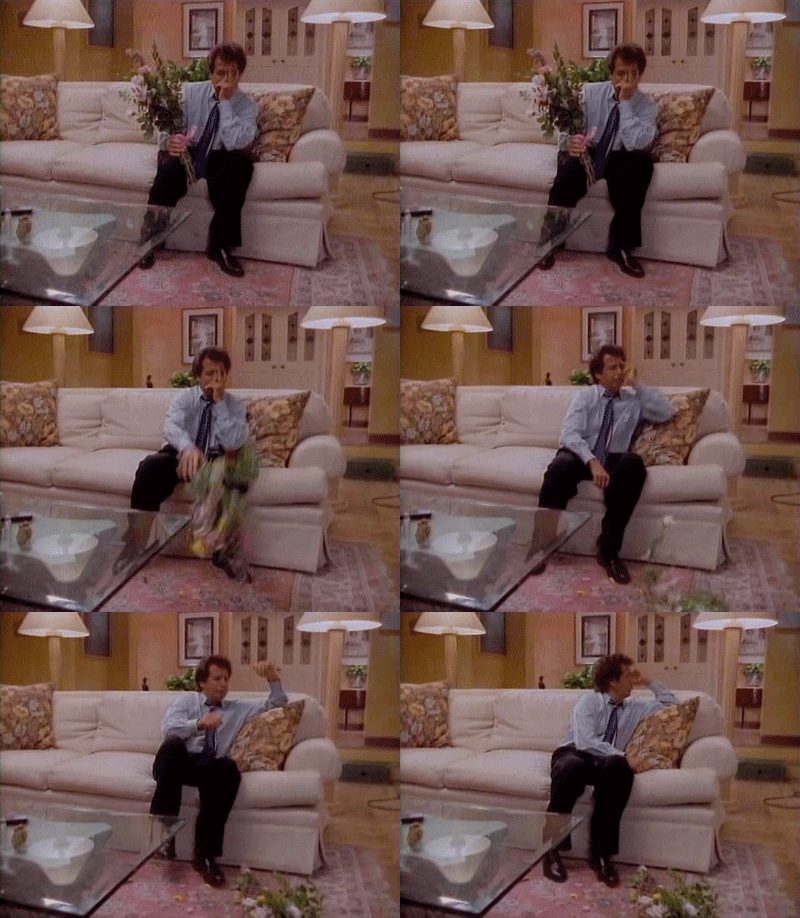
Every character was emotionally broken in some way.

Larry keeps people at arm’s length, hoping to get through life without getting hurt. In reality, he’s a walking, open wound.

Hank is six feet of insecurity in tap shoes. (“Hey now!”)

Artie drowns his pain in salty dogs.

Even Phil, the show’s wisecracking writer, eventually falls in love after seasons of playing the hardened cynic.

Larry, Hank, Artie, Phil, and Paula weren’t just glib caricatures. They were fully-realised human beings, complete with faults and foibles.

The show’s guests were flawed as well. Real celebrities appeared in episodes dealing with real-life crises: Burt Reynolds’ divorce from Loni Anderson, Chevy Chase’s epic talk show failure, Ellen Degeneres’ coming out.

While every script was tightly written, the cast often improvised on set. Shandling also made copious notes on scripts. Beside a line of Larry’s dialogue, one of his notes reads:

“Feel it. Then say it.”

In improv, we have a tendency to talk, not feel. And being deadpan can get you laughs, no question.

But how many times have you been in a scene where someone dies, or wants a divorce, or gets fired, and no one reacts?

Expressing emotion can be scary in real life. But what better place to explore it than onstage? Instead of being unfazed by everything, try overreacting for a change.

Scream with terror when someone mentions asparagus.

Tear your boss a new A for saying “Good morning.”

Cry when your scene partner sings the Care Bears theme.

Feel your response, then speak it.

One way to get out of your head and into your emotions is to move. David Razowsky teaches an exercise that’s incredible to watch, and a revelation to perform:

Two people go up, and exchange five lines of dialogue with no emotion or inflection; they just say the words in a monotone.

Person #1: Hi.

Person #2: Hello.

Person #1: How are you?

Person #2: Fine thanks.

Person #1: Glad to hear it.

Before a line is spoken, the actor has to move. They can move wherever they like in the space. Once they come to a natural stop, they say their line.

Their scene partner then has to move before they respond. Again, they can move wherever they like, but they can’t say their line until they’ve come to a stop somewhere in the space.

It’s always surprising to see where people feel compelled to move. It could be a few steps closer, very close, or far away from their scene partner. They could end up facing towards or away from the other person.

It sounds incredibly simple, but having done it myself, it’s easy to hear your partner’s line and start to speak before moving. The important thing is to let your body decide where you’re going to move. Then say your line.

Even though the words are delivered monotone, the scenes are inevitably infused with all kinds of emotions.

As Razowsky says, “Dialogue is informed by movement.”

If you find yourself “stuck” on stage, try moving, then speak. It doesn’t have to be big or frenetic. Just let your body take control. It’ll stop your brain from overthinking and let your feelings respond instead.

You don’t have to be a Monty Python fan to love this video.

Cleese explains there are two ways of working: what he refers to as “Open” and “Closed” modes. Creativity, it turns out, isn’t possible in the Closed mode.

That’s what we’re in most of the time: the feeling that there’s a lot of work to do, and we’d better get on with it. In Cleese’s words, it’s a purposeful, often humourless state that makes us slightly anxious, impatient, tense, stressed and even manic.

The Open mode, by contrast, is relaxed, expansive, less purposeful. We’re more contemplative, more inclined to humour, and consequently more playful. We’re also more curious, purely for the sake of curiosity, which allows our natural creativity to surface.

As a writer, I found it impossible to come up with ideas by staring at a blank page for hours. Time and time again, ideas would pop into my head when I wasn’t trying: in the shower, on the subway, even while brushing my teeth.

It’s the same with improv. When I go to a show thinking, “I’ve gotta kill it!” I suck. But those shows when I meander onstage with no agenda and nothing planned? That’s when the magic happens.

Cleese goes on to say:

• Creativity is not a talent. It’s a way of operating.

• It has nothing to do with IQ.

• The most creative people are simply good at getting themselves into “an ability to play…not for any immediate practical purpose, but just for enjoyment. Play for its own sake.”

And what is that last part if not a description of improv? No wonder it’s helped me in my writing, and in life.

If you’d like to learn more about getting into the creative mode, I highly recommend The Artist’s Way by Julia Cameron (thank you, Shari Hollett), and Seth Godin’s Linchpin.

In the meantime, enjoy this video. You’ll be richer for it.

“Imagination is more important than knowlege.” – Albert Einstein

Paul Aihoshi‘s tumblr is one of our favourite improv-related blogs.

Just don’t go there looking for information on shortform games, how to kill your Harold team audition, or the whole Close vs Johnstone thing.

What you will find is something way cooler.

Aihoshi photographs improvisers and writes a sort of stream-of-consciousness summary that’s utterly charming and often hilarious.

So far he’s snapped a cool cross-section of Toronto performers, including Simon Pond and Adam Ward of Pondward Bound, Jan Caruana, Yitzi Gal and James Gangl. We’re looking forward to the next installment.

All Photos © Paul Aihoshi

“The best thing about improv is that no matter how bad your show is, it’s only 30 minutes, and never exists again. The worst thing is no matter how good your show is, it’s only 30 minutes, and never exists again.” – Mick Napier

A great improv show is kinda like The Beatles At Shea Stadium: you really had to be there. Still, we wanted to try and capture some of that genius, so last year we started a blog called Improv Dialogue. Here are some favourite lines so far:

“The good thing about ice cream is, you can keep it in your freezer all year round.”

“I think it’s smart not to serve decaf. Fuck those people.”

“Of the two of us, I give off the greater crazy vibe.” “That’s the most lucid thing you’ve ever said.” “I didn’t say it. My mouth did.”

“Did you want that in twenties? Fifties? Hundreds?” “Twelves.”

“It’s horrible. It’s like somebody carved a turkey and then put it back together.”

“Minnesota is like the Canada of America.”

“If anyone out there has any EMS training…any first aid training…any training… Seriously people, if you can just get to New York City.”

“That takes me back to a summer I spent naked in a ravine.”

“Captain, you’re staring into space again.” “Sorry, I thought I saw an iceberg. I’ve crashed so many planes into icebergs it’s not funny.”

“Before you go, can you just one last time…move a crate of fish for me?”

“Just because a bunch of women get together in a room doesn’t mean we’re gonna watch Sex & The City and lament about how we don’t need men in our lives.”

“I’m gonna get rid of the sperm anyway. I’ll put it in her, or I’ll put it in a sock.”

“If this compass is correct, north is everywhere.”

“Come back to the city, where you drink coffee to wake up, drink alcohol to go to sleep, watch TV to live someone else’s life, and die of cancer from using a cell phone.”

“I love franchised shows.” “Yeah, Special Victims, Criminal Intent…” “Which is the one with the guy who used to be good?”

Improvised by: Rob Ariss Hills, Conor Bradbury, Jason Donovan, TJ Jagodowski, Cameron Algie and Steve Cole, Matt Folliott and Isaac Kessler, Unknown Improviser, Adam Cawley, Jess Grant, Alex Tindal, Devon Hyland, Simon Pond, Adrianne Gagnon, David Razowsky, Michael Graham, Kevin Whalen, David Pasquesi and TJ Jagodowski

Photo © Crista Flodquist

Heard some great stuff? Tweet (with improviser credits, if possible) @improvdialogue.