
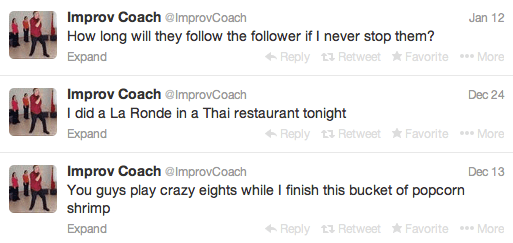
This is our new favourite thing. If you’ve ever coached a team, or been coached, these are right on the money. Follow on twitter @ImprovCoach.



The improv blog with attitude.
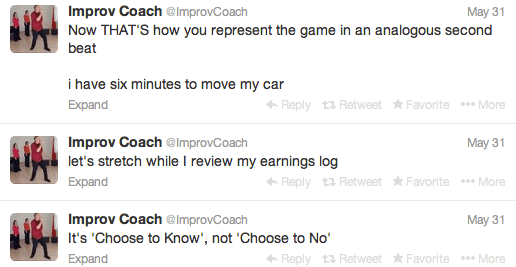
This is our new favourite thing. If you’ve ever coached a team, or been coached, these are right on the money. Follow on twitter @ImprovCoach.
When we came across the bookshelfies tumblr, we were smitten.
Here’s our improv-related section. Like a good Harold, it’s got a bit of this and a bit of that, but somehow everything’s connected. (See below for links.) What’s on yours?

The Artist’s Way
Lies: And the Lying Liars Who Tell Them: A Fair and Balanced Look at the Right
Final Cut: Art, Money, and Ego in the Making of Heaven’s Gate, the Film that Sank United Artists

Zen and the Art of Stand-Up Comedy
A New Earth: Awakening to Your Life’s Purpose
On Writing
The Right to Write
The Actor’s Art and Craft
Comedy Writing Secrets
And Here’s the Kicker: Conversations with 21 Top Humor Writers
You’re Not Doing It Right
American Theatre Book of Monologues for Men (Vol 1)
Taking the Leap
The Glass Teat
Magical Thinking
The Ocean at the End of the Lane
Born Standing Up
Truth in Comedy

The Basketball Diaries
Improvising Better: A Guide for the Working Improviser
Upright Citizens Brigade Comedy Improvisation Manual
The 
Story Line: Finding Gold in Your Life Story
The Art of Non-Conformity
Improvise: Scene from the Inside Out
Play
Your Screenplay Sucks!: 100 Ways to Make It Great
The Elements of Style
The Office: The Scripts
The Zoo Story and The Sandbox
Look Back in Anger
A Practical Handbook for the Actor
We looooove beatboxing in improv. You never know when you’ll need to add some mad flava to a soundscape, Bat opening, impromptu song, or Beastie Boys warm-up.
Since not everyone grew up listening to Biz Markie or Jam Master Jay, we were thrilled to find this beatbox tutorial from Dub FX. It’s fun, easy, and fast. If you can say “bouncing cats,” you’re ready to spit like a pro. Click below to watch.

Photo © Jeff Higgins
“When the rational mind is shut off, we have the possibility of intuition.” – Viola Spolin
Group mind, in my opinion, is one of the coolest things in improv.
When group mind is present, you don’t steer scenes: you’re compelled to move, together. It’s about letting go of consciously thinking and being in a state of flow.
If that all sounds a little “woo-woo” for you, here’s a true story:
When Cameron worked in advertising, he was part of a small creative department. They worked together, ate lunch together, and generally hung out together.
One day Carla, an art director, looked up from her layout and asked,
“Who’s that painter guy?”
Without hesitating, Cameron’s partner Matias blurted “Ansel Adams!”
Carla smiled and said, “Right. Yes, thank you.” Then she went back to her layout.
Cameron spun around, speechless. He kicked his chair over to Matias and said, “I was gonna say Ansel Adams!”
Now, if you asked me, or, oh, probably a million other people to name a “painter guy,” they’d probably say “Da Vinci” or “Warhol” or pretty much anyone other than Ansel fucking Adams.
Cameron and Matias knew Adams was a photographer, but they didn’t give their brains a chance to override their response with “That guy’s not a painter!”
Is that an example of group mind? I think so. (And if not, then what the hell is it?)
I’ve seen and experienced group mind many times, on stage and in rehearsals.
Devon Hyland and Matt Folliott did a show where Devon stepped out to initiate a new character. He’d barely gestured when Matt stepped in, and – knowing the move that was in Devon’s head – fleshed out the scene in just a few words.
To those of us in the audience, it was stupefying. We could see from Devon’s reaction that Matt had articulated what Devon intended, but how?
When I asked Cameron about that scene, he said, “I don’t remember. We were all so in the moment.”
That, for me, is the essence of group mind.
It’s like a school of fish, or a flock of birds. They’re so connected, so seamlessly entwined, it’s impossible to know who moved first. They could only be moving together.
In fact, scientists have built computer models that prove birds in flight are not merely watching and responding to one another. Their moves are so flawlessly synchronized, they could only be coming from some deeper, intangible level within.
So how do you cultivate group mind?
There really is no substitute for spending time together. Not just rehearsing and performing, but hanging out socially as well.
Go bowling instead of rehearsal one night. Take a road trip together. Host a potluck. Or just get drunk and play board games. The more experiences you accrue as a team, the more you’ll bond.
On the other hand, if you don’t like, trust, and respect each other, you’ll never achieve group mind; at least not on a consistent basis.
“Good chemistry is worth 100 practices.” – Will Hines
When you’re starting out in improv, chances are you’ll be thrown on a team with a bunch of random people. Some you’ll click with. Others you won’t.
When that team is dissolved (as most teams are), don’t let those relationships die. If you need to, form your own team with the people you clicked with, and keep playing together.
Chemistry lets you shorthand things. It makes things effortless. It’s why Seth Rogen, James Franco, Jonah Hill and Judd Apatow keep doing projects together. The same goes for the cast of Anchorman, the UCB four, and countless other ensembles.
Like twins or couples who finish each other’s sentences, you can develop an almost psychic rapport with your…giraffe. (Turns out Sally was gonna say “teammates.”)
Del Close described group mind as “One mind, many bodies.” The Caligula exercise can be sweaty and exhausting, but it’s great for connecting non-verbally.
Count To 20 is a good warm-up for quieting the brain and feeling the next move. (If you really want to swing for the fence, try counting to 50 or more.)
“Fall, then figure out what to do on the way down.” – Del Close
When you tap into group mind, you step into the unknown and enjoy the act of falling, together.
What’s your view on group mind? Have you had any interesting experiences? Leave a comment below, we’d love to hear them.

Photo © Keith Huang
This is a great tool for getting people comfortable with each other (we mean really comfortable), and for connecting non-verbally.
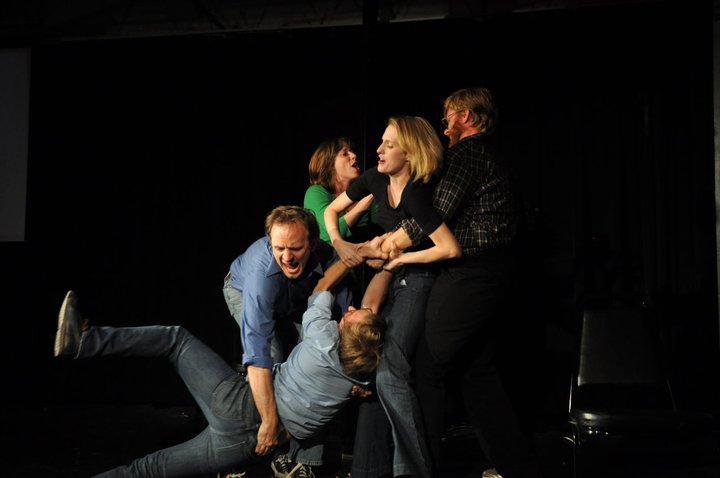
Photo © Crista Flodquist
To start, everyone stands and touches some part of someone else, using both hands. You don’t have to use your whole hand, it can be as little as the tip of one finger.
When the coach/director says go, everyone starts moving in any direction, as one entity. You can move wherever you want, but you must be in contact with other players at all times. If you find yourself losing the ability to use both hands, you can use a foot.
“Slow things down to make them more important, like the baby carriage scene from The Untouchables. When you slow it down and move or speak deliberately, it’s more fun than making fast, ambiguous motions.
Don’t left brain it. Don’t make pussy moves just to ‘go there’ already. Make everything, every movement or word, mean something.” – Susan Messing
If you find yourself phoning in movements, or hurrying from Point A to Point B, fully extend your body as you commit to the movement you’re already doing.
Caligula can get physically tiring very quickly, but it’s fascinating to watch the group meld and take on a life of its own. At some point you may find members being lifted, encircled, or even upside down. If that’s the case, take your time and lend physical support where it’s needed.

Photo © Crista Floquist
Wherever you are on your improv journey, these tips can help you get more joy.
1. Support the shit out of each other.

Photo © Kevin Thom
When someone makes a move, be the first to support it. Don’t wait to figure out what they’re doing, just respond.
Match their energy, heighten the move, scene paint, narrate…anything to add to it. It should look like you knew the move was coming, and love the idea. Move as a team.
Sometimes support means knowing when to edit. Your gut always knows when it’s time, so don’t hesitate if it’s telling you to sweep.
And support doesn’t stop with your team.
Attending other people’s shows adds your energy to the room, not to mention the show. Even better, bring friends and family from outside the community to share the experience.
And why not buy your favourite improviser a beer after the show? You can’t afford it? Oh. Then just tell them you liked the set and offer a sip of yours.
2. Be on time.
Yeah, we know. Improv sets are notorious for starting 10, 20, even 30 minutes late or more.
Some players are habitually late, so their team can’t start without them. If that’s you, make a new year’s resolution right now to be professional. You think TJ waits anxiously before every show, wondering where Dave is?
Being punctual shows you respect the audience, and your team. Also, be on time for rehearsals. Yes, even rehearsals.
For producers, don’t hold off the show waiting for more audience to arrive. Train your audiences to be on time by starting shows on time.
3. Don’t talk shit about your set.
Cameron’s first coach, Rob Norman, shared this pearl of wisdom: If you just got off stage and think you had a bad show, shut up.
Everyone experiences things differently. So while you may think you had a crap show, your teammates may have left the stage on a high. Don’t be a Betty Buzzkill. Or Danny Didn’tliketheshow. Or Maset McSucked.
Same goes for your audience. If someone compliments you after the show, don’t shake your head and start mumbling about how terrible you were. Just smile and say “Thank you.” (Try for that free beer!)
4. Stop “should-ing” on yourself.
You should have come in as the mad scientist. You should have brought back the pirate character. You should have swept before that scene died a slow, painful death.
Shelve your shoulds.
“There’s no ‘should have;’ there’s always a ‘could have.’ You should’ve been someone’s father, or you should’ve been someone’s boyfriend… But no. I could have, and it might’ve gone a different way, but you can’t judge yourself like that or your’re gonna not be entering.” – Scott Adsit
While you’re at it, stop comparing yourself to others in the comedy community. There is no one else on the planet like you, so comparing yourself is an exercise in futility.
When you find yourself thinking “How did he get on a Harold team and I didn’t?”, “Why did my web series not get a jillion hits?” or “I’m 25. How come I’m not already famous?!” – stop.
Instead of focusing on what you don’t have, make a list of what you do. We’re serious. Get a pen and write it down: your friends, your family, your cat, your health, your encyclopaedic knowledge of Batman. Then read Mike O’Brien’s advice for aspiring comedians. And as David Razowsky says, “Replace ambition with gratefulness.”
5. Broaden your horizons.
When Standards & Practices were invited to perform at Improvaganza, neither Cameron nor I had ever been to Edmonton. It turned out to be inspiring and life-changing for both of us.
We laughed our asses off, made new friends, and walked away with a new perspective on our craft.
Improvaganza, CIF, DCM, and Out of Bounds are amazing opportunities to connect with others who share your passion. If you’ve only ever studied or performed in one place, you owe it to yourself to see how others play, and festivals are a great way to do that.
6. Take notes. (Part One)
If you want to remember stuff from workshops or classes or rehearsals, write it down. When you’re trying to remember how to do a Deconstruction months from now, you’ll be glad you did.
I use Moleskines, or you can just press “play” on your smartphone’s voice memo app. Of course, you’ll still have to transcribe it, but it’s a great tool that lets you stay focused during class.
Take notes. (Part Deux)
Whether it’s an instructor, a coach, or an out-of-town improviser teaching a master class, when someone gives you a note, take it.
Chances are they’ve identified a tendency or behaviour that’s limiting you in some way. The least you can do is listen. When you argue, you miss an opportunity to learn. And take time away from others who want to.
7. Learn something new.
Improv is awesome, but to be really good at it, you need other things in your life.
So sign up for singing lessons, learn to juggle, join a softball team, enrol in cooking classes, make short films using Vine. It doesn’t matter what it is, as long as you’re stretching your synapses by trying something different.
Here’s one that’s simple and costs nothing: Try using your non-dominant hand for everything for a week. Cameron did this on a regular basis and now he’s pretty much ambidextrous. (Editor’s note: By ambidextrous, Sally means I can masturbate with either hand.)
8. Live boldly.
Every time we’ve done something that was a stretch for us, in work, in improv, or in life, we’ve grown exponentially. From signing up for Level A at Second City, to quitting a full-time job to pursue our true passions, it’s scary sometimes. But so worth it.
“We are not on this planet to make little, tiny moves.” – David Razowsky

Photo © Kevin Thom
You may also like Eight More Ways To Be Good With The Improv. Thanks for stopping by.

Last week we had the extreme pleasure of attending Toronto’s Impulse Festival.
For organizers Matt Baram and Naomi Snieckus, it was a chance to bring improv to a wider audience and showcase some of the best talent on the planet.
Whether it was Shakespearean improv by England’s School of Night, Bollywood Musicals by Improv Comedy Mumbai, or Gypsy Prov from Secret Impro Melbourne, the breadth of creativity on display was astounding.
But perhaps our favourite event of the festival was the soap-a-thon.
For the price of a donation to Gilda’s Club, patrons could see the funniest of the funny give it their all in a production that spanned more than two straight days. Folks like Colin Mochrie, Carolyn Taylor, Carmine Lucarelli, Mark Meer, Jacob Banigan, Sean McCann, Alan Cox, Chris Gibbs, Sandy Jobin-Bevans, Bob Banks, Kayla Lorette, Aurora Browne, Gary Rideout Jr, Ashley Comeau, Dale Boyer, Mark Andrada, James Gangl, Michael Grajewski, Marcel St Pierre, Lisa Merchant, Wayne Jones, Linda Kash, Dhruv Lohumi, and dozens more.
Neither sleep deprivation, nor blizzards, nor even a Toronto Hydro blackout could keep the cast from completing their goal, which they did, with a record-setting 55 hours at 10 pm Sunday night.
It was truly a great opportunity to reflect on the generous spirit of the improv community, not just in Toronto, but worldwide.

“I think of it like dance, or like a basketball team. A good basketball team has practised so much and knows each other so well that they know where they’re gonna be at any given time, or they understand the rhythm of each player. And they’ve worked so long putting it together slowly that it’s effortless, or it seems effortless.”

There’s so much great stuff happening at Toronto’s Impulse Festival, which started Thursday and ends tonight at the Young Theatre in the Distillery District.
Improv troupes from as far away as Germany, Australia, France, and India have come to play and mingle with Toronto’s funniest.
If you can’t make it in person, you can still watch a livestream of the 55-hour improvised Soap-A-Thon in support of Gilda’s Club Toronto.
A core group of fearless (some would say crazy) cast members are doing the full 55 hours, including festival organizers Matt Baram and Naomi Snieckus, along with Chris Gibbs, Carmine Lucarelli, Wayne Jones, Mark Meer, Jacob Banigan, and a gaggle of others.
Each episode is an hour and forty-five minutes, and in true soap opera fashion, you don’t need to see it from the start to understand the story. We caught it around the 24-hour mark and the actors were still shockingly coherent, not to mention laugh-out-loud funny.
You can watch the live feed and donate online here. Or better yet, come on down and support our hilarious community.


If there’s one thing improvisers love to do, it’s play.
So when Cameron got himself fired from advertising, he started a group called Funemployed.
It’s a community of fun people with the time and dedication to having fun – be they actors/improvisers, writers, artists, chefs, computer geeks, or just folks between jobs.
Since more and more people now have jobs with flexible hours, Cameron wanted to create a way for people to connect and spend their time joyfully, instead of being isolated. Anyone can post an idea or event for the group, and others will join in.
So far events have included softball, frisbee, free Improv for Anxiety drop-in classes, bowling, board games, and even trampoline dodgeball.
There are other “Funemployed” groups on facebook, including a web series and a few for job networking or finding your purpose. That’s cool, too, but the Toronto group is purely a fun-based initiative.
You can join the facebook group here. And if you’re not in Toronto, why not start your own chapter?


Photo © Jameson Kraemer


 People and Chairs