

Photo © Janna Giocoppo
The improv blog with attitude.
Photo © Janna Giocoppo

When I first learned improv, I was very concerned with supporting my scene partners. So concerned that when someone edited a scene I was in, I’d stop in mid-sentence and bolt off stage like I was being pursued by bath-salt zombies.
But then I saw other shows where that happened, and I realised it was distracting, and in most cases, unnecessary.
When your character is mid-sentence and suddenly stops, it’s like yanking a needle across a record (if you’ll forgive the old-timey metaphor).
You’re actually denying the audience a sense of closure, leaving your unfinished thought hanging like a question mark over the next scene.
It’s OK to finish your sentence.
Even if you say it while you’re moving swiftly off stage, it shows the audience that your scene is important. Not more important, but just as important as the one coming after.
As an added bonus, by completing your thought, you’ll often elicit laughter from the audience they’d otherwise miss out on.
Just don’t do a soliloquy while the person who tagged or swept you is standing there, waiting.
A Couple Of Exceptions…
• If a series of rapid-fire tag-outs breaks out, it’s better to keep the energy and momentum by exiting quickly, even if you don’t finish what you’re saying.
• You can also use ellipses within a scene where no one is trying to edit.
In that case, an unfinished thought can be a way to create intrigue and tension, as in this example from David Razowsky:
“I have a tattoo.” (pauses) “Anyway…” (trails off)
Try it at your next show or rehearsal.

Photo © People and Chairs
We can improvise anything we want on stage. Anything at all.
So why, as TJ points out, do we so often reach for the same old clichés?
“Experience what’s happening now, and make your surroundings real. You don’t have to invent an environment: it already exists.” – TJ Jagodowski
When you stop playing safe and really focus on what you and your scene partner have established, you’ll open up infinite new possibilities.
Cheers to that.
My boss saw two brothers, aged 4 and 8, being interviewed on Breakfast Television. The host asked what they wanted to be when they grow up.
The older brother answered “A dentist.”
The younger one blurted:
“I wanna be a dragon!”
As we get older, logic starts to rein in our imagination. Improv is a chance to let it run free again.
The next time something crazy, unexpected, or illogical happens on stage and your left brain wants to justify or “correct” it, ask yourself: Would you rather be a dentist, or a dragon?

(Also the best time to listen, feel, add information, keep the scene about, support what’s happening on stage, audition, jam, take a class, stop taking classes, put together your improv dream team, ask someone you admire to mentor or coach you, create a show, or pursue anything that’s been gathering dust in your soul.)
Director/artist/enfant terrible Tony Kaye once enraged a roomful of ad people who’d come to hear him speak at the Clio Awards. He walked to the podium, leaned in to the microphone, and said…
“Trust.”
Then he walked off, to booing and hissing.
Now Tony’s a weirdo, no doubt about it, but he did have a point.
On Saturday, my team and I did a set based on the show Roseanne.
We all loved having such clear-cut characters from the outset. I played Roseanne, and it made me realise the importance of having a point of view or “deal.” It freed me up to respond in the moment the whole show.
At one point, I was in a scene that got swept. Everyone moved off stage right except me; I walked stage left and stopped, because I’d forgotten this particular stage had no “off stage” on that side. All it had was a wall, a chair, and more stage.
Instead of panicking (a fave go-to of mine historically), I sat in the chair with my back to the wall. Even though I was clearly visible to the audience, I decided just to stay quiet and observe the players who’d taken centre stage.
DJ (played by my teammate Chris Besler) and Darlene (Maria Hajigeorgiou) discussed their sister Becky’s departure in the previous scene. Then I watched as “DJ” mimed opening his bedroom window, and exited the scene.
Now Maria was alone onstage. A beat went by and I heard myself say, “Looks like it’s just you and me, Darlene.”
She spun around and looked at me. “Mom! Have you been here the whole time?!”
I wouldn’t have made that move a year ago, and it felt amazing to have the courage to stay put, shut up, and when the time called for it, take focus. Most of all, it felt great to be supported by my team.
Trust yourself. Trust your teammates. Trust in the unknown.
Trust.
P.S. After the show Maria told me that in one episode, Roseanne actually hid in Darlene’s closet. How cool is that?

Corgi In The Forest as Jackie, Darlene, Becky, Dan, Roseanne and DJ – Photo © Caroline MacGillivray

Photo © Janna Giocoppo
Life is absurd.
If you doubt this, just spend five minutes on YouTube, CNN, or public transit.
Weird shit happens everywhere, every day. So why do we try so hard to make improv scenes go the way we expect them to?
The answer is usually fear.
Fear that we won’t know where the scene is going. Fear that our partner won’t understand our offer, or we won’t understand theirs. Fear of the unknown.
But isn’t that why we do improv in the first place? To do something we’ve never done before, and will never do again.
When we visit new places, try new cuisine, go to an art gallery or watch a movie, we want to be surprised. And improv is one of the few art forms where the actors get to be as surprised as the audience.
The conscious mind loves to control things, and our ego wants us to believe we need to control things in order for them to turn out OK.
For a long time I feared not getting certain, specific references on stage. (Let’s just say I stood on the sidelines nervously observing Mortal Kombat scenes.)
But how much funnier is it when someone doesn’t know the reference?
Suppose I endowed someone as Iron Chef, Geoffrey Zakarian.
You think the audience wants to see a perfect impression of the Chopped judge? If they did, they should’ve stayed home and watched the Food Network.
Maybe you’ve never heard of him, and the first thing that pops into your head is, “Zakarian…sounds Hungarian.”
Awesome. And if your idea of a Hungarian accent sounds more like the Swedish Chef, well…Bork!
Think about the best scenes you’ve ever done for a moment. The ones where everything felt effortless, and you never wanted it to end.
However those scenes started, I’ll bet none of them turned out the way you expected.
When you let go of your improv steering wheel, you connect with something deeper than your conscious mind can fathom. It’s the same state of flow that artists, musicians, authors, sculptors, dancers, and even scientists tap into when they bring something awe-inspiring into being.
The more you can open yourself up to that state, the more you will be amazed.
For inspiration, check out: 42 People You Won’t Believe Actually Exist.

Photo © People and Chairs
“I don’t like comedy. I like funny things. I don’t like comedy. Like, comedy movies are just, ‘Oh Jesus.'” – Louis C.K.
I know what he means. I’d rather sit through a bad drama than a B-grade comedy any day.
Cameron and I often “overdub” movies, Mystery Science Theatre 3000-style.
We’ve made fun of Tim Robbins in Arlington Road. Adrien Brody in Splice. Even Gene Hackman in Heist.
What makes it funny is the deadly seriousness of the actor on screen. (And really, nothing’s funnier than an Oscar-winning actor in something really bad.) The more dramatic the film is supposed to be, the greater the opportunity for comedy.
“Sometimes things are really funny if you’re absolutely earnest. If you’re really serious, it’s hilarious.” – Christopher Walken
The funniest people I know are great actors. They may be improvising on stage, but they are also acting. It requires a level of commitment to the scene most of us don’t even aim for.
That’s not to say I don’t enjoy goofy improv sets; I do. But for me the biggest laughs, the shows that really resonate, inevitably involve great acting.
One of my favourite movie scenes of all time is Walken as Diane Keaton’s psychotic brother in Annie Hall. (If you haven’t seen it, click here to watch.)
He plays the part like it’s Requiem For A Dream, not a quirky romantic comedy. It’s such a small role, but his commitment to character makes it unforgettable.
Note Woody’s performance, too. Even though he calls out Walken’s character as a freak, he does so in a way that’s understated.
Colbert, Carell, Razowsky, TJ and Dave, Jason Mantzoukas, Steve Coogan, Bob Odenkirk…these people get laughs precisely because they don’t play the scene for laughs.
Subtlety, emotion, and vulnerability, while seldom seen on stage, are all things that elevate good improv to great.
For more inspiration, check out Real Actors Read Yelp Reviews. So many great ones, but #3, read by award-winning actor Brian O’Neill, and #4 by Greg Hildreth are faves. (Canuck improvisers: how much does Hildreth remind you of Jameson Kraemer?!)
Last night some friends did an improvised version of Degrassi: Junior High. It was hilarious.
With a couple of cheesy wigs and some spandex, the performers had the audience in stitches. And it made me realise what a difference even a little specificity makes.
Sure, they were playing established characters. But it’s not like anyone remembered the original storylines.
What they had were the characters’ deals, or points of view, and a time period (the ’80s) as a backdrop.
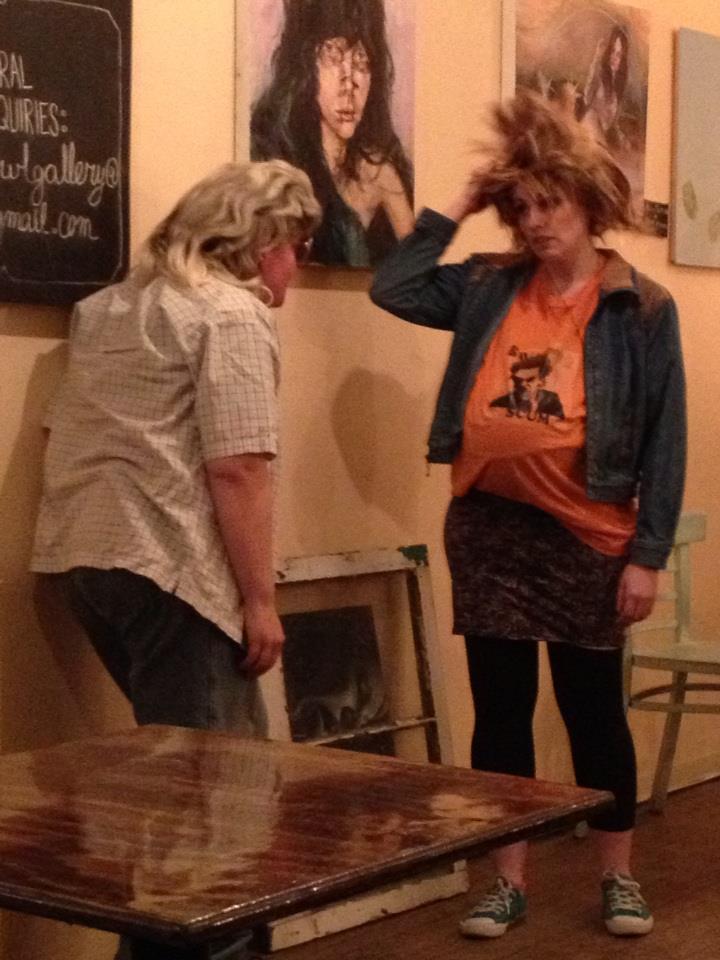
“Mr Raditch didn’t count on the four J’s: Joey Jeremiah in a jean jacket!” – Jason Donovan as Joey
Think of your favourite fictional characters, and you immediately picture their clothes, their favourite tchotchkes, and their environment:
• Dexter with his “kill outfit,” souvenir blood samples, and Miami bachelor pad
• The Wire‘s McNulty and Bunk getting drunk, the omnipresent orange sofa, Omar with his gun, or Senator Davis’s trademark “Sheeeeeeeeit!”
• Don Draper in his razor-sharp suit, downing whisky at 10 a.m. in his hip ’60s ad agency
Any one of those details would add richness to an improv scene. Together, they create a world.
For more inspiration, check out Design*Sponge‘s feature called “Living In…” It’s a visual recreation of the objects from movies and TV shows.
Click on the links to see how they break down the things that make up Best In Show, Downton Abbey, and Bill Cunningham New York.


 People and Chairs