

Photo © Roo Ster
The improv blog with attitude.
Photo © Roo Ster
When you treat your objects like they’re real, the scene becomes more real – for you, and the audience.
In this scene, Cameron tries to move an industrial stove. Instead of just sliding it across the stage in two seconds, you can almost see the hernia developing. (Now that’s comedy.)

Having a strong point of view makes doing a scene easy and fun. This exercise gives your character something concrete to play off of, right out of the gate.
Think of something you personally have a strong opinion about.
It doesn’t have to be political or religious; it can be as simple as “I hate clowns.”
Now, just flip the statement, whatever it is, and hold the opposite opinion as you play out your scene.
For example:
• “I enjoy exploring new cities” could become “I’m afraid of foreign places and people.”
• “Fox News is stupid” could become “Fox News is the best source of intelligent, factual information.”
• “Smartphones are destroying human interaction” could be “Smartphones make face-to-face communication better and more honest.”
etc.
You don’t have to force the topic into conversation, but you’ll find as your scene unfolds that you’ll share your newfound belief naturally.
To do the exercise, everyone thinks of a strongly-held opinion while they’re on the back line, then reverses it. Two people are chosen, and the Coach/Director gives a location to start their scene.
Try it at your next rehearsal.

Photo © Kevin Thom
We love this infographic by Bob Kodzis. If you’ve ever taken a class with David Razowksy, you’ll get it. And if you haven’t, we hope it intrigues you to do so.
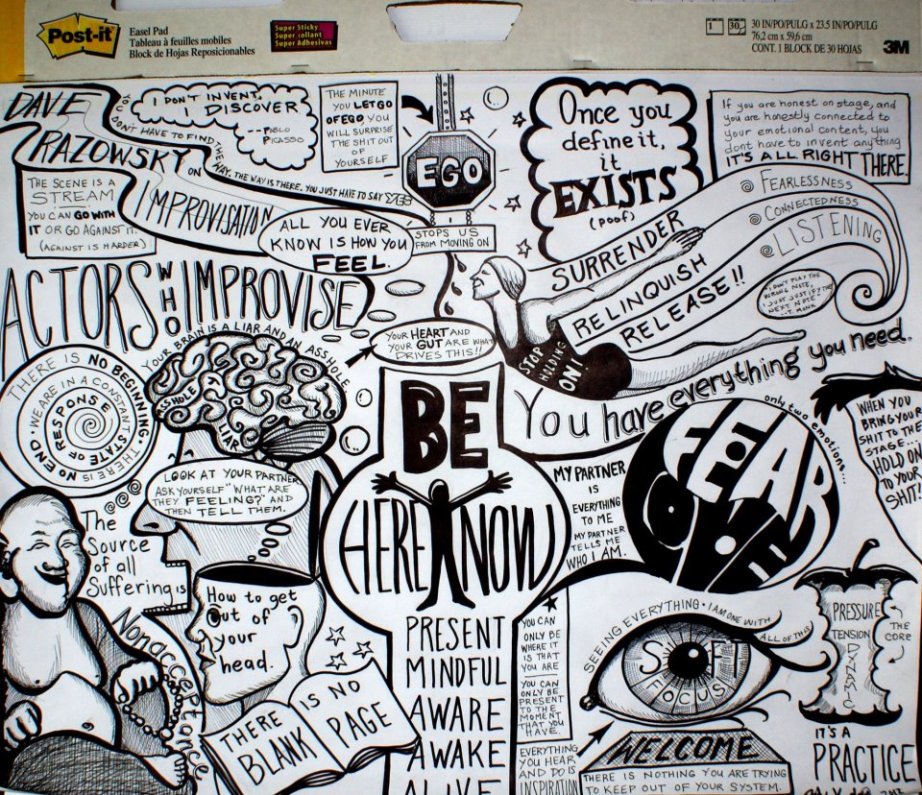
Image © Bob Kodzis
This is a great form for improvisers of all disciplines to drop in on and play with ease.
Director’s Cut takes five improvisers and turns them into movie directors. Before the show, each “director” chooses a film genre (Sci-Fi, Horror, Teen Romance, etc.) and is responsible for casting and directing their fellow improvisers for their portion of the show.
Before the first scene, each director gets an ask-for to help inspire their improvised film.
Directors stand stage left or right, and set up the narrative aspects of their film. For example, they might set up the Horror movie scene with, “We see three young men pull up to an abandoned cabin in the woods. They get out of their car, excited to spend a few nights in the wild. But one has an uneasy feeling about the cabin…”
The improvisers then start playing the scene. The director can chime in or side-coach to help explore relationships, the narrative, or anything else he or she finds interesting about the unfolding story.
The director can also set up character archetypes and names; anything really, as long as they leave room for the performers to play.
After we see the five movie styles or genres, the audience votes off one movie, and we see the continuation of the four remaining improvised films until one movie and director remain.
So much fun! It’s an easy form to grasp, and a real audience pleaser.
(Thanks to actor/improviser Matt Folliott for this post.)
I learned an early lesson in showing up at a Cage Match final years ago.

Photo © People and Chairs
Adam Cawley, Reid Janisse and Marty Adams were one of two teams performing, but according to the rules they couldn’t win, because one of their team members was missing.
That didn’t stop them from putting on one of the funniest shows I’d ever seen.
At one point they swept a scene so quickly, the stage was left bare for a second. Without hesitation, Adam pointed his finger and yelled “Empty stage!”
The three of them strode back on and walked in a circle, pointing and yelling “Empty stage! Empty stage!” in unison.
It was ridiculous, and hilarious, and people were crying with laughter.
I was blown away by their commitment to creating something out of literally nothing. And even though they couldn’t win, they showed up and gave it their all. No wonder they made it to the finals.
“Eighty percent of success is showing up.” – Woody Allen
It’s a simple thing, but it’s so important.
Show up.
For rehearsals.
In scenes.
For a show you said “yes” to – even if it was months ago and you forgot.
Showing up shows you care.
About your team, your scene partner, and yourself.
Photo © Kevin Thom
What if you could start over whenever you wanted? What if you could begin again? What if you could begin again again? What would you do differently if you could do it differently? When do you have the chance to do THAT?
Hm?
Well, you can each time you step on a stage, sit before a blank page, pick up your axe, sit at the bench, stand by the easel. You just have to decide that you are starting fresh. All it takes is your being aware that always your point of view can be at the “Point of New.”
What’s stopping you from starting anew?
You. Your story, your decision to think that you’re helplessly, hopelessly connected to your past actions. You know the dialogue:
“That’s what always happens.”
“That’s just the way we are.”
“I’m the kinda person who…”
“My family’s history is…”
“I’ll never get it.”
Or the classic:
“I don’t know.”
You do know, don’t you, that it’s your decision to state those statements, to engage in that text, to play that part? All of those sentences you decide to utter. Your choice to engage the thoughts then carry on with what you think is your destiny. We do it mindlessly.
UH-UH!
Be mindful that your words matter. Be aware that your thoughts are being thought. That your mental texts have weight. You give them weight. You give them meaning. You choose to dwell on them. Think about it. You might not say the “C” word or the “N” word. These are two of the heavy weight heavyweights. For some these words are “cringe-worthy” because we’ve given them power.
Your engaging in the sentences above are just as cringeable. Those two pieces of architecture have the same energy as the words you might use on yourself: the story that you “suck,” that “others are better at improv than you,” that others have “more experience,” are “blessed with wit,” or good looks or a better family who cares more for them than you perceived your family cared for you. These are bullshit memes that lets your ego control your artistry.
Your ego does not control you. You choose to let your ego control you. You do it by listening to it, then engaging in it. In all of the museums, in all of the theaters, in all of the galleries, in any hall or field or closet or on any wall there is no artwork that was created through the union of inspiration and ego. None. It can’t be made because that voice that you’re letting to speak drowns out the voice that you use to produce your output of you-ness.
Each time I stand at the entrance to the stage I’m aware that I’m standing in the middle of absolute nothingness, emptiness, a blank canvas. It’s the opportunity for me to be aware of non-engagement. I am not attached to my past performances, I am not aware of what I’ve done “wrong,” or what I’ve done “right.” I am just there. When I’m just standing in that void I’m present to my openness, my chance to listen to all that is happening. Not what has happened, nor what I hope will happen. It’s a sacred space, that place right where I’ll be entering the stage. My awareness to the stillness that’s there helps me to be affected by whatever stimulus I enter into on the stage, the stillness that’s there not because I put it there, but because it’s been there the whole time.
It’s the opportunity for a birth. Not a re-birth. A birth. Clean, fresh, aware, awake, alive, alert. It’s not an opportunity to run the mental newsreel, to make sure that the plan is going to go as planned when you planned it during the time that you planned it. It’s your opportunity to leave the baggage in the car, to store the stuff in the locker, to time to start anew. To keep what went on yesterday securely stored in the “history bin” you keep out of reach. Now is the best time. Now. Now. Now.
The time is always there. Always. Just like the moment is. Weird, huh?
©2013 David Razowsky
If you’d like to learn more about David’s workshops, shows, podcast, and other cool stuff, visit davidrazowsky.
Improv teams are a fluid, ephemeral thing.
A handful last years, while most last months, weeks, or even – like Todd Stashwick’s MayFly cast – one night.
Rob Ariss Hills is a Toronto improviser who created this to artwork to map his own improv lineage. If you’d like him to do the same for you, email him at: robertarisshills@gmail.com
Digital copies and/or posters are available (commissioned pieces will be higher resolution than the image below). For shipping outside Toronto, send your snail mail address to request a quote.

Image © Robert Ariss Hills


 People and Chairs