David Razowsky is.
If that’s a little too Zen for you, he’s a master improvisation teacher, actor and director who’s worked with DreamWorks, Steppenwolf, Steve Carell, Stephen Colbert and Amy Sedaris. He’s also the former Artistic Director of The Second City Training Centre.
I had the privilege of speaking with him about his approach to improv, life, and everything.

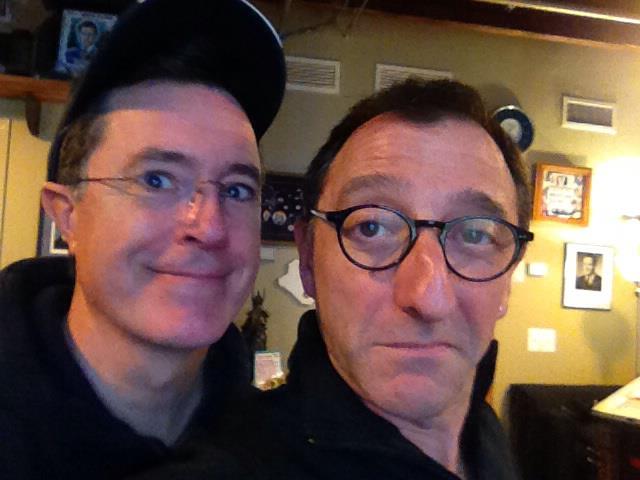
Photo © Kevin Thom
“The minute you let go of ego, you will surprise the shit out of yourself.” – David Razowsky
P&C: You’ve started teaching a course at iO West called “You,” that comes before students learn the Harold. Why is that important?
DR: I think people get caught up in the need for structure. It’s why you teach children to like religion, because it’s a structure. And then you’ve gotta let them leave when they want to, y’know, because it’s a structure that you’re gonna look at.
Until you know how to improvise, you shouldn’t be doing the structure. Because you’re adding so many things onto… you’re layering so many things. It’s like, “Get all these fucking blankets off me. I don’t need any of these blankets, just get them off me.”
So you’re saying, “How does this structure work?” “What is it that I do now?” And all of these fucking questions, as opposed to, “What is the foundation of everything that I’m doing?” And the foundation is really a relationship that you have with your partner. Everything else is built around that.
If you’re doing a structure, I don’t care what it is, and you don’t know how to improvise, you’re gonna be drowning in ego. Drowning in judgement and self-doubt and all that stuff. But at the end of the day if you know how to connect with somebody, you can do whatever you wanna do. Anything.
So what this class is teaching is, you to give yourself permission for you to evolve. You give yourself permission for you to artistically evolve, and for you to know that what you’re thinking is great. But you’ve got to know that you know it. It’s about you being present, and that’s what this class teaches. It teaches presence.
P&C: You’ve been performing with Carrie Clifford for some time now. What do you like about a two-person show versus a larger group? Do you think you can accomplish different things with a two-person dynamic than you can with a larger team?
DR: Oh for sure. With a two-person show, working with Carrie specifically, we can watch a relationship grow. And that’s why I think people come to theatre, is to watch these two characters build a relationship and grow from there.
Working with Carrie, it’s a very positive experience, she’s a very joyful person, and to be connected to somebody so joyful, it makes you feel joyful to watch it.
It’s never work. It’s just two people who are unfolding, evolving, and not working. We listen to each other very, very well. And we don’t just emotionally listen to each other, we’re deep-tissue listening to each other. I’m aware of where she wants a certain character to go, or to stop, or to move, and I’m aware of all that.
But that’s what you get out of working with any group, is listening to what they’re saying without them having to voice it. And I listen to what Carrie’s saying, even though she never voices it. She may say one thing, but I know that’s not what her intentions are. And that’s not to say that she’s confusing, it’s to say that I know one thing will come out of her mouth, but she clearly wants me to do something else.
Any group that you work with, if you don’t have listening, you don’t have anything. And I’m gonna go back to your question about the structure.
If you’re listening to the ego or your teacher within you, telling what you need to do or have to do in order to get this math equation working, you’re not able to connect to yourself emotionally to know where this person lives, emotionally lives.
In a group you have entrances and exits and you get to fuck around with more people, but it all goes along the same lines. If people aren’t listening, if people have agendas, it’s going to be hard.
To be honest with you, I don’t have a problem with that because I don’t play with those people. I will play with a group of people, but I will not play more than once with a group of people who have an agenda. I will play with you once if you have an agenda, then I will not play with you again. That is all. I am done. I’ve got enough, no more thanks. No, I won’t take it to go; you eat it.
P&C: Do you ever have what you would call a “bad show” anymore? Do you ever judge your performances?
DR: I think I mentioned to y’all that I don’t think I’ve had a bad show since the late ‘80s. I know that sounds weird, but something happened one day where I decided, I’m not gonna judge myself that way. I’m not gonna look at it as, Did I have a good show? Did I have a bad show?
I’m gonna look at it and think, Did I have fun? Did I listen to people? Did I forward the action? If I did find myself having an agenda, how did that work out for me? It probably didn’t work out well, and then I’d think, OK, I’m not going to do that again.
So the way that I look at it is, every single performance is a class, and if I’m not learning from me, I can’t learn. So it’s been 20 years, 25 years, whatever it’s been since I’ve really looked at the performance I do in that moment in a negative way.
But I think it has a lot to do with your attitude. What’s your attitude about everything? You can say, Did you have a bad show?, or Did you have a bad day?, or Did you have a bad experience at the supermarket? And I’ll go, No, No, No.
You know, I look at people’s facebook status and it’s like: “I’m having a hell of a day.” It’s like, keep publishing that… It’s boring to me, it’s just boring. If you wanna do it that’s great, I’m not gonna knock it, but I don’t want any part of it.
P&C: You have a very Zen approach to improv. Which came first, your interest in improv, or your interest in those kind of teachings?
DR: Improv first, and then I fell into that. I remember clearly when I fell into that. I remember it so clearly: I was at LAX, and I was about to take an American flight to Santa Cruz for the improv festival they had up there.
I went to the bookstore at the American Airlines terminal and I saw a book that said Buddhism Plain and Simple , and I thought, “Oh, it’s plain and simple. I’ll buy it.” It was written by a guy named Steve Hagen, and I bought it and I thought, “This speaks to me. This speaks to me! Everything that he’s saying speaks to me.”
And once that started happening I started to read more about those things. It washed over me in a way where I’d find myself being in an improv scene and saying, “OK, this is a wonderful place for me to practice some of this Buddhist stuff that monk Hagen was talking about.”
And as it went on I was thinking, “That worked.” To be present, to be here in the moment. Not to be ahead of myself or behind myself, but just to be here. Not to have any idea of where it’s going to go. To know that if I find myself in a place where I’m confused, to be confused.
And that is such an important thing, because in improvisation you may say, “This scene isn’t going where I want it to be.” Well, where is it? It’s “I’m confused right now,” or “I’m lost now.”
That’s the gift that you give yourself, you give yourself the gift of acknowledging what you’re feeling in that moment, and being A-OK with it because really, there’s nothing else you can do.
When I’m in an improv scene and I feel like I’m lost, it’s like, what a gift I just gave myself. I gave myself the gift of presence. I gave myself the gift of what it is that I’m doing in this moment.
I know certain people are gonna look at it and go, “You don’t know anything about Buddhism,” and it’s like, you got me on that one. I’ve read a couple of books, and I do this practice that people look at and go, Oh that’s Zen, and it’s Buddhism, and it’s like, that’s great. If that’s what it is, great.
All that I know is these precepts. I don’t need to codify it, I don’t need to tell you where it came from, it doesn’t really matter… at the end of the day, my experience in the moment with you while I’m in that scene is all that fucking matters.
And I also believe that it helps your life. So that came, and then what ended up happening was it just spilled over into the rest of my life. Where I started to gravitate towards people that had that same sort of feeling, without even really knowing it. Someone would say, “You’re talking about presence.” It’s like, Oh! We’re speaking this secret code that everybody feels but no one talks about.
A lot of people go, “Yeah, this is all mumbo jumbo.” And I just wanna go, Sure, if you say so. It’s not up to me if you’re gonna get it. I’m living it. I’m living it. I can teach it to you, or you can just watch me. Right now I’m living it, and that’s OK.
P&C: You prefer the term “actor” to “improviser.” Why is that?
DR: It cuts right to it. Because if you say you’re an improviser, you then want to put an improv structure on something that you’re going to get to anyway, and that is, you’re acting. You are acting. No matter what, you are acting.
If you wanna tell me, “Yeah, I just improvised. I’m an improviser, I’m not acting,” I wanna say, All right, you explain to me what the difference is.
Because if I’m gonna tape you and show a performance of you improvising, and then I’m gonna tape somebody who’s reading scripted material and I show it to the average person, they’re not gonna know what the fucking difference is anyway, because it doesn’t matter.
At the end of the day the end product is the end product. In Spain, they make something called pan. Here we make bread. It doesn’t taste any different.
What it also does is, one may think, “I don’t wanna be classified as an actor.” Why the fuck not?
And here’s another thing. If I say to you, “I want to pay you to act,” you go, “Ohhh, great!” If I say to you, “I’m gonna pay you to improvise,” you may be expecting less money.
P&C: (laughs) I’d say that’s probably 100% true.
DR: You might go, “OK, maybe I’ll get enough for a couple beers.” But if I say I’m gonna pay you to act, you’re like, “Ooooh, pay me to act.”
Another thing: when you look at acting – all improvisation is acting – you’re able to look at all behaviour as inspiration for you to engage with. Whereas in improvising people sit in fucking chairs and that’s all they do.
I wanna say if you’re an actor, let’s talk about blocking. Let’s talk about duration. Let’s talk about shape. Let’s talk about object work. Let’s talk about all those things.
But let’s not talk about all those things in terms of, that’s what an improviser does. Let’s talk about all those things in terms of, this is what an actor does. Let’s talk about all those things in terms of, this is what an artist does.
Let’s talk about the fact that if you’re an artist, if you’re a painter, you know what each fucking brush does, you know what the nap of the brush is, you know what all that stuff does. But an improviser is lazy. It’s lazy, lazy, lazy, lazy! (laughs)
Although there’s a lot of people I love watching who aren’t fucking lazy. But they’re not lazy because they’re really thinking about, present to and mindful of all that’s occurring to them, at the time that they’re doing it.
But I’m certain of that difference there.
Also if I say to you, you’re an actor… Anyone who’s reading this right now, if you say to yourself, “I’m an improviser,” it’s a narrow thought. And the energy of that is narrow. If I say to myself, “I’m an actor,” if I admit to myself that I’m an actor, I’ve got thousands of years of help behind me. As opposed to “I’m an improviser.”
People have been improvising for as long as they’ve been acting. But if I call myself an actor, I get to be broader. And I don’t mean to be bigger on stage or chew up the scenery or ham-fisted; I mean broader in terms of my base knowledge. Broader in terms of everything that’s going on onstage.
P&C: Sometimes Cameron will come home from a show and he’ll say, “I had a scene tonight and there weren’t a lot of laughs, but some people may have, if not cried, maybe felt a different emotion than the usual…” and he’s excited when that happens.
DR: But what you’re saying there is very interesting as well. It’s also, what’s your expectation from the audience? Because if you call yourself an actor, you don’t have an expectation that the audience needs to be fucking guffawing every minute. And the pressure is a lot, the potential to have the ego come in… The pressure is diminished, because you don’t have expectations from the audience when you call yourself an actor.
Now people are going to come to the show and they’re gonna expect improvisation but you know what? You’re improvising. If someone comes to an improv show and they don’t know that you’re improvising it’s like, Did you have a bag over your head, and you were kept in a box and then just released into this room?
That’s why I also feel like, I don’t take suggestions. I fucking don’t take them. If you don’t know that I’m improvising… And half the time that you take a suggestion the audience doesn’t remember.
P&C: I haven’t seen you improvise with Carrie, but I’ve seen TJ and Dave a number of times and they just start their thing. They don’t need this artifice of a word to get rolling.
DR: Right? Carrie and I have a bunch of videos online…
P&C: Oh great, I’ll check those out.
DR: There’s at least three produced shorts that we’ve done that are totally improvised. There’s one called Lambrusco, Mediterranean Diet, Ovened Bread, Marathon, and Maladies.
The one that I would watch first is Ovened Bread. It’s about ten minutes long, and it looks totally scripted. It looks so scripted. We didn’t go back, we didn’t re-edit it. It was just two cameras. Carrie’s husband put two cameras out and he was directing it. As this camera’s on here, he would move this camera around so it looked like three cameras.
P&C: Who are your acting heroes? Whose work do you admire?
DR: I’m thinking about somebody that I just saw that I thought, Oh my God I love everything that they do. She played Bob Dylan in that Bob Dylan movie…
P&C: Cate Blanchett?
DR: Cate Blanchett, I love her. I love her so much. Tilda Swinton, I love her. Meryl Streep… I’m one of those guys. Look, I just named three women. Oh, Steve Buscemi. Johnny Depp… Only because I like these guys, like, they know who the fuck they are. It’s like, “This is who the fuck I am.”
In terms of comedy I really like Kristen Wiig. I really like her a lot… [I’d] better get some men in there. (laughs)
I love Pasquesi. I think he’s fucking great. I really like David a lot; I like what he does. That’s plenty right there, right?
P&C: That’s great.
(In Part Two, we discuss David’s Viewpoints approach to improv, his experience at Second City with Stephen Colbert, Steve Carell, Amy Sedaris and Paul Dinello, and how not to get your scene partner “on you.”)



 , and I thought, “Oh, it’s plain and simple. I’ll buy it.” It was written by a guy named Steve Hagen, and I bought it and I thought, “This speaks to me. This speaks to me! Everything that he’s saying speaks to me.”


 People and Chairs