Info

Photo © Kevin Thom

Photo © Kevin Thom

We’ve all seen shows where someone decides to use a real prop on stage.

It’s usually small, like coins or a cell phone. And once it’s introduced, everyone tends to fixate on it: the players, as well as the audience.

I’ve seen seasoned performers kill it with props, but more often, props kill the scene.

Props work well in shortform games, like the one from Whose Line Is It Anyway? If everyone knows up front that they’re part of the show, the results can be frickin’ hilarious.

But using props in longform tends to throw players and audiences off a little. When everything else in the scene is imaginary, bringing in something real is a bit like shining a light on shadow puppets. The magic and mystery disappear.

Besides, as I’ve learned from writing for radio, it’s way cooler to let people imagine their own version of your world.

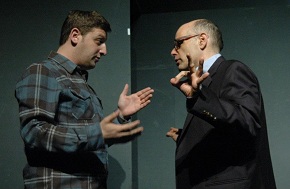
Of course, there are exceptions, and the photo above is one example.

Revel Theatre hosted a show recently where there happened to be books and a table on stage. Kevin Whalen literally stumbled on his character. When the lights went up he stumbled a little, and reached out to steady some books that were falling.

“Sorry! Soooooorry!”

His character was born in that second, when he organically reacted in the moment. Kevin’s scene partner, Reid Janisse, endowed him as an author.

As the scene progressed, Kevin alternated between haughty high status befitting a new author, and the grovelling apology he established in the first few seconds.

The scene worked, for two reasons:

1. Kevin didn’t decide to incorporate books into the scene. The prop more or less incorporated itself by falling over, and Kevin simply reacted to and embraced what happened.

2. While Kevin occasionally picked up a book, the scene wasn’t about the props. It was clearly about a weirdo author and his relationship with his agent, the bookstore owner, and his fans.

It definitely helped that Kevin and Reid are both pros.

Bottom line? When in doubt, leave it out.

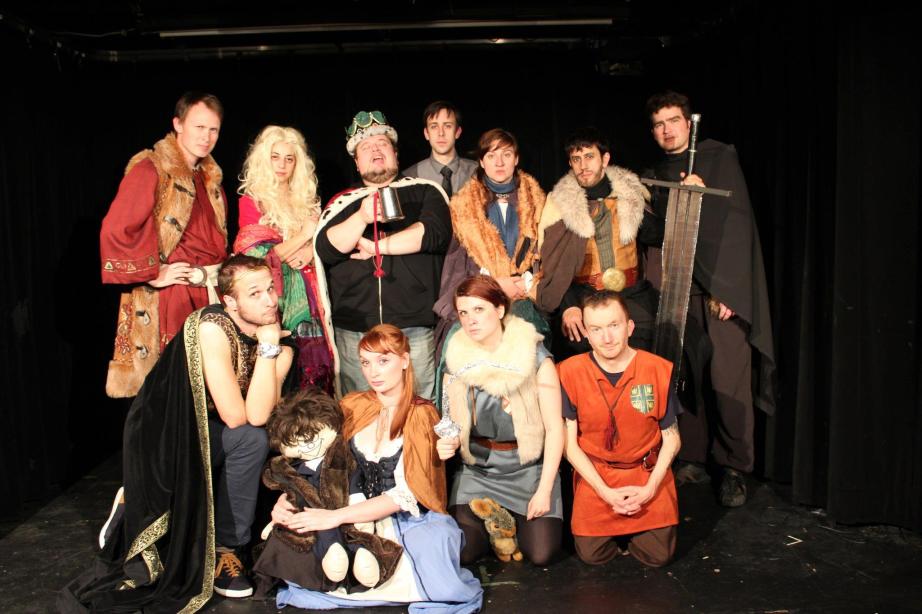
It’s no secret there are a lot of sci-fi and fantasy nerds – uh, fans – in the comedy community. But you don’t have to be a diehard Thronie to enjoy the improvised parody, Throne of Games. 

We asked Director Colin Munch and fellow cast member Kris Siddiqi about their world of the Seven Kingdoms.
ToGphoto

Photo © Paul AIhoshi

P&C: What were some of the challenges in adapting a series as popular – and mammoth – as Game of Thrones for the stage?

KS: Everything.

CM: Yeah, pretty much.

Picking what was important and what wasn’t important was so difficult. What moments we were going to focus on, what characters we were going to include.

KS: Getting people up to speed on a really thick, huge universe. And just being able to sort of skim the top of that, get that basic information out that needs to be gotten out, and still be able to translate the intentions of the character, and their placement in the world.

CM: [It was] probably equally challenging for those who didn’t know the world, as it was for those who do. Because you have to choose between being a know-it-all nerd and actually making choices that are playable, rather than just dumping knowledge.

KS: Totally. I think as improvisers, we always play in genres no matter what. If it’s there, we’re playing in the genre.

But that’s what makes these challenges easier to work with, because we’re all well versed in the tropes and the idiosyncrasies of the genre. And something like this is steeped in every single trope and idiom that a fantasy genre comes in.

CM: Yeah, it’s not just a mediaeval fantasy. It’s a murder mystery, it’s a family drama, it’s a horror story at times. It covers all the bases.

P&C: The cast reads like a Who’s Who of Canadian comedy greats. How did you choose people for each role?

CM: Well, we wanted [Kris] for Ned immediately. It was definitely a bonus that you were already a fan and were available. But you were the first name that was put forward for the cast.

I really wanted [Conor] Bradbury for Khal Drogo right away. I knew I could put him in jean shorts and he wouldn’t argue with me.

KS: Did you choose more on just on physical appearance or…?

CM: Well Paloma [Nunez] and Alice [Moran] did most of the casting, because they’re more familiar with who’s who in the community.

I was really focused on temperament and attitude rather than what they looked like. Rob Norman doesn’t look like a 14-year-old boy, but he plays Joffrey really, really well.

P&C: It’s rare to see costumes used in improv, let alone ones as elaborate as yours.

Does performing in costume help or hinder players?

KS: It helps.

CM: Absolutely. The one challenge it creates is it, in a way, can lock our actors into playing a single character. Which can be detrimental to the show as a whole.

Paloma can’t just toss off her dress and jump on and play another character; she pretty much has to be Cersei for the whole show. Whereas I as Viserys could probably just toss off my wig and come in as something else if I needed to.

KS: But I think really that’s the only difference. Because again it’s being improvisers and being used to like, “Oh, where’s a joke I can drop?” or “How can I help this scene?” We’re not as able to do that in this, again, because those costumes clearly define who you are.

CM: And it lets us act a little bit more than we usually get to. You get to sit in your character more; you don’t usually get that luxury when you’re just guys in t-shirts and jeans.

KS: When you have that pomp, it totally adds to it. Me and [James] Gangl did a show years ago based on Deadwood

CM: Yeah, Dreadwood!

KS: We had a friend who worked at a costume store, and she did the fittings for everyone. And there was the day when everyone saw themselves in costume… The room was kinda silent, because everyone’s gears were turning in their head: “Oh, look at me, look at me!

And then there was a silent thing amongst the guys in the cast where they all started growing mustaches and muttonchops.

CM: It’s amazing the beards that have sprung up in the TOG rehearsal process. Etan [Muskat]’s got a beard. Ken Hall’s been growing that beard for like, six months.

Also, I love how crappy Nug [Nahrgang]’s costume is. We just throw a cape and crown over whatever Nug shows up wearing.

His character is so in contrast to the rest of the players in the show. He’s this super contemporary, 21st century party animal. I haven’t seen him yet, but he’s ordered Stark and Baratheon jerseys for everyone.

KS: That’s what I like; where I’m taking it so seriously and he…not that he’s not, but he’s not, you know what I mean? And that’s the good back-and-forth that we have, is that I have to be so loyal and Nug is just taking the attitude that, yeah dude, Baratheon’s just a party guy. He’s just an old frat boy.

CM: And that’s the advantage that we have, doing parody. Kevin Whalen can take Peter Bealish and just make him, essentially pootytang. Take him to the extreme of this pimp character. And he totally gets away with it because he plays it so well.

P&C: Each show revolves around a different part of the storyline. How much is improvised and how much is true to the original books?

CM: We have a specific series of moments from the first season that we need to hit, but the content of each episode is completely improvised.

P&C: Game of Thrones has a dark quality that’s been compared to Mad Men and The Sopranos. How does that translate to comedy?

CM: I think that you can get away with so much if you tell people they’re about to see a comedy. You can take people to a real emotional place, to a real dark place, if you hold their hand and tell them “Don’t worry, it’s all in good fun.”

That’s my big philosophy with art and theatre, and I do it with Bad Dog and Sex T-Rex.

KS: Yeah. My thing is always when you take the work seriously, then the audience sees you taking it seriously, and they go, we will now commit to their commitment.

Like when Bruce [Hunter] walked in as Tywin in the last [season].

Bruce has been doing comedy and writing and directing in this city for longer than some of us have been alive. So when he walks in with a stage that’s packed with like, Aurora Browne and Paul Bates and Nug, I just remember him taking the piss out of everyone. No one could say anything to Bruce. Just like Tywin.

When he turned to Alice and said, “Who’s this? Has anyone raped her yet?” And just that, that’s a very dark line! It’s very true to the world, but it’s still pretty dark man. But it worked.

CM: For one of your first lines on stage. When you come in as character…and that’s the first thing you say? I can count on one hand the number of people who could pull that off.

KS: I think that’s what the darkness translates to. It translates to knowing when you can take advantage of it.

CM: And we don’t shy away from it, either. Our world is just as dark as theirs is. Bran still gets pushed off that tower. People die.

KS: People fuck.

CM: People fuck. People go to jail.

I’m looking forward to taking that to the next level in the second and third seasons, because the world gets so much worse.  And I know that we’ll be able to pull it off because the comedy is so good.

You can see Throne of Games at the Next Stage Festival, January 2 – 13. 


ToGPromo

Image © Alice Moran

If you’ve seen Inglourious Basterds, you know how incredibly powerful the opening scene is. (Spoiler alert: If you haven’t seen it, stop reading and get thee to Netflix.)

A farmer and his family are doing chores when Nazis pull up to their humble dwelling in the French countryside. The Colonel, played Oscar®-ly by Christoph Waltz, asks for a glass of milk. The farmer obliges, and the two men trade pleasantries. But beneath the bland words, tension is building.

Tarantino, though, is in no hurry to cut to the chase. He’s content to simply sit in that tension. Scratch that: he revels in it. Over the course of fifteen minutes, he builds the suspense in tiny increments.

Fifteen minutes. Of two men sitting and talking.

While it’s not uncommon in improv, it’s unheard of in feature films. And we’re riveted for every deliciously agonizing second.

This is drama at its finest, and great comedy works the same way.

“You don’t have to keep explaining every little detail. You’re there to enjoy the discovery as much as the audience.” – David Pasquesi

The Nazi Colonel could have got what he came for in the first three minutes. But then we’d be deprived of the slow – and terrifying – realization of the farmer’s situation for ourselves. (Not to mention one of cinema’s greatest scenes.)

Most of us have been trained at some point to get the “who, what, where” out there, sometimes in the first three lines.

This might rid the scene of ambiguity, but it also takes away a lot of the discovery.

TJ and Dave know who they are to each other right off the top of a scene, simply by the way they are sitting, standing, or moving in relation to each other.

You’ll never hear David blurt out “Hey John, as your boss I just wanna congratulate you on fifteen years working here at Wal-Mart as a greeter!”

Take a tip from the masters: make assumptions, as opposed to declaring everything overtly.

“Slow down and taste your food.” – Susan Messing

Just as Tarantino isn’t afraid to stay on one scene, don’t be afraid to sit in your scene as it unfolds. Instead of being in a hurry to get through it, look for ways to slow down.

Remember how the Colonel took out his pen and ink, unscrewed the ink bottle, unscrewed the pen, dipped it ink, and screwed the lid back on the bottle? How the farmer unwrapped his pipe from its pouch, filled the bowl with tobacco and lit it? All of this happened in real time.

The time it takes to fill a pipe and light it is the scene. It’s not “getting in the way of” the next thing.

Object work can help ground you on stage, so reach out into your environment and find something, then let it inform your character.

Enjoy The Sounds of Silence

The conversation between Nazi and farmer is punctuated by pauses. Strong verbal initiations are great, but sometimes silence is the strongest response of all.

How many times have you walked into a scene and waited for your partner to speak, only to have them stare at you and say nothing?

There’s a difference between staring blankly because you’ve got nothing, and staring silently because staring silently is your thing.

If you can push through the initial discomfort, when one of you finally does speak, it will almost always produce explosive laughter as a result of tension being broken.

Hold Your Fire

Tarantino films are famous for blood, knives, and Mexican stand-offs. But unlike a Bond film that opens with all guns blazing, Tarantino plays it slow. So he shows us a bunch of guys dissecting a Madonna song, long before we see Mr Blonde sever a cop’s ear.

Sometimes it’s fun to go all James Bond. But when you start your scene at a 10, the only place to go is down.

Try building your scene one brick at a time, and before you know it, fifteen minutes will have flown by.

Now if you’ll excuse me, I’ve gotta go watch Django again.

Screen shot 2013-06-27 at 3.33.16 PM

No holiday is complete around here without listening to The Beatles’ Christmas records, which were made for their fan club during the ’60s.

The Fab Four had loosely-prepared scripts, but there was always plenty of improvising in the studio. Apple recently released the complete set on coloured vinyl, or you can search to hear them on YouTube.

IMG_0458

This month’s issue of Vanity Fair is a must-read for comedy fans. Guest edited by Judd Apatow, it’s filled cover-to-cover with funny, from Louis C.K. to Chris Rock to Garry Shandling and the proverbial “and many more.”

Of special interest is a spread entitled Who’s Afraid of Nichols and May?

If you’re not familiar with auteur Mike Nichols and his genius creative partner Elaine May, this article traces their history as the first celebrity improvisers. Starting out with The Compass Players directed by Paul Sills, they quickly took the world by storm.

Their process of using improv to create great sketches is the genesis for Second City today. Google “Telephone Operator,” “Mother and Son,” and “$65 Funeral” to see how they created great two-person scenes with spare environments and lots of specificity.


More art from David Kantrowitz, featuring improv wisdom from TJ Jagodowski.

TJbyKantrowitz

Image © David Kantrowitz

John Hodgman spoke recently about how Stephen Colbert overcame embarrassment by doing embarrassing things in public, until it no longer bothered him.

This makes perfect sense.

Whether he’s bobsledding in skintight Spandex, or telling George Bush to his face what a douche he is, Colbert’s commitment to character is unflinching.

But for some people, fear of embarrassment can be debilitating.

Katagelophobia, Anyone?

Katagelophobia is the fear of embarrassment, ridicule, or (ironically for comedians) of being laughed at.

I’ve blogged before about Cameron’s anxiety-ridden past. For years he suffered from daily panic attacks, cold sweats, vomiting, eczema, coughing, diarrhea…you name it. Finally in desperation, we went to a shrink.

The therapist, it turned out, had problems of his own. But he said two things that completely changed Cameron’s life – and mine, too.

First, he suggested Cameron take up improv. And second, he said that most anxiety comes from a fear of embarrassment.

We left the therapist after only a few sessions, but Cameron enrolled at Second City. And he did something else that helped him, in improv and in life: he started doing “embarrassing” things, like purposely tripping and stumbling in front of strangers.

At first he would blush and get cold sweats. But he kept on doing it, day after day, until he actually looked for excuses to do silly things in public.

Today he’s so happy, calm and confident that people who didn’t know the “old” Cameron are flabbergasted to learn he wasn’t born fearless.

Disapproval Starts With You

Fear of embarrassment often comes from wanting approval. (“I hope I don’t fuck up on stage tonight. I’ll never be able to show my face again!”)

I’ve seen wanting approval cripple a lot of funny people, especially at festivals, where they put extra pressure on themselves to be brilliant.

Worrying about what your audience thinks is a surefire way to get in your head. When you worry, you judge, and it’s a fast trip to Suckville from there.

Richard Burton used to stand backstage before performances and whisper, “Fuck you! Fuck you!” to the audience. If you can let go on needing approval, you’ll have a much better show. And a helluva lot more fun.

Some people say anxiety before a performance is good, even necessary. I say bullshit. I’ve done plenty of crappy shows where I was nervous beforehand, and just as many good ones where I wasn’t.

It’s natural for some adrenaline to kick in before going on stage, but if having your girlfriend in the audience makes you jittery, click here for some exercises that can help.

Don’t Take Yourself So Seriously

One of my favourite sketches of all time is the Ministry of Silly Walks. It’s so quintessentially British. And yet as John Cleese said, “The aim of any good English gentleman is to get safely to his grave without ever having been embarrassed.”

To err is human. And life’s too short to worry what other people think. Chances are, they’re busy worrying what you think of them.

So if anxiety about making the wrong move, or even just looking stupid in public is holding you back, try looking stupid on purpose. It works.

To hear Hodgman talk about Colbert, click here.

Photo © Laura Dickinson Turner / Second City

Photo © Laura Dickinson Turner / Second City

Colbert kissing David Razowsky while Steve Carell watches at Second City’s 50th anniversary.

Photo © Mick Napier

Photo © Mick Napier

Jimmy Carrane gets it right in his latest blog post, “There’s No Right Way To Improvise.” (And we’re chuffed to get a mention.)

If you’re still worried about the “right” way to improvise, you need to read this.

Photo © Jimmy Carrane

Photo © Jimmy Carrane

Got an Armando coming up, or just want some tips on how to tell a great monologue?

Check out this article from Fast Company entitled How To Tell A Story – Right Now – From A Master Of Improv.

Photo © Jeremy Wein